

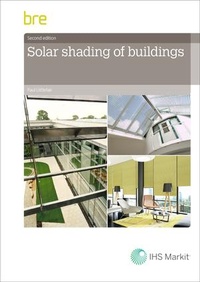
Solar Shading of Buildings
2nd Edition
Published on 16. August 2018
Book
Paperback/Softback
56 pages
978-1-84806-474-4 (ISBN)
Description
This report describes commonly used shading devices and some new developments. It gives the advantages and disadvantages of each kind of shading device. The guidance focuses on shading requirements in the UK and similar climates and latitudes.
More details
Edition
2nd edition
Language
English
Place of publication
Bracknell
United Kingdom
Target group
Professional and scholarly
Academic, Professional, and Professional Practice & Development
Illustrations
59 color images, 15 color tables and 12 color line drawings
Dimensions
Height: 297 mm
Width: 210 mm
Weight
266 gr
ISBN-13
978-1-84806-474-4 (9781848064744)
Copyright in bibliographic data and cover images is held by Nielsen Book Services Limited or by the publishers or by their respective licensors: all rights reserved.
Schweitzer Classification
Other editions
Previous edition
Book
01/1999
1st Edition
IHS BRE Press
€72.62
Article exhausted; check for reprint
Person
Paul Littlefair, Principal Lighting Consultant, BRE, UK
Content
Executive Summary
1 Introduction
1.1 Why Shading?
1.2 Examples
2 Principles
2.1 Movement of the Sun and Window Orientation
2.2 Loss of Daylight
2.3 View Out
2.4 Fixed and Adjustable Shading
3 External Shading
3.1 Overhangs
3.2 Light Shelves
3.3 Awnings and Canopies
3.4 Fixed and Moveable Louvres
3.5 Other Shading Devices
4 Glazing
4.1 Standard Solar-control Glazing: Reflective and Absorbing
4.2 Soft-coat Low-emissivity 'Heat Mirror' Glazing
4.3 Reducing Window Area
4.4 Window Films
4.5 Other Glazing Types
5 Mid-pane Devices
5.1 Mid-pane Blinds
5.2 Shading in Double-skinned Facades
5.3 Other Mid-pane Shading Types
6 Internal Shading
6.1 Venetian Blinds
6.2 Vertical Louvre Blinds
6.3 Roller Blinds
6.4 Curtains
6.5 Other Internal Shading Devices
7 Conclusions
7.1 Notes to Table 15
8 References
Appendix: Measuring and Calculating Shading Performance
A.1 Measuring Solar Gain
A.2 Effect on Daylight
A.3 Openness Coefficient
A.4 Databases of Shading Performance
A.5 Modelling Performance
A.6 Life-cycle Assessment
1 Introduction
1.1 Why Shading?
1.2 Examples
2 Principles
2.1 Movement of the Sun and Window Orientation
2.2 Loss of Daylight
2.3 View Out
2.4 Fixed and Adjustable Shading
3 External Shading
3.1 Overhangs
3.2 Light Shelves
3.3 Awnings and Canopies
3.4 Fixed and Moveable Louvres
3.5 Other Shading Devices
4 Glazing
4.1 Standard Solar-control Glazing: Reflective and Absorbing
4.2 Soft-coat Low-emissivity 'Heat Mirror' Glazing
4.3 Reducing Window Area
4.4 Window Films
4.5 Other Glazing Types
5 Mid-pane Devices
5.1 Mid-pane Blinds
5.2 Shading in Double-skinned Facades
5.3 Other Mid-pane Shading Types
6 Internal Shading
6.1 Venetian Blinds
6.2 Vertical Louvre Blinds
6.3 Roller Blinds
6.4 Curtains
6.5 Other Internal Shading Devices
7 Conclusions
7.1 Notes to Table 15
8 References
Appendix: Measuring and Calculating Shading Performance
A.1 Measuring Solar Gain
A.2 Effect on Daylight
A.3 Openness Coefficient
A.4 Databases of Shading Performance
A.5 Modelling Performance
A.6 Life-cycle Assessment