

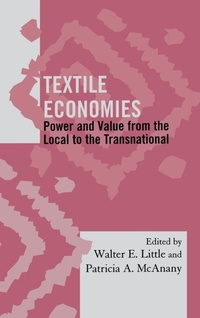
Textile Economies
Power and Value from the Local to the Transnational
Published on 22. September 2011
Book
Hardback
342 pages
978-0-7591-2061-7 (ISBN)
Description
Textiles have been a highly valued and central part of the politics of human societies across culture divides and over millennia. The economy of textiles provides insight into the fabric of social relations, local and global politics, and diverse ideologies. Textiles are a material element of society that fosters the study of continuities and disjunctions in the economic and social realities of past and present societies. From stick-loom weaving to transnational factories, the production of cloth and its transformation into clothing and other woven goods offers a way to study the linkages between economics and politics. The volume is oriented around a number of themes: textile production, textiles as trade goods, textiles as symbols, textiles in tourism, and textiles in the transnational processes. Textile Economies appeals to a broad range of scholars interested in the intersection of material culture, political economy, and globalization, such as archaeologists, cultural anthropologists, economists, museum curators, and historians.
Reviews / Votes
Spanning every continent, and a temporal arc that begins in pre-history and takes us to the present, this edited collection demonstrates how much we can learn through textiles-among the most potent, meaningful, and desired of human creations. Privileging the artisanal domain of textile production, while at the same time acknowledging the significance of industrialism, the respective authors illuminate labor processes, societal inequality, global interactions, and the constitution of both spiritual and material value. -- Jane Schneider, City University of New York Textile Economies brings together a group of intelligently researched and argued articles that examine how different systems of value play into the lives of textiles and the people who create, market, and consume them. Relationships of power and strategies to negotiate these thread through richly detailed case studies that focus on the local but are ever mindful of the global flows and creative (re)imaginings in contemporary and historical contexts. A welcome contribution to the growing literature on the social life of textiles. -- Carol Hendrickson, Marlboro CollegeMore details
Series
Language
English
Place of publication
California
United States
Dimensions
Height: 235 mm
Width: 157 mm
Thickness: 23 mm
Weight
647 gr
ISBN-13
978-0-7591-2061-7 (9780759120617)
Copyright in bibliographic data and cover images is held by Nielsen Book Services Limited or by the publishers or by their respective licensors: all rights reserved.
Schweitzer Classification
Other editions
Additional editions
Walter E. Little | Patricia A. McAnany
Textile Economies
Power and Value from the Local to the Transnational
E-Book
10/2011
1st Edition
AltaMira Press
€132.99
Available for download
Walter E. Little | Patricia A. McAnany
Textile Economies
Power and Value from the Local to the Transnational
E-Book
10/2011
1st Edition
AltaMira Press
€132.99
Available for download
Persons
Walter E. Little is associate professor of Anthropology at the University at Albany, SUNY, and director of the Ethnographic Field School in Guatemala. He is the author of Mayas in the Marketplace and co-author of Mayas in Postwar Guatemala.
Patricia A. McAnany is Kenan Eminent Professor of Anthropology at the University of North Carolina, Chapel Hill. She is the author of Ancestral Maya Economies in Archaeological Perspective and Living with the Ancestors: Kinship and Kingship in Ancient Maya Society.
Patricia A. McAnany is Kenan Eminent Professor of Anthropology at the University of North Carolina, Chapel Hill. She is the author of Ancestral Maya Economies in Archaeological Perspective and Living with the Ancestors: Kinship and Kingship in Ancient Maya Society.
Content
Introduction
Part I. Creativity and Value
Chapter 1. Exchange without Brokers: Weaver-Client Relationships in Senegal
Laura L. Cochrane
Chapter 2. Heritage and Authorship Debates in Three Sumatran Songkets
Susan Rodgers
Chapter 3. Creativity, Place, and Commodities: The Making of Public Economies in Andean Apparel Industries
Rudi Colloredo-Mansfeld, Jason Antrosio, and Eric C. Jones
Chapter 4. Tivaivai and Value in the Cook Islands Ritual Economy: The Creation of Value, Values, and Valuables in a Diasporic Community
Jane Horan
Chapter 5. The Political Economy of an Art Form: The Akotifahana Cloth of Madagascar
Sarah Fee
Part II. The Power of Cloth and the Sanctity of Power
Chapter 6. Textiles and Chimu Identity under Inka Hegemony on the North Coast of Peru
Cathy Lynne Costin
Chapter 7. Late Classic Maya Textile Economies: An Object History Approach
Christina T. Halperin
Chapter 8. Hohokam Cotton: Irrigation, Production, and Trade in Perhistory
Robert C. Hunt
Chapter 9. Neighborly Ties and Sohbet: Global Capitalism and the Work of Weaving in Konya, Turkey
Damla Isik
Chapter 10. Sanctity, Social Distance, and the Price of Cloth in a Moroccan Suq
John A. Napora
Part III. (Re)invented Traditions in Transnational Context
Chapter 11. Good Hands: Silk Weaving and Transnational Artisan Partnerships in Cambodia
Susan Falls and Jessica Smith
Chapter 12. Recommunitizing Practice, Refashionizing Capital: Artisans and Entrepreneurship in a Philippine Textile Industry
B. Lynne Milgram
Chapter 13. The Decline of a Weaving Cooperative in Western Turkey
Kimberly Hart
Chapter 14. Made in Italy: Metaphors for Merchandising Textiles in a Global Economy
Joan Weibel-Orlando
Chapter 15. Creating Fame and Fortune from the Ruins of Handloom in Kerala, Southern India
Lucy Norris
Part I. Creativity and Value
Chapter 1. Exchange without Brokers: Weaver-Client Relationships in Senegal
Laura L. Cochrane
Chapter 2. Heritage and Authorship Debates in Three Sumatran Songkets
Susan Rodgers
Chapter 3. Creativity, Place, and Commodities: The Making of Public Economies in Andean Apparel Industries
Rudi Colloredo-Mansfeld, Jason Antrosio, and Eric C. Jones
Chapter 4. Tivaivai and Value in the Cook Islands Ritual Economy: The Creation of Value, Values, and Valuables in a Diasporic Community
Jane Horan
Chapter 5. The Political Economy of an Art Form: The Akotifahana Cloth of Madagascar
Sarah Fee
Part II. The Power of Cloth and the Sanctity of Power
Chapter 6. Textiles and Chimu Identity under Inka Hegemony on the North Coast of Peru
Cathy Lynne Costin
Chapter 7. Late Classic Maya Textile Economies: An Object History Approach
Christina T. Halperin
Chapter 8. Hohokam Cotton: Irrigation, Production, and Trade in Perhistory
Robert C. Hunt
Chapter 9. Neighborly Ties and Sohbet: Global Capitalism and the Work of Weaving in Konya, Turkey
Damla Isik
Chapter 10. Sanctity, Social Distance, and the Price of Cloth in a Moroccan Suq
John A. Napora
Part III. (Re)invented Traditions in Transnational Context
Chapter 11. Good Hands: Silk Weaving and Transnational Artisan Partnerships in Cambodia
Susan Falls and Jessica Smith
Chapter 12. Recommunitizing Practice, Refashionizing Capital: Artisans and Entrepreneurship in a Philippine Textile Industry
B. Lynne Milgram
Chapter 13. The Decline of a Weaving Cooperative in Western Turkey
Kimberly Hart
Chapter 14. Made in Italy: Metaphors for Merchandising Textiles in a Global Economy
Joan Weibel-Orlando
Chapter 15. Creating Fame and Fortune from the Ruins of Handloom in Kerala, Southern India
Lucy Norris