

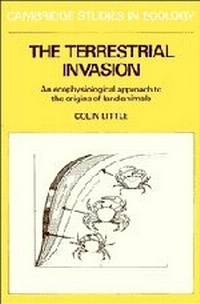
The Terrestrial Invasion
An Ecophysiological Approach to the Origins of Land Animals
Published on 14. June 1990
Book
Hardback
314 pages
978-0-521-33447-1 (ISBN)
Description
The theme of this book is the invasion of land by animal lines which originated in aquatic environments. It brings together physiological and ecological evidence to show both the likely routes taken out of the sea by the aquatic ancestors of terrestrial animals and the changes in structure and function associated with these routes. The author takes an ecophysiological approach, and by using representative examples, provides a novel background against which both the terrestrial adaptations of individual species and the make up and function of terrestrial ecosystems can be considered. Dr Little is the author of the highly acclaimed book The Colonisation of Land, which discusses the phylogeny and physiology of terrestrial and semi-terrestrial animals. The Terrestrial Invasion takes a fresh approach and provides an excellent introduction to the origins of land animals suitable for ecologists, physiologists and evolutionary biologists.
More details
Series
Language
English
Place of publication
Cambridge
United Kingdom
Target group
Professional and scholarly
Dimensions
Height: 228 mm
Width: 152 mm
Thickness: 21 mm
Weight
558 gr
ISBN-13
978-0-521-33447-1 (9780521334471)
Copyright in bibliographic data and cover images is held by Nielsen Book Services Limited or by the publishers or by their respective licensors: all rights reserved.
Schweitzer Classification
Other editions
New editions
Book
06/1990
Cambridge University Press
€55.90
Shipment within 15-20 days
Additional editions
Book
06/1990
Cambridge University Press
€55.90
Shipment within 15-20 days
Person
Content
Preface; Part I. Introduction: 1. Perspective; 2. Problems: terrestrial versus aquatic habitats; 3. The evidence; Part II. Routes on to Land: 4. The origins of terrestrial animals in relation to salt and water balance; 5. Muddy and sandy shores: interstitial fauna and the burrowers; 6. Saltmarshes and mangrove swamps as routes on to land; 7. Rocky and shingle shores as routes on to land; 8. The freshwater route to land; Part III. Life on Land: 9. Terrestrial adaptations; 10. Terrestrial ecosystems.