

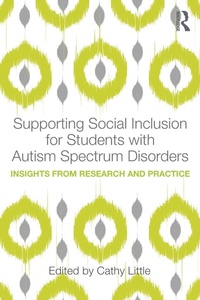
Supporting Social Inclusion for Students with Autism Spectrum Disorders
Insights from Research and Practice
1st Edition
Published on 20. February 2017
Book
Paperback/Softback
184 pages
978-1-138-18997-3 (ISBN)
Description
Drawing together contributions from experts at the forefront of research in the field, Supporting Social Inclusion for Students with Autism Spectrum Disorders demonstrates that social inclusion is a defining feature of successful education of students with a spectrum disorder.
Divided into three parts, this book begins by proposing a contemporary and operational definition of social inclusion that will help facilitate active engagement by all stakeholders involved in supporting social inclusion within educational settings. The relationship between well-developed social skills and positive social outcomes is also explored, and subsequent chapters explicate and contextualize social inclusion across a range of educational settings. The final chapters present case studies and viewpoints from stakeholders central to the successful social inclusion of students with the disorder. Through discussion of its findings, this book provides the reader with a deep understanding of social inclusion and confirms its importance in facilitating positive educational outcomes for students with Autism Spectrum Disorder.
A unique contribution to the field, this book will be of key interest to postgraduates, researchers and academics in the area of inclusive education and Autism Spectrum Disorder. It will also appeal to those who research, study and work in the areas of special and inclusive education, and developmental psychology.
Divided into three parts, this book begins by proposing a contemporary and operational definition of social inclusion that will help facilitate active engagement by all stakeholders involved in supporting social inclusion within educational settings. The relationship between well-developed social skills and positive social outcomes is also explored, and subsequent chapters explicate and contextualize social inclusion across a range of educational settings. The final chapters present case studies and viewpoints from stakeholders central to the successful social inclusion of students with the disorder. Through discussion of its findings, this book provides the reader with a deep understanding of social inclusion and confirms its importance in facilitating positive educational outcomes for students with Autism Spectrum Disorder.
A unique contribution to the field, this book will be of key interest to postgraduates, researchers and academics in the area of inclusive education and Autism Spectrum Disorder. It will also appeal to those who research, study and work in the areas of special and inclusive education, and developmental psychology.
Reviews / Votes
'This book provides insight in the social inclusion of students with Autism Spectrum Disorders. In the three parts of the book important topics are elaborated among which the social inclusion at different education levels. This book is of great relevance for researchers working in the field of inclusion, but also for educational professionals (e.g., school psychologists, special education teachers) and students.' - Anke de Boer, Ph.D., Assistant Professor at the department of Special Needs Education and Youth Care of the University of Groningen, The Netherlands.'Increasing evidence from follow-up studies of adults with autism indicates that, although autism symptoms and behavioural difficulties tend to reduce over time, social inclusion for most individuals remains very limited. In exploring research on ways of encouraging social inclusion, from the earliest school years into adolescence and beyond, this book provides valuable information on how schools, families, and society as a whole can help to enhance the lives of young people with autism.' - Patricia Howlin, Emeritus Professor of Clinical Child Psychology, King's College, London
'This is an excellent, wide-ranging and timely book that brings a critical educational issue into sharp focus. With contributions from leading researchers around the world, Supporting Social Inclusion for Students with Autism Spectrum Disorders is an essential text for anyone with an interest in autism and education. The reader is expertly guided through contemporary theory and research relating to what we mean by social inclusion, key considerations for students with autism in different phases of education, and the role played by different stakeholders in the inclusion process.' - Neil Humphrey, Head of Manchester Institute of Education, Professor, Psychology of Education, University of Manchester
More details
Language
English
Place of publication
London
United Kingdom
Publishing group
Taylor & Francis Ltd
Target group
College/higher education
Illustrations
6 s/w Zeichnungen, 4 s/w Tabellen
4 Tables, black and white; 6 Line drawings, black and white
Dimensions
Height: 234 mm
Width: 156 mm
Thickness: 11 mm
Weight
319 gr
ISBN-13
978-1-138-18997-3 (9781138189973)
Copyright in bibliographic data and cover images is held by Nielsen Book Services Limited or by the publishers or by their respective licensors: all rights reserved.
Schweitzer Classification
Other editions
Additional editions
Cathy Little
Supporting Social Inclusion for Students with Autism Spectrum Disorders
Insights from Research and Practice
E-Book
04/2017
Routledge
€59.49
Available for download
Cathy Little
Supporting Social Inclusion for Students with Autism Spectrum Disorders
Insights from Research and Practice
E-Book
04/2017
Routledge
€59.49
Available for download
Cathy Little
Supporting Social Inclusion for Students with Autism Spectrum Disorders
Insights from Research and Practice
Book
02/2017
1st Edition
Routledge
€215.41
Shipment within 10-20 days
Person
Cathy Little is a lecturer in the Faculty of Education and Social Work, University of Sydney, Australia.
Content
Introduction Cathy Little
Part 1. An introduction to Social Inclusion for students with Autism Spectrum Disorders
1. Social Inclusion and Students with an Autism Spectrum Disorder? Cathy Little
2. Social Inclusion for Students with Autism Spectrum Disorders Sunny Kim, Brittany Koegel, and Lynn Koegel
3. Bullying and Social Vulnerability of Students with Autism Spectrum Disorder Sarah Feuerbacher, Travis Moore, and Hannah Robinson
4. Identity Formation in Individuals with Asperger's Syndrome Caitlin van der Walt
Part 2. Social Inclusion across the Educational Environment
5. Social Inclusion in the Early Years Janice K. Lee, Jaclyn Joseph, Phillip Strain, Glen Dunlap
6. Social Inclusion in the Primary School Years Alice Jones Bartoli
7. The Transition from Primary to Secondary School for Students with Autism Spectrum Conditions Judith Hebron
8. Post School Social Inclusion for Adults with Autism in Australia Michelle Bonati
Part 3. Key stakeholders in the support of Social Inclusion
9. The Role of School Communities in Facilitating Social Inclusion Cathy Little
10. Using Typically Developing Peers as Support for Social Inclusion of Children and Adolescents with Autism in School Settings Jill Locke and Colleen Harker
11. The Role of Families in Supporting Social Inclusion Iva Strnadova
12. The Influence of Culture on Social Inclusion of Children with Autism Spectrum Disorder Kanokporn Vibulpatanavong
13. Social inclusion: A Personal Reflection Stephen Shore
Part 1. An introduction to Social Inclusion for students with Autism Spectrum Disorders
1. Social Inclusion and Students with an Autism Spectrum Disorder? Cathy Little
2. Social Inclusion for Students with Autism Spectrum Disorders Sunny Kim, Brittany Koegel, and Lynn Koegel
3. Bullying and Social Vulnerability of Students with Autism Spectrum Disorder Sarah Feuerbacher, Travis Moore, and Hannah Robinson
4. Identity Formation in Individuals with Asperger's Syndrome Caitlin van der Walt
Part 2. Social Inclusion across the Educational Environment
5. Social Inclusion in the Early Years Janice K. Lee, Jaclyn Joseph, Phillip Strain, Glen Dunlap
6. Social Inclusion in the Primary School Years Alice Jones Bartoli
7. The Transition from Primary to Secondary School for Students with Autism Spectrum Conditions Judith Hebron
8. Post School Social Inclusion for Adults with Autism in Australia Michelle Bonati
Part 3. Key stakeholders in the support of Social Inclusion
9. The Role of School Communities in Facilitating Social Inclusion Cathy Little
10. Using Typically Developing Peers as Support for Social Inclusion of Children and Adolescents with Autism in School Settings Jill Locke and Colleen Harker
11. The Role of Families in Supporting Social Inclusion Iva Strnadova
12. The Influence of Culture on Social Inclusion of Children with Autism Spectrum Disorder Kanokporn Vibulpatanavong
13. Social inclusion: A Personal Reflection Stephen Shore