

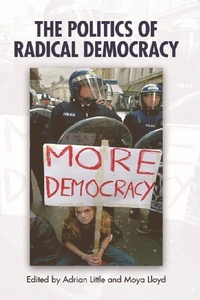
The Politics of Radical Democracy
Published on 4. November 2008
Book
Hardback
240 pages
978-0-7486-3399-9 (ISBN)
Description
This book addresses the idea of radical democracy and, in particular, its poststructuralist articulation. It analyses the approach to radical democracy taken by a number of contemporary theorists and political commentators:, including Ernesto Laclau and Chantal Mouffe, Judith Butler, William Connolly, Jacques Ranciere, Claude Lefort, Sheldon Wolin, Michael Hardt, and Antonio Negri, and Giorgio Agamben. By examining critically the critiques accounts of democracy advanced by these theorists, this volume explores how a more radically conceived theory of democracy might be extended in a more egalitarian and inclusive direction.developed.The strand of radical democracy examined in this book is defined by a number of characteristics:*Democracy is conceptualised understood as a fugitive condition, being open to perpetual disruption and reinvention*The relationship between the state and civil society is regarded as the site where the open-ended 'promise' of democracy is fought out*There is an emphasis on questions of political renewal*There is a deep suspicion of identity-based political claims*Politics is conceived as either the site of or as one of the mechanisms for identity construction* Democratic politics is understood as a politics of contestation and disagreement* Democracy is regarded as always at least partially conflictual and not a means through which violence and conflict can be permanently eradicated*There is a deep suspicion of identity-based political claims*The political is assumed to be ontologically conflictual, with such conflict being understood as ultimately ineradicable from politics, though the form it takes necessarily varies from time to time and context to contextThe book clarifies the concept of radical democracy by mapping the field, and elaborates it further through a critical engagement with the works of its key proponents. In addition, it draws on the insights of radical democratic theory to explore a range of concre
More details
Language
English
Place of publication
Edinburgh
United Kingdom
Target group
College/higher education
Product notice
sewn/stitched
Cloth over boards
With dust jacket
Dimensions
Height: 241 mm
Width: 164 mm
Thickness: 27 mm
Weight
519 gr
ISBN-13
978-0-7486-3399-9 (9780748633999)
Copyright in bibliographic data and cover images is held by Nielsen Book Services Limited or by the publishers or by their respective licensors: all rights reserved.
Schweitzer Classification
Other editions
Additional editions
Adrian Little | Moya Lloyd
Politics of Radical Democracy
E-Book
08/2019
1st Edition
Edinburgh University Press
€0.00
Available for download
Persons
Adrian Little is Professor of Political Theory at the University of Melbourne. He is a Fellow of the Academy of Social Sciences in Australia in recognition of his research in areas including political theory, democratic politics, Indigenous-settler relations and the politics of Northern Ireland. Previous books include Enduring Conflict (Bloomsbury, 2014), Democratic Piety (Edinburgh University Press, 2008), Democracy and Northern Ireland (Palgrave, 2004) and The Politics of Community (Edinburgh University Press, 2002). Moya Lloyd is Executive Dean of the Faculty of Social Sciences and Professor of Politics in the Department of Government at the University of Essex.
Content
Introduction (Moya Lloyd and Adrian Little); 1. Rhetoric and Radical Democratic Political Theory (Alan Finlayson, Swansea); 2. Performing radical democracy (Moya Lloyd, Loughborough); 3. Aboriginal Sovereignty and the Democratic Paradox (Andrew Schaap, Exeter); 4. Judith Butler, Radical Democracy and Micro-Politics (Birgit Schippers, St Mary's, Belfast); 5. Poststructuralism, Civil Society, and Radical Democracy (James Martin, Goldsmiths); 6. Hegemony and Globalist Strategy (Mark Wenman, Nottingham); 7. Is 'Another World' Possible? Laclau, Mouffe and Social Movements (Andy Robinson and Simon Tormey, Nottingham); 8. Friends and Enemies, Slaves and Masters: Fanaticism, Wendell Phillips and the Limits of Agonism (Joel Olson, Northern Arizona); 9. The Northern Ireland Paradox (Adrian Little, Melbourne); Conclusion (Adrian Little and Moya Lloyd); Bibliography; Index.