


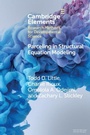
Parceling in Structural Equation Modeling
A Comprehensive Introduction for Developmental Scientists
Published on 28. July 2022
Book
Paperback/Softback
70 pages
978-1-009-21164-2 (ISBN)
Description
Parceling is pre-modeling strategy to create fewer and more reliable indicators of constructs for use with latent variable models. Parceling is particularly useful for developmental scientists because longitudinal models can become quite complex and even intractable when measurement models of items are fit. In this Element the authors provide a detailed account of the advantages of using parcels, their potential pitfalls, as well as the techniques for creating them for conducting latent variable structural equation modeling (SEM) in the context of the developmental sciences. They finish with a review of the recent use of parcels in developmental journals. Although they focus on developmental applications of parceling, parceling is also highly applicable to any discipline that uses latent variable SEM.
More details
Series
Language
English
Place of publication
Cambridge
United Kingdom
Edition type
New edition
Product notice
Paperback (trade)
Illustrations
Worked examples or Exercises
Dimensions
Height: 229 mm
Width: 152 mm
Thickness: 4 mm
Weight
104 gr
ISBN-13
978-1-009-21164-2 (9781009211642)
Copyright in bibliographic data and cover images is held by Nielsen Book Services Limited or by the publishers or by their respective licensors: all rights reserved.
Schweitzer Classification
Other editions
Additional editions

Todd D. Little | Charlie Rioux | Omolola A. Odejimi
Parceling in Structural Equation Modeling
A Comprehensive Introduction for Developmental Scientists
E-Book
07/2022
Cambridge University Press
€15.49
Available for download
Todd D. Little
Parceling in Structural Equation Modeling
A Comprehensive Introduction for Developmental Scientists
E-Book
07/2022
Cambridge University Press
€15.49
Available for download
Persons
Content
1. Introduction; 2. Parceling: what is it and why use it?; 3. How to build parcels; 4. Longitudinal models; 5. Parceling in the literature; 6. Conclusion.