

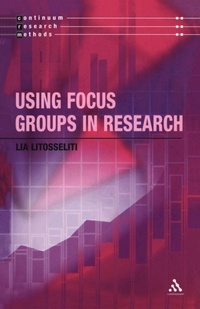
Using Focus Groups in Research
Published on 1. December 2003
Book
Paperback/Softback
104 pages
978-0-8264-6472-9 (ISBN)
Description
Focus Groups are often under-used as a valuable tool for research. This practical and extremely well-written guide offers advice on: * planning and organising focus groups * what types of questions to use* the limitations and advantages of using these groups as research methods* collecting the data at group sessions* how to analyse the data produced
Reviews / Votes
'Intended as an introduction to Focus Groups for research students, this book is a god-send for anyone considering the pros and cons of this approach, and a valuable practical toolkit for putting focus groups together. Its academic background makes this even more useful. It is properly referenced throughout, and sufficiently rigorous for its stated purpose - supporting MPhil and PHD students. Despite this - or perhaps because of it - it is written in clear, accessible English and introduces all the necessary concepts as it goes along.' * Amazon.Com Books *More details
Series
Language
English
Place of publication
London
United Kingdom
Publishing group
Bloomsbury Publishing PLC
Target group
College/higher education
Professional and scholarly
Dimensions
Height: 216 mm
Width: 140 mm
Thickness: 6 mm
Weight
155 gr
ISBN-13
978-0-8264-6472-9 (9780826464729)
Copyright in bibliographic data and cover images is held by Nielsen Book Services Limited or by the publishers or by their respective licensors: all rights reserved.
Schweitzer Classification
Other editions
Additional editions
Lia Litosseliti
Using Focus Groups in Research
E-Book
12/2003
1st Edition
Continuum Publishing Corporation
€37.49
Available for download
Person
Lia Litosseliti is Associate Professor in Linguistics at City, University of London, UK, and Senior Fellow of the Higher Education Academy, UK. Her research interests are in the areas of gender and language, discourse analysis and research methodologies.
Content
1. Introducing focus groups-
Preliminaries and definitions
-What kind of focus group
-Focus groups as a qualitative research method in the social sciences
2. Benefits and limitations of focus group methodology
-When to use groups and for what kinds of questions
-Limitations of focus groups
3. Planning and organising focus groups
-Selecting the participants
-The role of the moderator
-Selecting a location and other praticalities of setting up focus groups
-Ethical issues
4. Developing and asking questions
-The topic guide of questioning route
-Types of questions-Kinds of questions
5. Conducting focus groups
-Before the focus group session
-Stages of the focus group session
-After the session
6. Analysing focus group data
Further reading
References
Preliminaries and definitions
-What kind of focus group
-Focus groups as a qualitative research method in the social sciences
2. Benefits and limitations of focus group methodology
-When to use groups and for what kinds of questions
-Limitations of focus groups
3. Planning and organising focus groups
-Selecting the participants
-The role of the moderator
-Selecting a location and other praticalities of setting up focus groups
-Ethical issues
4. Developing and asking questions
-The topic guide of questioning route
-Types of questions-Kinds of questions
5. Conducting focus groups
-Before the focus group session
-Stages of the focus group session
-After the session
6. Analysing focus group data
Further reading
References