

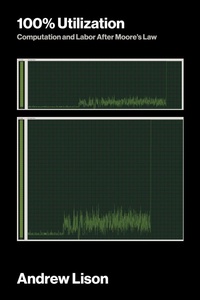
100% Utilization
Computation and Labor After Moore's Law
Published on 26. May 2026
Book
Paperback/Softback
300 pages
978-0-262-05136-1 (ISBN)
Description
A wide-ranging analysis of how the material limits to discrete, silicon-based computing power impact employment and automation.
Since the end of the Second World War, we have come to expect continual growth in computing power and the rapid development of digital technology. This dynamic has enabled informational procedures to supplant an ever-increasing range of human and mechanical activity. However, indications that the semiconductor industry is approaching the physical limits of integrated circuitry pose an existential challenge to Intel Corporation cofounder Gordon Moore’s “law,” which prescribes an exponential increase in microchip density—and, by extension, processing performance—every two years.
Placing theories of employment in dialectical conjunction with the concrete operations of computing, 100% Utilization explores the consequences of pushing processing power to its limits for a culture seemingly reliant on automation as much as human labor. In accounting for this contradiction, Andrew Lison offers a corrective to theories of digital mediation emphasizing its symbolic and representational capabilities. He connects the looming end of Moore’s law to trends in semiconductor manufacturing, custom hardware, and parallelized software techniques, including AI. Ultimately, he traces this historical technological boom and impending bust through the racialized history of Silicon Valley to longer-term conceptions of the relationship between machinery and labor.
Since the end of the Second World War, we have come to expect continual growth in computing power and the rapid development of digital technology. This dynamic has enabled informational procedures to supplant an ever-increasing range of human and mechanical activity. However, indications that the semiconductor industry is approaching the physical limits of integrated circuitry pose an existential challenge to Intel Corporation cofounder Gordon Moore’s “law,” which prescribes an exponential increase in microchip density—and, by extension, processing performance—every two years.
Placing theories of employment in dialectical conjunction with the concrete operations of computing, 100% Utilization explores the consequences of pushing processing power to its limits for a culture seemingly reliant on automation as much as human labor. In accounting for this contradiction, Andrew Lison offers a corrective to theories of digital mediation emphasizing its symbolic and representational capabilities. He connects the looming end of Moore’s law to trends in semiconductor manufacturing, custom hardware, and parallelized software techniques, including AI. Ultimately, he traces this historical technological boom and impending bust through the racialized history of Silicon Valley to longer-term conceptions of the relationship between machinery and labor.
More details
Language
English
Place of publication
Cambridge (Massachusetts)
United States
Publishing group
MIT Press Ltd
Illustrations
4
Dimensions
Height: 229 mm
Width: 152 mm
Weight
369 gr
ISBN-13
978-0-262-05136-1 (9780262051361)
Copyright in bibliographic data and cover images is held by Nielsen Book Services Limited or by the publishers or by their respective licensors: all rights reserved.
Schweitzer Classification
Other editions
Additional editions
E-Book
05/2026
MIT Press
€58.99
Available for download
Person
Andrew Lison
Content
TABLE OF CONTENTS
Introduction The Ground Truth of Digital Mediation 1
Chapter 1 Approaching 100% Utilization 32
Chapter 2 Economies and Scales: Producing and Consuming Computing Power 67
Chapter 3 Squeezing Silicon: From Software Control to Hardware Efficiency 103
Chapter 4 Convolute N(eural): Overused AI and Underemployed Minds 151
Chapter 5 Winter in the Valley: The Accelerating Dynamics of Stagnation 191
Chapter 6 Beyond Homeostasis 242
Conclusion Indeterminate Elements 279
Introduction The Ground Truth of Digital Mediation 1
Chapter 1 Approaching 100% Utilization 32
Chapter 2 Economies and Scales: Producing and Consuming Computing Power 67
Chapter 3 Squeezing Silicon: From Software Control to Hardware Efficiency 103
Chapter 4 Convolute N(eural): Overused AI and Underemployed Minds 151
Chapter 5 Winter in the Valley: The Accelerating Dynamics of Stagnation 191
Chapter 6 Beyond Homeostasis 242
Conclusion Indeterminate Elements 279