

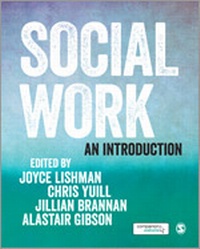
Social Work
An Introduction
1st Edition
Published on 24. March 2014
Book
Hardback
536 pages
978-1-4462-0888-5 (ISBN)
Description
Social Work: An Introduction is designed to help your students make the best start in their academic and professional careers. Mapped throughout to the most up-to-date professional standards, the book covers the full range of knowledge and skills students need to gain in the early stages of their social work course and as they prepare to go out on placement.
Key Learning Features:
Key Themes and Chapter Introductions - to set the scene and place each chapter in context.
Case Studies and Practice Vignettes - illustrate how theory, knowledge and policy translate to real-life practice. Also help students consider the service-user's experience and develop a holistic approach to care.
Exercises, Activities and Reflective Questions - independent learning tasks to help students apply theory to their practice, and to develop their skills of critical reflection
Critical Thinking Boxes - support your students in their journey towards becoming critically reflexive practitioners.
Visit the companion website to access a range of resources to support both lecturers and students, including:
Vodcasts and podcasts from students, lecturers, service users and authors to introduce key topics to audio and visual learners
Activities and case studies from different fields and settings to show how theory translates into real life practice
Selected SAGE journal articles to help take learning to the next level
Up-to-date links to codes of ethics, frameworks and other useful resources.
Key Learning Features:
Key Themes and Chapter Introductions - to set the scene and place each chapter in context.
Case Studies and Practice Vignettes - illustrate how theory, knowledge and policy translate to real-life practice. Also help students consider the service-user's experience and develop a holistic approach to care.
Exercises, Activities and Reflective Questions - independent learning tasks to help students apply theory to their practice, and to develop their skills of critical reflection
Critical Thinking Boxes - support your students in their journey towards becoming critically reflexive practitioners.
Visit the companion website to access a range of resources to support both lecturers and students, including:
Vodcasts and podcasts from students, lecturers, service users and authors to introduce key topics to audio and visual learners
Activities and case studies from different fields and settings to show how theory translates into real life practice
Selected SAGE journal articles to help take learning to the next level
Up-to-date links to codes of ethics, frameworks and other useful resources.
Reviews / Votes
I have a degree in Criminology and I am currently in my first year studying Social Work. As I have previously studied at degree level, I understand the importance of a good core book that gives you a basic understanding of the significant areas in that field. For me Lishman et al has encapsulated the necessary information and identifies key aspects that I can read further into.Core theories and ideologies run throughout the book, this is supported by exercises and case studies. I personally found the case studies really useful as it is a good way of applying what you have learnt to an unfamiliar situation. This ensures you have an understanding of what you have just learnt and if you are unsure you are encouraged to read further around the subject. What is great about this book is it advises where to go for further reading to underpin your learning.
Finally the companion website advertised in the book is very beneficial. It ensures immediate access to up to date information. I have learnt that the Laws surround social work are ever evolving and it is important to be as up to date as possible. This is a perfect way to keep up to date, not just with law but with codes of practice and framework's.
All in all I believe this book is a vital part of anyone studying or wanting to learn about the core modules of being a social worker. This book has clarified certain aspects of social work and I find myself referring to it to confirm my understanding. -- Ellie Morton [The book] gives the reader a clear understanding of the basic, but paramount, issues that need to be considered in each key area of social work practice. This will be invaluable not only for people who have started on courses but for people who are considering social work as a career. In an age where people constantly find it difficult to answer the question 'what is social work' this book goes a great way towards providing a firm foundation for making that clear. -- Patricia Woolley Many students of Social Work will understandably want to buy one big book to support their studies, and this text is not only big, but also weighty and substantial. The book offers a solid grounding in the underpinning knowledge base of social sciences, law and ethics, before considering models of assessment, intervention, evaluation and critical reflexivity. Most importantly, at this time, this is a welcome publication that acknowledges Social Work to be about relationships and politics and policy. -- Nigel Horner This book is a comprehensive introduction. It encompasses the knowledge and processes needed by contemporary social workers practising throughout the UK, and relevant far beyond. Led by some of the foremost Scottish social work academics it is a jewel in the discipline's literary crown! -- Professor Jonathan Parker
More details
Language
English
Place of publication
London
United Kingdom
Target group
College/higher education
Dimensions
Height: 232 mm
Width: 186 mm
Weight
1102 gr
ISBN-13
978-1-4462-0888-5 (9781446208885)
Copyright in bibliographic data and cover images is held by Nielsen Book Services Limited or by the publishers or by their respective licensors: all rights reserved.
Schweitzer Classification
Other editions
New editions
Book
01/2018
2nd Edition
SAGE Publications Ltd
€143.70
Article exhausted; check for reprint
Persons
Professor Joyce Lishman is now retired, and was previously Head of the School of Applied Social Studies, Robert Gordon University, Aberdeen, UK. She was also General Editor of the Research Highlights in Social Work series for many years. Chris Yuill is a sociologist at Robert Gordon University, Aberdeen, whose work focuses on the sociology of health and the sociology of urban experiences. In addition to a variety of journal publications and research reports he has written and co-edited a number of textbooks for SAGE, one of his most recent being Sociology for Social Work co-edited with Alastair Gibson. Other texts include Understanding the Sociology of Health: An Introduction with Anne-Marie Barry, which is now in its third edition and has also been translated into Chinese. Chris has also served two terms on the executive of the British Sociological Association. Alastair Gibson graduated with an MA in History before becoming frustrated as a hospital administrator and deciding to move into the more challenging and rewarding practice of social work. He worked in Aberdeen and Gateshead in a variety of health care social work settings and then taught at RGU. Developing his enthusiasm for inter-professional practice, he was a founder member of CAIPE and helped develop shared training for social work, health, education and police trainees. He has thoroughly enjoyed teaching Human Growth and Behaviour as well as being Course Leader of the BA (Hons) Social Work by Distance Learning before retiring in 2009. He is now an independent practice teacher.
Content
About the editors
About the authors
Preface
Acknowledgements
Guided tour of the book
Introduction
Knowledge Base
Values and ethics
Law
Social policy & politics
Sociology
Material circumstances, poverty and social inequality
Psychology
Human growth and development
Communication and ICT
Research and development
Reflective practice
Assessment
Generic issues in assessment and managing uncertainty
Models of assessment
Risk assessment
Interprofessional practice
Service user & carer perspectives
Models of Intervention
Relationship-based
Crisis intervention
Cognitive behavioural
Task centred
Working in the life space
Person centred planning and personalisation
Narrative therapy
Motivational interviewing
Solution-focussed approach
Counselling
Interventions in Practice
Working with children and young people
Methods of intervention in working with individuals with substance problems
Mental health
Criminal justice
Learning disability
Disability and sensory impairment
Social work interventions with older people
Evaluation
Conclusion
Glossary
About the authors
Preface
Acknowledgements
Guided tour of the book
Introduction
Knowledge Base
Values and ethics
Law
Social policy & politics
Sociology
Material circumstances, poverty and social inequality
Psychology
Human growth and development
Communication and ICT
Research and development
Reflective practice
Assessment
Generic issues in assessment and managing uncertainty
Models of assessment
Risk assessment
Interprofessional practice
Service user & carer perspectives
Models of Intervention
Relationship-based
Crisis intervention
Cognitive behavioural
Task centred
Working in the life space
Person centred planning and personalisation
Narrative therapy
Motivational interviewing
Solution-focussed approach
Counselling
Interventions in Practice
Working with children and young people
Methods of intervention in working with individuals with substance problems
Mental health
Criminal justice
Learning disability
Disability and sensory impairment
Social work interventions with older people
Evaluation
Conclusion
Glossary