

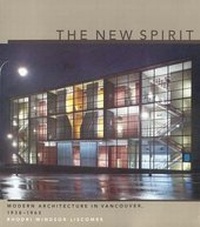
The New Spirit
Modern Architecture in Vancouver, 1938-1963
Published on 24. February 1997
Book
Paperback/Softback
208 pages
978-0-262-62115-1 (ISBN)
Description
The first comprehensive study of the acclaimed Modernist architecture of Vancouver.
The Modernist architecture of the two post-war decades established Vancouver's reputation as a center for progressive design and culture, a city where architects pursued their desire "to make of architecture a great humanistic experience." With an introduction by Adele Freedman discussing Modernism in Canadian architecture as a whole, Rhodri Windsor Liscombe's The New Spirit is the first comprehensive study of the acclaimed Modernist architecture of Vancouver. Modernism in Vancouver had many facets: it was a synthesis of expressions driven by a sense of social responsibility; it emphasized concerns such as economy of form, human uses, relation to site, affordability, and the effective employment of new technology. The author explores 25 years of sophisticated and distinctive architectureal innovation, examining both the conditions that brought this movement about and the forces that led to its decline. Given the eventual debasement of Modernism and the demolition of many of these Vancouver buildings, this account of the ambition of Modernist Canadian architects "to enhance the physical environment for human well-being" -- in homes, community centers, libraries and universities, churches, office towers, and apartment buildings -- serves as a reminder of how high ideals and a lively architectural culture can shape a better city.
The Modernist architecture of the two post-war decades established Vancouver's reputation as a center for progressive design and culture, a city where architects pursued their desire "to make of architecture a great humanistic experience." With an introduction by Adele Freedman discussing Modernism in Canadian architecture as a whole, Rhodri Windsor Liscombe's The New Spirit is the first comprehensive study of the acclaimed Modernist architecture of Vancouver. Modernism in Vancouver had many facets: it was a synthesis of expressions driven by a sense of social responsibility; it emphasized concerns such as economy of form, human uses, relation to site, affordability, and the effective employment of new technology. The author explores 25 years of sophisticated and distinctive architectureal innovation, examining both the conditions that brought this movement about and the forces that led to its decline. Given the eventual debasement of Modernism and the demolition of many of these Vancouver buildings, this account of the ambition of Modernist Canadian architects "to enhance the physical environment for human well-being" -- in homes, community centers, libraries and universities, churches, office towers, and apartment buildings -- serves as a reminder of how high ideals and a lively architectural culture can shape a better city.
More details
Series
Language
English
Place of publication
Cambridge, Mass.
United States
Publishing group
MIT Press Ltd
Target group
College/higher education
Professional and scholarly
Interest Age: From 18 years
Product notice
Paperback (trade)
Dimensions
Height: 267 mm
Width: 241 mm
Thickness: 20 mm
Weight
1043 gr
ISBN-13
978-0-262-62115-1 (9780262621151)
Copyright in bibliographic data and cover images is held by Nielsen Book Services Limited or by the publishers or by their respective licensors: all rights reserved.
Schweitzer Classification