

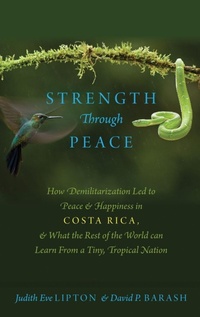
Strength Through Peace
How Demilitarization Led to Peace and Happiness in Costa Rica, and What the Rest of the World can Learn From a Tiny, Tropical Nation
Published on 8. November 2018
Book
Hardback
272 pages
978-0-19-992497-4 (ISBN)
Description
Costa Rica is the only full-fledged and totally independent country to be entirely demilitarized. Its military was abolished in 1948, with the keys to the armory handed to the Department of Education. Socially, Costa Rica is a success story. Although 94th in the world for GDP, it is in the top 10 on various measurements of health and well-being. Citizens enjoy high standards of living that include universal access to healthcare, education, and pensions. In addition, the country practices sustainable resource management, such as reforestation and the development of solar and wind power, and it expects to be carbon neutral by 2020. Hunting is illegal. 25% of the landmass is parks and reserves. The government supports universal health care, especially maternal and child health. Costa Rica even has a Blue Zone, an area where people live extraordinarily long, healthy lives.
To some extent, Costa Rica is simply lucky: it was largely inaccessible, and it had virtually no precious minerals, therefore it was mostly spared the ravages of predatory colonialism. The Costa Rican people made very good social decisions, ranging from an avowed commitment to social democracy at the national level, to local land distribution to develop stable middle class farmers. But Costa Rica's neighbors have not enjoyed nearly as much peace and prosperity. It is unlikely that Costa Rica's demilitarization and its remarkable social success are coincidental; clearly, something special is going on. Through good luck, good leadership, and good decisions, Costa Rica has become arguably the sanest and most progressive country on earth. This book examines how and why Costa Rica is safe and independent without any military at all, and what the rest of us can learn from its success.
To some extent, Costa Rica is simply lucky: it was largely inaccessible, and it had virtually no precious minerals, therefore it was mostly spared the ravages of predatory colonialism. The Costa Rican people made very good social decisions, ranging from an avowed commitment to social democracy at the national level, to local land distribution to develop stable middle class farmers. But Costa Rica's neighbors have not enjoyed nearly as much peace and prosperity. It is unlikely that Costa Rica's demilitarization and its remarkable social success are coincidental; clearly, something special is going on. Through good luck, good leadership, and good decisions, Costa Rica has become arguably the sanest and most progressive country on earth. This book examines how and why Costa Rica is safe and independent without any military at all, and what the rest of us can learn from its success.
Reviews / Votes
"A timely book! Overall, the book is theoretically well developed, with a wealth of information on this understudied topic, and represents an original and innovative piece of scholarship which adds to the literature. Moreover, it's well-written and lucid which should appeal to generalists seeking a better contextualization of Costa Rica and the region." * Peace Research Journal * Costa Rica is a wonderful enigma * and this book helps strip some of the mystery away, explaining how this country manages to be happy and useful despite doing little to damage the planet's environment. It's the kind of lesson we need quickly to learn around the world."Bill McKibben, author of The End of Nature
* Strength Through Peace is an engaging book about Costa Rica, a small country in a dangerous part of the world that abolished its military in 1948 and has tried to meet the needs of its people instead. Costa Rica's bold step continues to provide an important lesson for the world: If you want peace, prepare for peace." * David Krieger, President, Nuclear Age Peace Foundation
* No book could be more relevant and appropriate to our time than Strength Through Peace. It is imperative that all who care about the sanctity of evolution must read this book and then lead a revolution to preserve all life on earth." * Helen Caldicott, MD, Founder and President [1978-1983], Physicians for Social Responsibility; Founder, Helen Caldicott Foundation for a Nuclear Free Future
* Here is a story worth celebrating: Costa Rica's unwavering pursuit of social progress via demilitarization. You will experience renewed hope, and want to share it with all of your friends and loved ones!" * Michael Klare, Five College Professor of Peace & World Security Studies, Hampshire College
* Most people think war is ineradicable, because it's part of human nature, but they're wrong. In Strength Through Peace, Lipton and Barash argue that Costa Rica, which abolished its army in 1948, offers hope that the US and other nations can kick the habit of militarism. I hope lots of people read this fascinating, uplifting book, because the first step toward ending war is to believe we can do it." * John Horgan, author of The End of War
*
More details
Language
English
Place of publication
New York
United States
Target group
Professional and scholarly
Dimensions
Height: 240 mm
Width: 161 mm
Thickness: 19 mm
Weight
575 gr
ISBN-13
978-0-19-992497-4 (9780199924974)
Copyright in bibliographic data and cover images is held by Nielsen Book Services Limited or by the publishers or by their respective licensors: all rights reserved.
Schweitzer Classification
Other editions
Additional editions
Judith Eve Lipton | David P. Barash
Strength Through Peace
How Demilitarization Led to Peace and Happiness in Costa Rica, and What the Rest of the World can Learn From a Tiny, Tropical Nation
E-Book
09/2018
1st Edition
OUP eBook
€16.49
Available for download
Judith Eve Lipton | David P. Barash
Strength Through Peace
How Demilitarization Led to Peace and Happiness in Costa Rica, and What the Rest of the World can Learn From a Tiny, Tropical Nation
E-Book
09/2018
1st Edition
OUP eBook
€16.49
Available for download
Persons
David P. Barash is an evolutionary biologist, Professor of Psychology emeritus at the University of Washington, and author of more than 200 technical research articles, and 39 books. He is also a long-time peace activist and was named by a right-wing organization as one of the 64 most dangerous professors in the US.
Judith Eve Lipton is a psychiatrist who practiced psychopharmacology and psychosomatic medicine for 30 years. She learned sociobiology from David Barash, and they went on to maximize their fitness by investing in 4 children and 7 grandchildren, so far, not to mention co-authoring 8 books, about war, sex, and human nature. She is passionate about animals, peace, and the prevention of nuclear war.
Judith Eve Lipton is a psychiatrist who practiced psychopharmacology and psychosomatic medicine for 30 years. She learned sociobiology from David Barash, and they went on to maximize their fitness by investing in 4 children and 7 grandchildren, so far, not to mention co-authoring 8 books, about war, sex, and human nature. She is passionate about animals, peace, and the prevention of nuclear war.
Content
1. Pursuing the Paradox 2. War and Human Nature 3. Costa Rica's Demilitarization 4. Demilitarization Elsewhere
5. Good Luck 6. Good Decisions 7. The Past as Prologue 8. Guns and Butter, Bananas and Coffee 9. Safety, Security, Defense and Deterrence 10. Conclusion: On the Fragility of Good Things
5. Good Luck 6. Good Decisions 7. The Past as Prologue 8. Guns and Butter, Bananas and Coffee 9. Safety, Security, Defense and Deterrence 10. Conclusion: On the Fragility of Good Things