

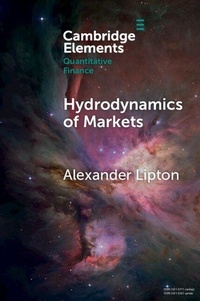
Hydrodynamics of Markets
Hidden Links between Physics and Finance
Published on 2. January 2025
Book
Paperback/Softback
148 pages
978-1-009-50310-5 (ISBN)
Description
An intriguing link between a wide range of problems occurring in physics and financial engineering is presented. These problems include the evolution of small perturbations of linear flows in hydrodynamics, the movements of particles in random fields described by the Kolmogorov and Klein-Kramers equations, the Ornstein-Uhlenbeck and Feller processes, and their generalizations. They are reduced to affine differential and pseudo-differential equations and solved in a unified way by using Kelvin waves and developing a comprehensive math framework for calculating transition probabilities and expectations. Kelvin waves are instrumental for studying the well-known Black-Scholes, Heston, and Stein-Stein models and more complex path-dependent volatility models, as well as the pricing of Asian options, volatility and variance swaps, bonds, and bond options. Kelvin waves help to solve several cutting-edge problems, including hedging the impermanent loss of Automated Market Makers for cryptocurrency trading. This title is also available as Open Access on Cambridge Core.
More details
Series
Language
English
Place of publication
Cambridge
United Kingdom
Product notice
Paperback (trade)
Illustrations
Worked examples or Exercises
Dimensions
Height: 229 mm
Width: 152 mm
Thickness: 9 mm
Weight
226 gr
ISBN-13
978-1-009-50310-5 (9781009503105)
Copyright in bibliographic data and cover images is held by Nielsen Book Services Limited or by the publishers or by their respective licensors: all rights reserved.
Schweitzer Classification
Other editions
Additional editions
Book
01/2025
Cambridge University Press
€86.40
Shipment within 15-20 days
Person
Content
1. Introduction; 2. Fluid Flows; 3. Kolmogorov Stochastic Process; 4. Klein-Kramers Stochastic Process; 5. Transition Probability Densities for Stochastic Processes; 6. Gaussian Stochastic Processes; 7. Non-Gaussian Stochastic Processes; 8. Pricing of Financial Instruments; 9. Conclusions.