

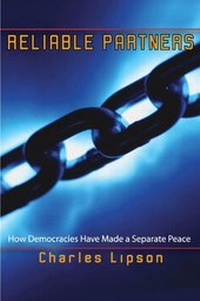
Reliable Partners
How Democracies Have Made a Separate Peace
Published on 22. July 2003
Book
Hardback
272 pages
978-0-691-11390-6 (ISBN)
Description
Democracies often go to war but almost never against each other. Indeed, "the democratic peace" has become a catchphrase among scholars and even U.S. Presidents. But why do democracies avoid fighting each other? "Reliable Partners" offers the first systematic and definitive explanation. Examining decades of research and speculation on the subject and testing this against the history of relations between democracies over the last two centuries, Charles Lipson concludes that constitutional democracies have a "contracting advantage" - a unique ability to settle conflicts with each other by durable agreements. In so doing, he forcefully counters realist claims that a regime's character is irrelevant to war and peace. Lipson argues that because democracies are confident their bargains will stick, they can negotiate effective settlements with each other rather than incur the great costs of war. Why are democracies more reliable partners? Because their politics are uniquely open to outside scrutiny and facilitate long-term commitments, they cannot easily bluff, deceive, or launch surprise attacks.
While this transparency weakens their bargaining position, it also makes their promises more credible - and more durable, for democracies are generally stable. Their leaders are constrained by constitutional rules, independent officials, and the political costs of abandoning public commitments. All this allows for solid bargains between democracies. When democracies contemplate breaking their agreements, their open debate gives partners advance notice and a chance to protect themselves. Hence, agreements among democracies are less risky than those with nondemocratic states. Setting rigorous analysis in friendly, vigorous prose, "Reliable Partners" resolves longstanding questions about the democratic peace and highlights important new findings about democracies in world politics, from rivalries to alliances. Above all, it shows conclusively that democracies are uniquely adapted to seal enduring bargains with each other and thus avoid the blight of war.
While this transparency weakens their bargaining position, it also makes their promises more credible - and more durable, for democracies are generally stable. Their leaders are constrained by constitutional rules, independent officials, and the political costs of abandoning public commitments. All this allows for solid bargains between democracies. When democracies contemplate breaking their agreements, their open debate gives partners advance notice and a chance to protect themselves. Hence, agreements among democracies are less risky than those with nondemocratic states. Setting rigorous analysis in friendly, vigorous prose, "Reliable Partners" resolves longstanding questions about the democratic peace and highlights important new findings about democracies in world politics, from rivalries to alliances. Above all, it shows conclusively that democracies are uniquely adapted to seal enduring bargains with each other and thus avoid the blight of war.
Reviews / Votes
[I]mportant and engagingly written... If you want a book that takes theory seriously yet will engage students on fundamental aspects of international politics, this is one on a short shelf. -- Bruce Russett Perspectives on PoliticsMore details
Language
English
Place of publication
New Jersey
United States
Target group
Professional and scholarly
College/higher education
Product notice
Trade binding
Illustrations
2 Abbildungen, 4 Tabellen
2 line illus. 4 tables.
Dimensions
Height: 229 mm
Width: 152 mm
Weight
539 gr
ISBN-13
978-0-691-11390-6 (9780691113906)
Copyright in bibliographic data and cover images is held by Nielsen Book Services Limited or by the publishers or by their respective licensors: all rights reserved.
Schweitzer Classification
Other editions
Additional editions

E-Book
12/2013
1st Edition
Princeton University Press
€171.95
Available for download
Person
Charles Lipson is Professor of Political Science at the University of Chicago, where he founded and codirects PIPES, the Program on International Politics, Economics, and Security. He is the author of "Standing Guard: Protecting Foreign Capital in the Nineteenth and Twentieth Centuries".