

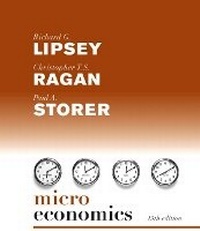
Microeconomics plus MyEconLab in CourseCompass plus ebook Student Access Kit
13th Edition
Published on 23. November 2007
Book
Paperback/Softback
978-0-321-52383-9 (ISBN)
Description
When asked to describe this text, most Lipsey readers use the same word: precise. The authors do not gloss over subjects when presenting economic ideas; rather, they offer a patient explanation of the concept and back it up with the latest research and data. Taken separately, neither theory nor data alone can give students a true understanding of the idea, but when combined these elements give students a complete view of economics in the real world.
The Thirteenth Edition is significantly revised to reflect the latest advancements in the field, including major updates to monetary policy, globalization issues, and hot research areas like experimental economics. Economic debates are explored for each major concept, so students learn to analyze policy intuitively and from an economic perspective.
MyEconLab now includes a subset of the text's end-of-chapter problems so that assignments can be automatically graded online. MyEconLab in CourseCompass (TM) provides additional optional customization and communication tools. Instructors who teach distance-learning courses or very large lecture sections find the CourseCompass (TM) format useful because they can upload course documents and assignments, customize the order of chapters, and use communication features such as Digital Dropbox and Discussion Board.
View a demo of MyEconLab. For more information about MyEconLab in CourseCompass (TM), or to request an Instructor Access Code, visit MyEconLab.
The Thirteenth Edition is significantly revised to reflect the latest advancements in the field, including major updates to monetary policy, globalization issues, and hot research areas like experimental economics. Economic debates are explored for each major concept, so students learn to analyze policy intuitively and from an economic perspective.
MyEconLab now includes a subset of the text's end-of-chapter problems so that assignments can be automatically graded online. MyEconLab in CourseCompass (TM) provides additional optional customization and communication tools. Instructors who teach distance-learning courses or very large lecture sections find the CourseCompass (TM) format useful because they can upload course documents and assignments, customize the order of chapters, and use communication features such as Digital Dropbox and Discussion Board.
View a demo of MyEconLab. For more information about MyEconLab in CourseCompass (TM), or to request an Instructor Access Code, visit MyEconLab.
More details
Edition
13th edition
Language
English
Place of publication
Upper Saddle River
United States
Publishing group
Pearson Education (US)
Target group
Professional and scholarly
Weight
1025 gr
ISBN-13
978-0-321-52383-9 (9780321523839)
Copyright in bibliographic data and cover images is held by Nielsen Book Services Limited or by the publishers or by their respective licensors: all rights reserved.
Schweitzer Classification
Persons
Dr. Richard G. Lipsey is currently professor emeritus of economics at Simon Fraser University and Fellow of the Canadian Institute for Advanced Research and member of their large-scale, international research project on Economic Growth and Policy. He is an officer of the Order of Canada, a fellow of the Royal Society of Canada and the Econometric Society and a past president of the Canadian Economic Society and the Atlantic Economic Society. He also holds honorary doctorates from the Universities of McMaster, Victoria, Carleton, Queen's, Toronto, Guelph, Western Ontario, Essex (England) and UBC. Dr. Lipsey received his B.A. from UBC., M.A. from Toronto and PhD from London School of Economics.
Christopher Ragan is an Associate Professor of Macroeconomics and Economic Policy at McGill University. He received his Ph.D. from Massachusetts Institute of Technology. He has served as Special Advisor for the Bank of Canada in Ottawa and as Associate Dean of Arts for McGill University. He is currently the Editor in Chief of World Economic Affairs.
Paul Storer received his Ph.D. in 1992 from the University of Western Ontario. Prior to joining Western in 1996, he served as an economist for the Bank of Canada and as a faculty member at the University of Quebec at Montreal. Storer's teaching and research interests include macroeconomics, money and banking, labor, and Canadian economic policy and issues. His current research focuses on economic integration in North America and on the economics of education. In 1997, 2001, and 2004 he received the CBE Dean's research award. He received the 2004 "Excellence in Teaching Award, one of two awarded each year by the University.
Christopher Ragan is an Associate Professor of Macroeconomics and Economic Policy at McGill University. He received his Ph.D. from Massachusetts Institute of Technology. He has served as Special Advisor for the Bank of Canada in Ottawa and as Associate Dean of Arts for McGill University. He is currently the Editor in Chief of World Economic Affairs.
Paul Storer received his Ph.D. in 1992 from the University of Western Ontario. Prior to joining Western in 1996, he served as an economist for the Bank of Canada and as a faculty member at the University of Quebec at Montreal. Storer's teaching and research interests include macroeconomics, money and banking, labor, and Canadian economic policy and issues. His current research focuses on economic integration in North America and on the economics of education. In 1997, 2001, and 2004 he received the CBE Dean's research award. He received the 2004 "Excellence in Teaching Award, one of two awarded each year by the University.
Content
Part I. What Is Economics?
Chapter 1. Economic Issues and Concepts
Chapter 2. How Economists Work
Part II. An Introduction to Demand and Supply
Chapter 3. Demand, Supply, and Price
Chapter 4. Elasticity
Chapter 5. Markets in Action
Part III. Consumers and Producers
Chapter 6. Consumer Behavior
Chapter 7. Producers in the Short Run
Chapter 8. Producers in the Long Run
Part IV. Market Structure and Efficiency
Chapter 9. Competitive Markets
Chapter 10. Monopoly, Cartels, and Price Discrimination
Chapter 11. Imperfect Competition and Strategic Behavior
Chapter 12. Economic Efficiency and Public Policy
Part V. Factor Markets
Chapter 13. How Factor Markets Work
Chapter 14. Labor Markets
Chapter 15. Interest Rates and the Capital Market
Part VI. Government in the Market Economy
Chapter 16. Market Failures and Government Intervention
Chapter 17. The Economics of Environmental Protection
Chapter 18. Taxation and Public Expenditure
Part XII. The United States in the Global Economy
Chapter 33. The Gains from International Trade
Chapter 34. Trade Policy
Glossary
Mathematical Notes
Time Line of Great Economists
Index
Credits
Chapter 1. Economic Issues and Concepts
Chapter 2. How Economists Work
Part II. An Introduction to Demand and Supply
Chapter 3. Demand, Supply, and Price
Chapter 4. Elasticity
Chapter 5. Markets in Action
Part III. Consumers and Producers
Chapter 6. Consumer Behavior
Chapter 7. Producers in the Short Run
Chapter 8. Producers in the Long Run
Part IV. Market Structure and Efficiency
Chapter 9. Competitive Markets
Chapter 10. Monopoly, Cartels, and Price Discrimination
Chapter 11. Imperfect Competition and Strategic Behavior
Chapter 12. Economic Efficiency and Public Policy
Part V. Factor Markets
Chapter 13. How Factor Markets Work
Chapter 14. Labor Markets
Chapter 15. Interest Rates and the Capital Market
Part VI. Government in the Market Economy
Chapter 16. Market Failures and Government Intervention
Chapter 17. The Economics of Environmental Protection
Chapter 18. Taxation and Public Expenditure
Part XII. The United States in the Global Economy
Chapter 33. The Gains from International Trade
Chapter 34. Trade Policy
Glossary
Mathematical Notes
Time Line of Great Economists
Index
Credits