

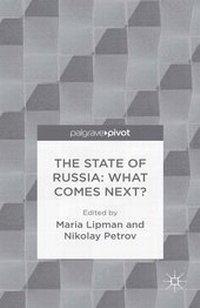
The State of Russia: What Comes Next?
Published on 14. January 2014
Book
Paperback/Softback
157 pages
978-1-349-57820-7 (ISBN)
Description
Following the crisis in Ukraine, the Putin regime made political choices that will determine Russia's development for years to come. This cutting edge Pivot makes a key contribution to the debate on Russia's development and traces emerging trends in various spheres of Russian life, from the economy and foreign policy, to society and ideology.
More details
Edition
2015 ed.
Language
English
Place of publication
London
United Kingdom
Product notice
Paperback (trade)
Unsewn / adhesive bound
Illustrations
Bibliography
Dimensions
Height: 216 mm
Width: 140 mm
ISBN-13
978-1-349-57820-7 (9781349578207)
DOI
10.1057/9781137548115
Copyright in bibliographic data and cover images is held by Nielsen Book Services Limited or by the publishers or by their respective licensors: all rights reserved.
Schweitzer Classification
Other editions
Additional editions
Nikolay Petrov | Maria Lipman
The State of Russia: What Comes Next?
Book
07/2015
Palgrave Macmillan
€53.49
Shipment within 10-20 days
Persons
Sergey Aleksashenko, Visiting Scholar, Georgetown University, USA
Pavel Baev, Research Director and Research Professor, Peace Research Institute in Oslo (PRIO), Norway
Lev Gudkov, Director of the Levada Center, Moscow, Russia
Maria Lipman, Visiting Fellow, European Council of Foreign Relations, London, UK
Boris Makarenko, Chairman of the Board of the Center for Political Technologies, and Professor at the Higher School of Economics, Russia
Nikolay Petrov, Professor and Laboratory Head, Laboratory for Regional Development Assessment Methods, Higher School of Economics, Russia
Natalia Zubarevich, Professor, Moscow State University and Director of the Regional Program, Independent Institute for Social Policy, Russia
Pavel Baev, Research Director and Research Professor, Peace Research Institute in Oslo (PRIO), Norway
Lev Gudkov, Director of the Levada Center, Moscow, Russia
Maria Lipman, Visiting Fellow, European Council of Foreign Relations, London, UK
Boris Makarenko, Chairman of the Board of the Center for Political Technologies, and Professor at the Higher School of Economics, Russia
Nikolay Petrov, Professor and Laboratory Head, Laboratory for Regional Development Assessment Methods, Higher School of Economics, Russia
Natalia Zubarevich, Professor, Moscow State University and Director of the Regional Program, Independent Institute for Social Policy, Russia
Content
List of Charts and Tables
Note on Contributors
Introduction; Maria Lipman and Nikolay Petrov
1. Post-Crimean Political Order; Boris Makarenko
2. The Russian Economy at the Start of the Post-Putin Era; Sergey Aleksashenko
3. The Relations Between the Center and the Regions; Natalia Zubarevich
4. Russia Reinvents Itself as a Rogue State in the Ungovernable Multi-Polar World; Pavel Baev
5. Putin ' 's Relapse Into Totalitarianism; Lev Gudkov
6. Putin ' 's ' 'Besieged Fortress ' ' and Its Ideological Arms; Maria Lipman
7. Conclusions; Maria Lipman and Nikolay Petrov
Index
Note on Contributors
Introduction; Maria Lipman and Nikolay Petrov
1. Post-Crimean Political Order; Boris Makarenko
2. The Russian Economy at the Start of the Post-Putin Era; Sergey Aleksashenko
3. The Relations Between the Center and the Regions; Natalia Zubarevich
4. Russia Reinvents Itself as a Rogue State in the Ungovernable Multi-Polar World; Pavel Baev
5. Putin ' 's Relapse Into Totalitarianism; Lev Gudkov
6. Putin ' 's ' 'Besieged Fortress ' ' and Its Ideological Arms; Maria Lipman
7. Conclusions; Maria Lipman and Nikolay Petrov
Index