

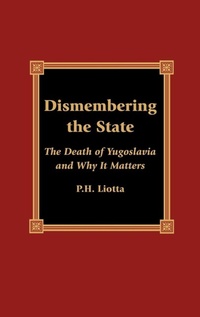
Dismembering the State
The Death of Yugoslavia and Why It Matters
Published on 18. April 2001
Book
Hardback
640 pages
978-0-7391-0212-1 (ISBN)
Description
P. H. Liotta's previous book, The Wreckage Reconsidered, was acclaimed as a tour de force of scholarship. In Dismembering the State, Liotta continues to challenge numerous assumptions about the disintegration of Yugoslavia. His research uses an "ecological," or holistic, perspective to address interwoven questions such as the role of military intervention as coercive diplomacy, the use of chaos as a strategy against America's and NATO's technological military predominance, and the influence of post-Cold War European democratic and economic reforms. This book considers how a host of factors, from 1991 to 1999, combined to contribute significantly to both the disintegration of the nation-state and to the continued instability of the present states of the former Yugoslavia. Of interest to both scholars and sophisticated lay readers, Liotta has fashioned a scholarly assessment of this timely and complex topic that promises to be as innovative as it is erudite.
More details
Language
English
Place of publication
United States
Publishing group
Bloomsbury Publishing Plc
Dimensions
Height: 240 mm
Width: 161 mm
Thickness: 38 mm
Weight
1104 gr
ISBN-13
978-0-7391-0212-1 (9780739102121)
Copyright in bibliographic data and cover images is held by Nielsen Book Services Limited or by the publishers or by their respective licensors: all rights reserved.
Schweitzer Classification
Person
P. H. Liotta is Professor of National Security Affairs at the U.S. Naval War College.
Content
Part 1 Introduction and Assessment
Chapter 2 Introduction
Chapter 3 Working out the Logic and Ill-Logic of Disintegration
Part 4 A Mask for Chaos: Social Aspects of Disintegration
Chapter 5 Rockin' the State: Malthus, Mayhem, and the Myth of Yugoslavia
Chapter 6 Chaos: Strategic Aspects of Disintegration
Part 7 No Man's Land: Economic and Political Aspects of Disintegration
Chapter 8 Paradigm Lost: Yugoslav Self-Management and the Economics of Disaster
Chapter 9 Towards a Bad End: The Ethics of Intervention and the Former Yugoslavia, 1991-1998
Part 10 Thicker than Water: Historic and Religious Aspects of Disintegration
Chapter 11 Balkan Fragmentation and the Rise of the Parastate
Chapter 12 Religion and War: Fault Lines in the Balkan Enigma
Part 13 Beyond the Pale: Aftershocks in Bosnia-Herzegovina, Kosovo, and Macedonia
Chapter 14 Making Dayton Work: NATO, S-FOR, and the Difficult Peace
Chapter 15 If It's Not One Thing, It's Another: Bosnia and the Ecnomics of War and Peace
Chapter 16 The Last Best Hope: The "Future" Republic of Macedonia
Chapter 17 After Kosovo
Part 18 Conclusion: Outcomes and Possibilities
Part 19 Appendices
Chapter 2 Introduction
Chapter 3 Working out the Logic and Ill-Logic of Disintegration
Part 4 A Mask for Chaos: Social Aspects of Disintegration
Chapter 5 Rockin' the State: Malthus, Mayhem, and the Myth of Yugoslavia
Chapter 6 Chaos: Strategic Aspects of Disintegration
Part 7 No Man's Land: Economic and Political Aspects of Disintegration
Chapter 8 Paradigm Lost: Yugoslav Self-Management and the Economics of Disaster
Chapter 9 Towards a Bad End: The Ethics of Intervention and the Former Yugoslavia, 1991-1998
Part 10 Thicker than Water: Historic and Religious Aspects of Disintegration
Chapter 11 Balkan Fragmentation and the Rise of the Parastate
Chapter 12 Religion and War: Fault Lines in the Balkan Enigma
Part 13 Beyond the Pale: Aftershocks in Bosnia-Herzegovina, Kosovo, and Macedonia
Chapter 14 Making Dayton Work: NATO, S-FOR, and the Difficult Peace
Chapter 15 If It's Not One Thing, It's Another: Bosnia and the Ecnomics of War and Peace
Chapter 16 The Last Best Hope: The "Future" Republic of Macedonia
Chapter 17 After Kosovo
Part 18 Conclusion: Outcomes and Possibilities
Part 19 Appendices