

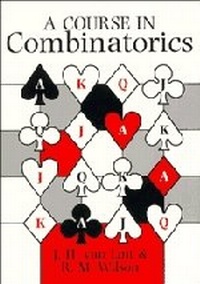
A Course in Combinatorics
Published on 10. December 1992
Book
Paperback/Softback
542 pages
978-0-521-42260-4 (ISBN)
Description
This major textbook, a product of many years' teaching, will appeal to all teachers of combinatorics who appreciate the breadth and depth of the subject. The authors exploit the fact that combinatorics requires comparatively little technical background to provide not only a standard introduction but also a view of some contemporary problems. All of the 36 chapters are in bite-size portions; they cover a given topic in reasonable depth and are supplemented by exercises, some with solutions, and references. To avoid an ad hoc appearance, the authors have concentrated on the central themes of designs, graphs and codes.
Reviews / Votes
' ... a valuable book ...' The Times Higher Education SupplementMore details
Language
English
Place of publication
Cambridge
United Kingdom
Target group
College/higher education
Product notice
Paperback (trade)
Illustrations
45 Line drawings, unspecified
Dimensions
Height: 247 mm
Width: 174 mm
Thickness: 30 mm
Weight
930 gr
ISBN-13
978-0-521-42260-4 (9780521422604)
Copyright in bibliographic data and cover images is held by Nielsen Book Services Limited or by the publishers or by their respective licensors: all rights reserved.
Schweitzer Classification
Other editions
New editions
J. H. van Lint | R. M. Wilson
A Course in Combinatorics
Book
11/2001
2nd Edition
Cambridge University Press
€119.10
Shipment within 15-20 days
Persons
Content
1. Graphs; 2. Trees; 3. Colourings of graphs and Ramsey's theorem; 4. Turan's theorem; 5. Systems of distinct representatives; 6. Dilworth's theorem and extremal set theory; 7. Flows in networks; 8. De Bruijn sequences; 9. The addressing problem for graphs; 10. The principle of inclusion and exclusion: inversion formulae; 11. Permanents; 12. The van der Waerden conjecture; 13. Elementary counting: Stirling numbers; 14. Recursions and generated functions; 15. Partitions; 16. (0,1) matrices; 17. Latin squares; 18. Hadamard matrices, Reed-Muller codes; 19. Designs; 20. Codes and designs; 21. Strongly regular graphs and partial geometries; 22. Orthogonal Latin squares; 23. Projective and combinatorial geometries; 24. Gaussian numbers and q-analogues; 25. Lattices and Moebius inversion; 26. Combinatorial designs and projective geometry; 27. Difference sets and automorphisms; 28. Difference sets and the group ring; 29. Codes and symmetric designs; 30. Association schemes; 31. Algebraic graphs: eigenvalue techniques; 32. Graphs: planarity and duality; 33. Graphs: colourings and embeddings; 34. Trees, electrical networks and squared rectangles; 35. Polya theory of counting; 36. Baranyai's theorem; Appendices.