

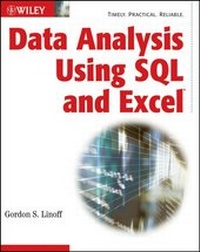
Data Analysis Using SQL and Excel
Published on 16. October 2007
Book
Paperback/Softback
696 pages
978-0-470-09951-3 (ISBN)
Description
Leverage the power of SQL and Excel to perform business analysis
Three key efforts are essential to effectively transform data into actionable information: retrieving data with SQL, presenting data with Excel, and understanding statistics as the foundation of data analysis. Data mining expert Gordon Linoff focuses on these topics and shows you how SQL and Excel can be used to extract business information from relational databases. He begins by taking a look at how data is central to the task of understanding customers, products, and markets, and he then goes on to show you how to use that data to define business dimensions, store transactions about customers, and summarize important data to produce results. Along the way, he shares stories based on his personal experience in the field, intended to enrich your understanding of why some things work--and others don't.
Each chapter explains when and why to perform a particular type of business analysis in order to obtain useful results, how to design and perform the analysis using SQL and Excel, and what you can expect the results to look like. Throughout the book, critical features of Excel are highlighted, interesting uses of Excel graphics are explained, and dataflows and graphical representations of data processing are used to illustrate how SQL works.
Data Analysis Using SQL and Excel shares hints, warnings, and technical asides about Excel, SQL, and data analysis/mining. The book also discusses:
* How entity-relationship diagrams describe the structure of data
*
Ways to use SQL to generate SQL queries
*
Descriptive statistics, such as averages, p-values, and the chi-square test
*
How to incorporate geographic information into data analysis
*
Basic ideas of hazard probabilities and survival
*
How data structures summarize what a customer looks like at a specific point in time
*
Several variants of linear regression
The companion Web site provides the data sets, Excel spreadsheets, and examples featured in the book.
Three key efforts are essential to effectively transform data into actionable information: retrieving data with SQL, presenting data with Excel, and understanding statistics as the foundation of data analysis. Data mining expert Gordon Linoff focuses on these topics and shows you how SQL and Excel can be used to extract business information from relational databases. He begins by taking a look at how data is central to the task of understanding customers, products, and markets, and he then goes on to show you how to use that data to define business dimensions, store transactions about customers, and summarize important data to produce results. Along the way, he shares stories based on his personal experience in the field, intended to enrich your understanding of why some things work--and others don't.
Each chapter explains when and why to perform a particular type of business analysis in order to obtain useful results, how to design and perform the analysis using SQL and Excel, and what you can expect the results to look like. Throughout the book, critical features of Excel are highlighted, interesting uses of Excel graphics are explained, and dataflows and graphical representations of data processing are used to illustrate how SQL works.
Data Analysis Using SQL and Excel shares hints, warnings, and technical asides about Excel, SQL, and data analysis/mining. The book also discusses:
* How entity-relationship diagrams describe the structure of data
*
Ways to use SQL to generate SQL queries
*
Descriptive statistics, such as averages, p-values, and the chi-square test
*
How to incorporate geographic information into data analysis
*
Basic ideas of hazard probabilities and survival
*
How data structures summarize what a customer looks like at a specific point in time
*
Several variants of linear regression
The companion Web site provides the data sets, Excel spreadsheets, and examples featured in the book.
More details
Edition
1. Auflage
Language
English
Place of publication
Chichester
United Kingdom
Publishing group
John Wiley and Sons Ltd
Target group
Professional and scholarly
Dimensions
Height: 23.4 cm
Width: 18.7 cm
Thickness: 3.6 cm
Weight
997 gr
ISBN-13
978-0-470-09951-3 (9780470099513)
Schweitzer Classification
Other editions
New editions
Gordon S. Linoff
Data Analysis Using SQL and Excel
Book
01/2016
2nd Edition
Wiley
€48.50
Shipment within 15-20 days
Person
GORDON S. LINOFF is a cofounder of Data Miners, Inc., a consultancy specializing in data mining. He is the coauthor of the bestselling Data Mining Techniques, Second Edition, and Mastering Data Mining (both from Wiley). He has more than a decade of experience applying data mining techniques to business problems in marketing and customer relationship management.
Content
Foreword.
Acknowledgments.
Introduction.
Chapter 1 A Data Miner Looks at SQL.
Chapter 2 What's In a Table? Getting Started with Data Exploration.
Chapter 3 How Different Is Different?
Chapter 4 Where Is It All Happening? Location, Location, Location.
Chapter 5 It's a Matter of Time.
Chapter 6 How Long Will Customers Last? Survival Analysis to Understand Customers and Their Value.
Chapter 7 Factors Affecting Survival: The What and Why of Customer Tenure.
Chapter 8 Customer Purchases and Other Repeated Events.
Chapter 9 What's in a Shopping Cart? Market Basket Analysis and Association Rules.
Chapter 10 Data Mining Models in SQL.
Chapter 11 The Best-Fit Line: Linear Regression Models.
Chapter 12 Building Customer Signatures for Further Analysis.
Appendix Equivalent Constructs Among Databases.
Index.
Acknowledgments.
Introduction.
Chapter 1 A Data Miner Looks at SQL.
Chapter 2 What's In a Table? Getting Started with Data Exploration.
Chapter 3 How Different Is Different?
Chapter 4 Where Is It All Happening? Location, Location, Location.
Chapter 5 It's a Matter of Time.
Chapter 6 How Long Will Customers Last? Survival Analysis to Understand Customers and Their Value.
Chapter 7 Factors Affecting Survival: The What and Why of Customer Tenure.
Chapter 8 Customer Purchases and Other Repeated Events.
Chapter 9 What's in a Shopping Cart? Market Basket Analysis and Association Rules.
Chapter 10 Data Mining Models in SQL.
Chapter 11 The Best-Fit Line: Linear Regression Models.
Chapter 12 Building Customer Signatures for Further Analysis.
Appendix Equivalent Constructs Among Databases.
Index.