

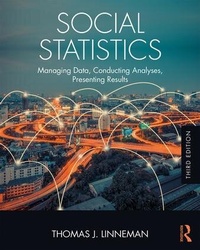
Social Statistics
Managing Data, Conducting Analyses, Presenting Results
3rd Edition
Published on 18. October 2017
Book
Paperback/Softback
682 pages
978-1-138-22863-4 (ISBN)
Description
With a clear and engaging writing style and strong examples from the real world, this text covers current statistical techniques at an introductory level and emphasizes the clear presentation of results to a variety of audiences, making the course more useful to students and their careers. Interconnection features among chapters help students understand how all of the techniques fit together. Using varied data sets, the text features a highly rated companion website that includes videos of the author offering step-by-step explanations of how to carry out the techniques, interpret the results, and present them to varied audiences.
NEW TO THIS EDITION
More inter-chapter connections have been added to improve students' conceptual learning.
Several examples (on immigration, health, and civil rights) now permeate the text for easy comparison of techniques across chapters.
The section on managing data is considerably expanded to cover topics such as finding new sources of data, dealing with missing data, and how to combine data reliably.
Very current examples from the scholarly literature from criminology, education, and health show how researchers use each chapter's techniques to tell compelling stories.
Instructors can choose from a variety of greatly expanded materials to enhance their lectures: engaging animations of key concepts; dynamic demonstrations of how statistics change in line with the data; short lectures on difficult-to-explain topics; and in-class exercises that will help students learn how to make sense of statistical results.
NEW TO THIS EDITION
More inter-chapter connections have been added to improve students' conceptual learning.
Several examples (on immigration, health, and civil rights) now permeate the text for easy comparison of techniques across chapters.
The section on managing data is considerably expanded to cover topics such as finding new sources of data, dealing with missing data, and how to combine data reliably.
Very current examples from the scholarly literature from criminology, education, and health show how researchers use each chapter's techniques to tell compelling stories.
Instructors can choose from a variety of greatly expanded materials to enhance their lectures: engaging animations of key concepts; dynamic demonstrations of how statistics change in line with the data; short lectures on difficult-to-explain topics; and in-class exercises that will help students learn how to make sense of statistical results.
More details
Series
Edition
3rd edition
Language
English
Place of publication
London
United Kingdom
Publishing group
Taylor & Francis Ltd
Target group
College/higher education
Illustrations
217 s/w Abbildungen, 44 s/w Photographien bzw. Rasterbilder, 173 s/w Zeichnungen, 308 s/w Tabellen
308 Tables, black and white; 173 Line drawings, black and white; 44 Halftones, black and white; 217 Illustrations, black and white
Dimensions
Height: 235 mm
Width: 187 mm
Weight
1383 gr
ISBN-13
978-1-138-22863-4 (9781138228634)
Copyright in bibliographic data and cover images is held by Nielsen Book Services Limited or by the publishers or by their respective licensors: all rights reserved.
Schweitzer Classification
Other editions
New editions
Book
12/2021
4th Edition
Routledge
€155.99
Shipment within 10-20 days
Additional editions
Book
10/2017
3rd Edition
Routledge
€259.98
Article exhausted; check for reprint
Person
Thomas J. Linneman is Professor of Sociology at the College of William and Mary in Williamsburg, Virginia, where he has won several teaching awards for his rigorous and innovative courses.
Content
Preface
Acknowledgments
Chapter 1: Life in a Data-Laden Age: Finding and Managing Datasets
Chapter 2: The Art of Visual Storytelling: Creating Accurate Tables and Graphs
Chapter 3: Summarizing Center and Diversity: Basic Descriptive Statistics
Chapter 4: Using Sample Crosstabs to Talk About Populations: The Chi-square Test
Chapter 5: Using a Sample Mean or Proportion to Talk About a Population: Confidence Intervals
Chapter 6: Using Multiple Sample Means to Talk About Populations: T-Tests and ANOVA
Chapter 7: Give Me One Good Reason Why: Bivariate Correlation and Regression
Chapter 8: Using Sample Slopes to Talk About Populations: Inference and Regression
Chapter 9: It's All Relative: Dichotomies as Independent Variables in Regression
Chapter 10: Above and Beyond: The Logic of Controlling and the Power of Nested Regression Models
Chapter 11: Some Slopes are Bigger than Others: Calculating and Interpreting Beta Coefficients
Chapter 12: Different Slopes for Different Folks: Interaction Effects
Chapter 13: Explaining Dichotomous Outcomes: Logistic Regression
Chapter 14: Visualizing Causal Stories: Path Analysis
Chapter 15: Questioning the Greatness of Straightness: Nonlinear Relationships
Chapter 16: Problems and Prospects: Regression Diagnostics, Advanced Techniques, and Where to Go Now
Appendix A: Variables and Indexes from the Datasets Used in the End-of-Chapter Exercises
Appendix B: 100 Articles That Use Statistics in Less than Scary Ways
Appendix C: Statistical Tables
Appendix D: Answers to Odd-Numbered End-of-Chapter Exercises
Bibliography
Glossary/Index
Acknowledgments
Chapter 1: Life in a Data-Laden Age: Finding and Managing Datasets
Chapter 2: The Art of Visual Storytelling: Creating Accurate Tables and Graphs
Chapter 3: Summarizing Center and Diversity: Basic Descriptive Statistics
Chapter 4: Using Sample Crosstabs to Talk About Populations: The Chi-square Test
Chapter 5: Using a Sample Mean or Proportion to Talk About a Population: Confidence Intervals
Chapter 6: Using Multiple Sample Means to Talk About Populations: T-Tests and ANOVA
Chapter 7: Give Me One Good Reason Why: Bivariate Correlation and Regression
Chapter 8: Using Sample Slopes to Talk About Populations: Inference and Regression
Chapter 9: It's All Relative: Dichotomies as Independent Variables in Regression
Chapter 10: Above and Beyond: The Logic of Controlling and the Power of Nested Regression Models
Chapter 11: Some Slopes are Bigger than Others: Calculating and Interpreting Beta Coefficients
Chapter 12: Different Slopes for Different Folks: Interaction Effects
Chapter 13: Explaining Dichotomous Outcomes: Logistic Regression
Chapter 14: Visualizing Causal Stories: Path Analysis
Chapter 15: Questioning the Greatness of Straightness: Nonlinear Relationships
Chapter 16: Problems and Prospects: Regression Diagnostics, Advanced Techniques, and Where to Go Now
Appendix A: Variables and Indexes from the Datasets Used in the End-of-Chapter Exercises
Appendix B: 100 Articles That Use Statistics in Less than Scary Ways
Appendix C: Statistical Tables
Appendix D: Answers to Odd-Numbered End-of-Chapter Exercises
Bibliography
Glossary/Index