

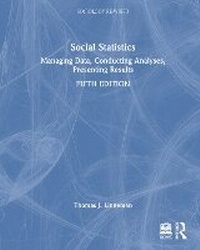
Social Statistics
Managing Data, Conducting Analyses, Presenting Results
5th Edition
Published on 30. July 2025
Book
Hardback
632 pages
978-1-032-49037-3 (ISBN)
Description
With a clear, engaging writing style and fascinating examples using a variety of real data, this text covers the contemporary statistical techniques that students will encounter in the world of social research. It covers these techniques at an introductory level and carefully guides students through increasingly complex examples without intimidating them. Recurrent examples using four timely topics-immigration, income inequality, the distribution of household labor, and health (including attitudes toward doctors and pandemic restrictions)-help students understand how the techniques fit together and how to use the techniques in combination with one another. A superb author-created web resource accompanies the text. How to make clear presentations of research results is also a feature of the text.
New to this edition:
Most of the literature examples that end each chapter are new and use very recent research from top academic journals (over half of the new literature examples are from 2023 or 2024). They feature research about some of the most pertinent and provocative social issues of the day: political polarization, conspiracy beliefs, mental health, transgender support, racial stereotypes, vaccine refusal, sexual harassment, and numerous facets of the COVID-19 pandemic.
Examples throughout the book use the most recent data from the General Social Survey. Four timely topics are threaded throughout the book: immigration, income inequality, the distribution of household labor, and health. Linneman uses these topics recurrently with different statistical techniques to illustrate how the techniques are related to one another.
The new edition more explicitly emphasizes that the various techniques the students are learning are often used in combination with one another. Linneman carefully scaffolds the techniques, introducing a new technique and then showing how this technique can be combined with techniques taught in previous chapters. He does this with a new emphasis on psychologically supporting students who might be trepidatious about their newfound statistical skills.
New to this edition:
Most of the literature examples that end each chapter are new and use very recent research from top academic journals (over half of the new literature examples are from 2023 or 2024). They feature research about some of the most pertinent and provocative social issues of the day: political polarization, conspiracy beliefs, mental health, transgender support, racial stereotypes, vaccine refusal, sexual harassment, and numerous facets of the COVID-19 pandemic.
Examples throughout the book use the most recent data from the General Social Survey. Four timely topics are threaded throughout the book: immigration, income inequality, the distribution of household labor, and health. Linneman uses these topics recurrently with different statistical techniques to illustrate how the techniques are related to one another.
The new edition more explicitly emphasizes that the various techniques the students are learning are often used in combination with one another. Linneman carefully scaffolds the techniques, introducing a new technique and then showing how this technique can be combined with techniques taught in previous chapters. He does this with a new emphasis on psychologically supporting students who might be trepidatious about their newfound statistical skills.
More details
Series
Edition
5th edition
Language
English
Place of publication
London
United Kingdom
Publishing group
Taylor & Francis Ltd
Target group
College/higher education
Postgraduate and Undergraduate
Illustrations
207 s/w Zeichnungen, 259 s/w Tabellen, 207 s/w Abbildungen, 56 farbige Abbildungen, 56 Farbfotos bzw. farbige Rasterbilder
259 Tables, black and white; 207 Line drawings, black and white; 56 Halftones, color; 56 Illustrations, color; 207 Illustrations, black and white
Dimensions
Height: 235 mm
Width: 191 mm
Weight
1400 gr
ISBN-13
978-1-032-49037-3 (9781032490373)
Copyright in bibliographic data and cover images is held by Nielsen Book Services Limited or by the publishers or by their respective licensors: all rights reserved.
Schweitzer Classification
Other editions
Additional editions
Book
08/2025
5th Edition
Routledge
€129.50
Shipment within 10-20 days
E-Book
07/2025
5th Edition
Routledge
€138.99
Available for download
E-Book
07/2025
5th Edition
Routledge
€138.99
Available for download
Previous edition
Book
12/2021
4th Edition
Routledge
€282.26
Shipment within 10-20 days
Person
Thomas J. Linneman is Professor of Sociology at the College of William & Mary. The recipient of several teaching awards, he teaches statistics, social change, sexualities, and the COVID-19 pandemic. His research on teaching statistics recently appeared in the journal Teaching Sociology. After a student posted one of his teaching videos on TikTok and it went viral, a Buzzfeed list named him "Best Professor on the Planet."
Content
1. Life in a Data-Laden Age: Finding and Managing Datasets
2. The Art of Visual Storytelling: Creating Accurate Tables and Graphs
3. Summarizing Center and Diversity: Basic Descriptive Statistics
4. Using Sample Crosstabs to Talk About Populations: The Chi-Square Test
5. Using a Sample Mean or Proportion to Talk About a Population: Confidence Intervals
6. Using Multiple Sample Means to Talk About Populations: t-Tests and ANOVA
7. Give Me One Good Reason Why: Bivariate Correlation and Regression
8. Using Sample Slopes to Talk About Populations: Inference and Regression
9. It's All Relative: Dichotomies as Independent Variables in Regression
10. Above and Beyond: The Logic of Controlling and the Power of Nested Regression Models
11. Some Slopes Are Bigger Than Others: Calculating and Interpreting Beta Coefficients
12. Different Slopes for Different Folks: Interaction Effects
13. Explaining Dichotomous Outcomes: Logistic Regression
14. Visualizing Causal Stories: Path Analysis
15. Questioning the Greatness of Straightness: Nonlinear Relationships
16. Problems and Prospects: Regression Diagnostics, Advanced Techniques, and Where to Go Now
2. The Art of Visual Storytelling: Creating Accurate Tables and Graphs
3. Summarizing Center and Diversity: Basic Descriptive Statistics
4. Using Sample Crosstabs to Talk About Populations: The Chi-Square Test
5. Using a Sample Mean or Proportion to Talk About a Population: Confidence Intervals
6. Using Multiple Sample Means to Talk About Populations: t-Tests and ANOVA
7. Give Me One Good Reason Why: Bivariate Correlation and Regression
8. Using Sample Slopes to Talk About Populations: Inference and Regression
9. It's All Relative: Dichotomies as Independent Variables in Regression
10. Above and Beyond: The Logic of Controlling and the Power of Nested Regression Models
11. Some Slopes Are Bigger Than Others: Calculating and Interpreting Beta Coefficients
12. Different Slopes for Different Folks: Interaction Effects
13. Explaining Dichotomous Outcomes: Logistic Regression
14. Visualizing Causal Stories: Path Analysis
15. Questioning the Greatness of Straightness: Nonlinear Relationships
16. Problems and Prospects: Regression Diagnostics, Advanced Techniques, and Where to Go Now