

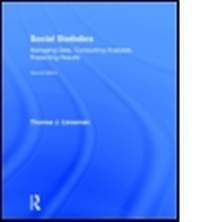
Social Statistics
Managing Data, Conducting Analyses, Presenting Results
2nd Edition
Published on 31. March 2014
Book
Hardback
656 pages
978-0-415-66146-1 (ISBN)
Description
Many fundamentally important decisions about our social life are a function of how well we understand and analyze DATA. This sounds so obvious but it is so misunderstood. Social statisticians struggle with this problem in their teaching constantly. This book and its approach is the ally and support of all instructors who want to accomplish this hugely important teaching goal.
This innovative text for undergraduate social statistics courses is, (as one satisfied instructor put it), a "breath of fresh air." It departs from convention by not covering some techniques and topics that have been in social stat textbooks for 30 years, but that are no longer used by social scientists today. It also includes techniques that conventional wisdom has previously thought to be the province of graduate level courses.
Linneman's text is for those instructors looking for a thoroughly "modern" way to teach quantitative thinking, problem-solving, and statistical analysis to their students...an undergraduate social statistics course that recognizes the increasing ubiquity of analytical tools in our data-driven age and therefore the practical benefit of learning how to "do statistics," to "present results" effectively (to employers as well as instructors), and to "interpret" intelligently the quantitative arguments made by others.
A NOTE ABOUT THE AUTHOR...
At a recent Charter Day celebration, author Tom Linneman was awarded the Thomas Jefferson Teaching Award, the highest award given to young faculty members at the College of William and Mary. The citation for his award noted that Linneman has developed a reputation among his students as a demanding professor - but one who genuinely cares about them.
This innovative text for undergraduate social statistics courses is, (as one satisfied instructor put it), a "breath of fresh air." It departs from convention by not covering some techniques and topics that have been in social stat textbooks for 30 years, but that are no longer used by social scientists today. It also includes techniques that conventional wisdom has previously thought to be the province of graduate level courses.
Linneman's text is for those instructors looking for a thoroughly "modern" way to teach quantitative thinking, problem-solving, and statistical analysis to their students...an undergraduate social statistics course that recognizes the increasing ubiquity of analytical tools in our data-driven age and therefore the practical benefit of learning how to "do statistics," to "present results" effectively (to employers as well as instructors), and to "interpret" intelligently the quantitative arguments made by others.
A NOTE ABOUT THE AUTHOR...
At a recent Charter Day celebration, author Tom Linneman was awarded the Thomas Jefferson Teaching Award, the highest award given to young faculty members at the College of William and Mary. The citation for his award noted that Linneman has developed a reputation among his students as a demanding professor - but one who genuinely cares about them.
More details
Series
Edition
2nd New edition
Language
English
Place of publication
London
United Kingdom
Publishing group
Taylor & Francis Ltd
Target group
College/higher education
Edition type
New edition
Illustrations
300 s/w Tabellen, 48 s/w Photographien bzw. Rasterbilder, 244 s/w Zeichnungen
follow last edn, new pantone - PANTONE 300. Printing 45lb Somerset.; 244 Line drawings, black and white; 48 Halftones, black and white; 300 Tables, black and white
Dimensions
Height: 235 mm
Width: 187 mm
Weight
1157 gr
ISBN-13
978-0-415-66146-1 (9780415661461)
Copyright in bibliographic data and cover images is held by Nielsen Book Services Limited or by the publishers or by their respective licensors: all rights reserved.
Schweitzer Classification
Other editions
New editions
Book
10/2017
3rd Edition
Routledge
€259.98
Article exhausted; check for reprint
Additional editions
Book
03/2014
2nd Edition
Routledge
€132.20
Article exhausted; check different version
Previous edition
Book
01/2011
1st Edition
Routledge
€141.13
Article exhausted; check for reprint
Person
Tom Linneman is Associate Professor of Sociology at The College of William and Mary in Williamsburg, Virginia, where he has won several teaching awards for his rigorous and innovative courses.
Content
Chapter 1: Life in a Data-Laden Age: Finding and Managing Datasets / Chapter 2: The Art of Visual Storytelling: Creating Accurate Tables and Graphs / Chapter 3: Summarizing Center and Diversity: Basic Descriptive Statistics / Chapter 4: Using Sample Crosstabs to Talk about Populations: The Chi-Square Test / Chapter 5:Using a Sample Mean or Proportion to Talk about a Population:Confidence Intervals / Chapter 6: Using Multiple Sample Means to Talk about Populations: T-Tests and ANOVA / Chapter 7:Give Me One Good Reason Why: Bivariate Correlation and Regression / Chapter 8:Using Sample Slopes to Talk about Populations: Inference and Regression / Chapter 9: It's All Relative: Dichotomies as Independent Variables in Regression / Chapter 10: Above and Beyond: The Logic of Controlling and the Power of Nested Regression Models / Chapter 11:Some Slopes Are Bigger Than Others: Calculating and Interpreting Beta Coefficients / Chapter 12:Different Slopes for Different Folks: Interaction Effects / Chapter 13:Explaining Dichotomous Outcomes: Logistic Regression / Chapter 14:Visualizing Causal Stories: Path Analysis / Chapter 15:Questioning the Greatness of Straightness: Nonlinear Relationships / Chapter 16: Problems and Prospects: Regression Diagnostics, Advanced Techniques, and Where to Go Now / Appendix A:Variables and Indexes from the American National Election Studies, the World Values Survey, and Three Surveys from the Pew Internet and American Life Project /Appendix B: Eighty-Six Articles That Use Statistics in Less than Scary Ways / Appendix C:Statistical Tables / Appendix D:Answers to Selected End-of-Chapter Exercises