

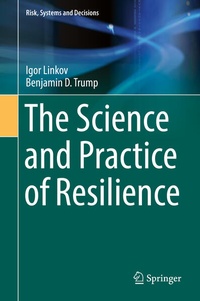
The Science and Practice of Resilience
Description
This book offers a comprehensive view on resilience based upon state-of-the-science theories and methodological applications that resilience may fill. Specifically, this text provides a compendium of knowledge on the theory, methods, and practice of resilience across a variety of country and case contexts, and demonstrates how a resilience-based approach can help further improved infrastructure, vibrant societies, and sustainable environments and ecologies, among many others.
Resilience is a term with thousands of years of history. Only recently has resilience been applied to the management of complex interconnected systems, yet its impact as a governing philosophy and an engineering practice has been pronounced. Colloquially, resilience has been used as a synonym for 'bouncing back'. Philosophically and methodologically, however, it is much more. In a world defined by interconnected and interdependent systems such as water, food, energy, transportation, and the internet, a sudden and unexpected disruption to one critical system can lead to significant challenges for many others. The Science and Practice of Resilience is beneficial for those seeking to gain a rich knowledge of the resilience world, as well as for practitioners looking for methods and tools by which resilience may be applied in real-world contexts.
More details
Other editions
Additional editions
Persons
Dr. Benjamin D. Trump is an ORISE Postdoctoral Fellow for the US Army Corps of Engineers and a Postdoctoral Research Fellow at the University of Lisbon, Portugal. He has also held a postdoctoral appointment at the University of Maryland, and as a research intern at the Institute of Occupational Medicine in Singapore. Dr. Trump's work focuses on decision making and governance of activities under significant uncertainty, such as emerging and enabling technologies (synthetic biology, nanotechnology) and developing organizational, infrastructural, social, and informational resilience against systemic threats to complex interconnected systems. Dr. Trump served as a delegate to assist US presence in OECD's Global Science Forum in 2017, and is the President of the Society for Risk Analysis' Decision Analysis and Risk Specialty Group in 2018-2019. His work has been featured in over 50 peer-reviewed publications, journal articles, and book chapters, including publications in Nature, Nature Nanotechnology, EMBO Reports, Environmental Science & Technology, Health Policy, and Regulation and Governance, among others. Dr. Trump was also an author of the International Risk Governance Council's Guidelines for the Governance of Systemic Risks, as well as their 2nd Volume of the Resource Guide on Resilience. Dr. Trump is also frequently active with several Advanced Research Workshops for the North Atlantic Treaty Organization's Science for Peace Programme, including his role as a Director of a workshop titled Cybersecurity and Resilience for the Arctic. Dr. Trump received his PhD from the University of Michigan's School of Public Health, Department of Health Management and Policy in 2016. He received a M.S. (2012) in Public Policy and Management and a B.S. in Political Science (2011) from Carnegie Mellon University.
Content
PartI: Foundations of Resilience.- Chapter1: Risk and Resilience: Similarities and Differences.- Chapter2: Resilience as Function of Space and Time.- Chapter3: Panarchy: Thinking in Systems and Networks.- Chapter4: Lessons from History.- PartII: Resilience Assessment: State of Science and Governance.- Chapter5: Resilience and Governance.- Chapter6: Resilience Quantification and Assessment.- PartIII: Resilience Management: State of Practice and Case Studies.- Chapter7: The State of Practice.- Chapter8: Metrics-based Approaches.- Chapter9: Applications of Network Science and Systems Thinking.- Chapter10: Conclusion.