

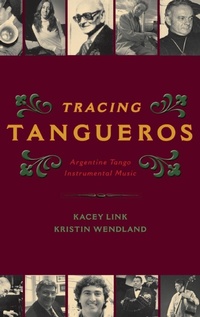
Tracing Tangueros
Argentine Tango Instrumental Music
Published on 24. March 2016
Book
Hardback
384 pages
978-0-19-934822-0 (ISBN)
Description
Tracing Tangueros offers an inside view of Argentine tango music in the context of the growth and development of the art form's instrumental and stylistic innovations. Rather than perpetuating the glamorous worldwide conceptions that often only reflect the tango that left Argentina nearly 100 years ago, authors Kacey Link and Kristin Wendland trace tango's historical and stylistic musical trajectory in Argentina, beginning with the guardia nueva's crystallization of the genre in the 1920s, moving through tango's Golden Age (1925-1955), and culminating with the "Music of Buenos Aires" today. Through the transmission, discussion, examination, and analysis of primary sources currently unavailable outside of Argentina, including scores, manuals of style, archival audio/video recordings, and live video footage of performances and demonstrations, Link and Wendland frame and define Argentine tango music as a distinct expression possessing its own musical legacy and characteristic musical elements.
Beginning by establishing a broad framework of the tango art form, the book proceeds to move through twelve in-depth profiles of representative tangueros (tango musicians) within the genre's historical and stylistic trajectory. Through this focused examination of tangueros and their music, Link and Wendland show how the dynamic Argentine tango grows from one tanguero linked to another, and how the composition techniques and performance practices of each generation are informed by that of the past.
Beginning by establishing a broad framework of the tango art form, the book proceeds to move through twelve in-depth profiles of representative tangueros (tango musicians) within the genre's historical and stylistic trajectory. Through this focused examination of tangueros and their music, Link and Wendland show how the dynamic Argentine tango grows from one tanguero linked to another, and how the composition techniques and performance practices of each generation are informed by that of the past.
Reviews / Votes
"Tracing Tangueros is required reading not only for scholars of Tango but also for those interested in the multidimensional juncture of music, dance, lyrics, and culture. Befitting the subject matter, Kacey Link and Kristin Wendland offer intellectually intimate and provocative research articulated in a uniquely graceful and elegant prose."--Juan Chattah, University of Miami - Frost School of Music"Tracing Tangueros is an excellent introduction to the knowledge, comprehension and study of instrumental tango music. The book offers precise information about the genre to those who are outside the tango world. However, those who are deeply involved with the genre will find challenging ideas about how tango is seen and valued worldwide. Listeners and dancers, musicians and scholars will find it most useful and a good read."--Omar Garcia
Brunelli, Instituto Nacional de Musicologia "Carlos Vega", Buenos Aires, Argentina
"This book will perhaps be of most value and interest to practitioners seeking to understand better how to perform, arrange, or create tango music." --Music and Letters
"Taken in conjunction with material on its website, Tracing Tangueros enriches understanding of a uniquely Argentine cultural phenomenon." --Dance Research
More details
Series
Language
English
Place of publication
New York
United States
Target group
College/higher education
Professional and scholarly
Illustrations
14 halftones, 22 music examples, and 15 figures
Dimensions
Height: 240 mm
Width: 161 mm
Thickness: 25 mm
Weight
743 gr
ISBN-13
978-0-19-934822-0 (9780199348220)
Schweitzer Classification
Other editions
Additional editions
Book
03/2016
Oxford University Press Inc
€65.50
Shipment within 15-20 days
E-Book
01/2016
1st Edition
OUP eBook
€30.49
Available for download
E-Book
01/2016
1st Edition
OUP eBook
€30.49
Available for download
Persons
Kacey Link, D.M.A., is a pianist and scholar residing in Southern California. Kristin Wendland, Ph.D., is a Senior Lecturer at Emory University Department of Music. Together they have given lectures and presentations on Argentine tango throughout the United States as invited university guests and for professional societies.
Content
Acknowledgments
About the Companion Website
Introduction. Argentine Tango: A Multidimensional Art Form
Part One: Argentine Tango Instrumental Music
I. What Makes It an Argentine Tango?
II. Trajectory of Argentine Tango Instrumental Music
III. Arranging and Performance Techniques
Part Two: Representative Argentine Tangueros and Their Orchestras from the Guardia Nueva to Today
IV. The Guardia Nueva and the Golden Age (1925-55)
Julio De Caro
Anibal Troilo
Osvaldo Pugliese
Cafecito Interlude: Juan D'Arienzo and Carlos Di Sarli
V. Post-Golden Age (1955-1990)
Horacio Salgan
Astor Piazzolla
Julian Plaza
Leopoldo Federico
Cafecito Interlude: Rodolfo Mederos and Nestor Marconi
VI. The "Music of Buenos Aires" (1990-present)
Damian Bolotin
Sonia Possetti
Juan Pablo Navarro
Postre: Part Two Conclusion
Notes
Bibliography
Index of Titles and Translations
General Index
About the Companion Website
Introduction. Argentine Tango: A Multidimensional Art Form
Part One: Argentine Tango Instrumental Music
I. What Makes It an Argentine Tango?
II. Trajectory of Argentine Tango Instrumental Music
III. Arranging and Performance Techniques
Part Two: Representative Argentine Tangueros and Their Orchestras from the Guardia Nueva to Today
IV. The Guardia Nueva and the Golden Age (1925-55)
Julio De Caro
Anibal Troilo
Osvaldo Pugliese
Cafecito Interlude: Juan D'Arienzo and Carlos Di Sarli
V. Post-Golden Age (1955-1990)
Horacio Salgan
Astor Piazzolla
Julian Plaza
Leopoldo Federico
Cafecito Interlude: Rodolfo Mederos and Nestor Marconi
VI. The "Music of Buenos Aires" (1990-present)
Damian Bolotin
Sonia Possetti
Juan Pablo Navarro
Postre: Part Two Conclusion
Notes
Bibliography
Index of Titles and Translations
General Index