

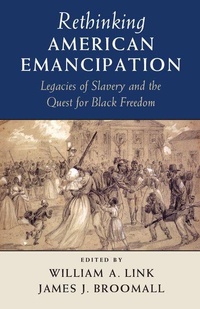
Rethinking American Emancipation
Legacies of Slavery and the Quest for Black Freedom
Published on 12. November 2015
Book
Hardback
292 pages
978-1-107-07303-6 (ISBN)
Description
On January 1, 1863, Abraham Lincoln announced the Emancipation Proclamation, an event that soon became a bold statement of presidential power, a dramatic shift in the rationale for fighting the Civil War, and a promise of future freedom for four million enslaved Americans. But the document marked only a beginning; freedom's future was anything but certain. Thereafter, the significance of both the Proclamation and of emancipation assumed new and diverse meanings, as African Americans explored freedom and the nation attempted to rebuild itself. Despite the sweeping power of Lincoln's Proclamation, struggle, rather than freedom, defined emancipation's broader legacy. The nine essays in this volume unpack the long history and varied meanings of the emancipation of American slaves. Together, the contributions argue that 1863 did not mark an end point or a mission accomplished in black freedom; rather, it initiated the beginning of an ongoing, contested process.
Reviews / Votes
'Rethinking American Emancipation introduces new scholarly perspectives on the black freedom struggle and expands our understanding of emancipation in the context and aftermath of the American Civil War. Highlighting the ways in which emancipation was claimed, contested, and remembered, this terrific collection is a must-read for anyone interested in slavery and freedom. Its provocative and original arguments establish new standards in the field that will inform scholarly debates for years to come.' Crystal N. Feimster, Yale University, Connecticut 'This wide-ranging collection of essays showcases some of the best recent work on emancipation in the American South, and reveals the vitality and diversity of the rapidly evolving scholarship.' Peter Kolchin, Henry Clay Reed Professor of History, University of Delaware 'This is a remarkable collection of essays that includes the writing of some of the most innovative scholars of emancipation and reconstruction working today. These historians' interpretively forceful essays work brilliantly in conversation with one another. They yield a volume that illustrates in bold relief the ways in which emancipation was so much more than 'a moment' or a concept, but rather a lengthy, irregular, and multivalent process. This volume is an invaluable encapsulation of current scholarship on emancipation and reconstruction.' Anne Marshall, Mississippi State University 'Eschewing the iconography of emancipation, the nine essays in this volume from a 2013 conference offer 'new ways' of understanding slavery's demise in the US: e.g., Lincoln's 1863 edict did not end slavery, but began freedom's long journey; emancipation impacted all Southerners, not just former slaves; the emancipation state continued its territorial expansion and conquest into the US West; emancipation remained contested terrain by radicals and liberals in the US and diasporic Africans in the Americas. The volume sits within an evolving historiography of 'factors, contingencies, and individual efforts' shaping emancipation. Summing up: recommended. All academic levels/libraries.' J. R. Kerr-Ritchie, ChoiceMore details
Series
Language
English
Place of publication
Cambridge
United Kingdom
Target group
Professional and scholarly
College/higher education
Illustrations
14 Halftones, unspecified
Dimensions
Height: 235 mm
Width: 157 mm
Thickness: 20 mm
Weight
577 gr
ISBN-13
978-1-107-07303-6 (9781107073036)
Copyright in bibliographic data and cover images is held by Nielsen Book Services Limited or by the publishers or by their respective licensors: all rights reserved.
Schweitzer Classification
Other editions
Additional editions
William A. Link | James J. Broomall
Rethinking American Emancipation
Legacies of Slavery and the Quest for Black Freedom
E-Book
11/2015
Cambridge University Press
€23.49
Available for download
William A. Link | James J. Broomall
Rethinking American Emancipation
Legacies of Slavery and the Quest for Black Freedom
Book
11/2015
Cambridge University Press
€40.60
Shipment within 15-20 days
E-Book
11/2015
Cambridge University Press
€21.99
Available for download
Persons
William A. Link is Richard J. Milbauer Professor of History at the University of Florida. His books include Roots of Secession: Slavery and Politics in Antebellum Virginia; Righteous Warrior: Jesse Helms and the Rise of Modern Conservatism; Atlanta, Cradle of the New South: Race and Remembering in the Civil War's Aftermath; and Southern Crucible: The Making of the American South. James J. Broomall is Director of the George Tyler Moore Center for the Study of the Civil War and Assistant Professor in the History Department at Shepherd University. A contributor to Creating Citizenship in the Nineteenth-Century South and Civil War History, Broomall's writings have also appeared in A Companion to the American Civil War in the Journal of the Civil War Era.
Content
Introduction William A. Link and James Broomall; Part I. Claiming Emancipation: 1. A universe of flight Yael Sternhell; 2. Force, freedom, and the making of emancipation Greg Downs; 3. Military interference in elections as an influence on abolition William A. Blair; Part II. Contesting Emancipation: 4. 'One pillar of the social fabric may still stand firm': bluegrass marriage in the emancipation era Allison Fredette; 5. Axes of empire: race, region, and the 'greater Reconstruction' of federal authority after emancipation Carole Emberton; 6. Fear of reenslavement: black political mobilization in response to the waning of Reconstruction Justin Behrend; Part III. Remembering Emancipation: 7. African Americans and the long emancipation in New South Atlanta William A. Link; 8. 'Washington, Toussaint, and Bolivar, the glorious advocates of liberty': black internationalism and reimagining emancipation Paul Ortiz; 9. Remembering the abolitionists John Stauffer; Epilogue: emancipation and the nation Laura F. Edwards.