

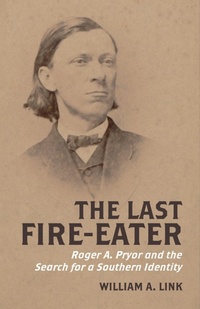
The Last Fire-Eater
Roger a. Pryor and the Search for a Southern Identity
Published on 9. November 2022
Book
Hardback
136 pages
978-0-8071-7821-8 (ISBN)
Description
In The Last Fire-Eater, renowned historian of the American South William A. Link examines the life of Roger A. Pryor, a Virginia secessionist, Confederate general, and earnest proponent of postwar sectional reconciliation whose life involved a series of remarkable transformations. Pryor's journey, Link reveals, mirrored that of the South. At times, both proved puzzling and contradictory.
Pryor recast himself during a crucial period in southern history between the 1850s and the close of the nineteenth century. An archetypical southern-rights advocate, Pryor became a skilled practitioner in the politics of honor. As a politician and newspaper editor, he engaged in duels and viewed the world through the cultural prism of southern honor, assuming a more militant and aggressive stance on slavery than most of his regional peers. Later, he served in the Confederate army during the Civil War, rising to the rank of brigadier general and seeing action across the Eastern Theater. Captured late in the conflict, Pryor soon after abandoned his fiery persona and renounced extremism. He then moved to New York City, where he emerged as a prominent lawyer and supporter of the sort of intersectional detente that stood as a central facet of what southern boosters labeled the "New South."
Dramatic change characterized Pryor's long life. Born in 1828, he died four months after the end of World War I. He witnessed fundamental shifts in the South that included the destruction of slavery, the defeat of the Confederacy, and the redefinition of manhood and honor among elite white men who relied less on violence to resolve personal grievances. With Pryor's lifetime of remakings as its focus, The Last Fire-Eater serves as a masterful history of transformation in the South.
Pryor recast himself during a crucial period in southern history between the 1850s and the close of the nineteenth century. An archetypical southern-rights advocate, Pryor became a skilled practitioner in the politics of honor. As a politician and newspaper editor, he engaged in duels and viewed the world through the cultural prism of southern honor, assuming a more militant and aggressive stance on slavery than most of his regional peers. Later, he served in the Confederate army during the Civil War, rising to the rank of brigadier general and seeing action across the Eastern Theater. Captured late in the conflict, Pryor soon after abandoned his fiery persona and renounced extremism. He then moved to New York City, where he emerged as a prominent lawyer and supporter of the sort of intersectional detente that stood as a central facet of what southern boosters labeled the "New South."
Dramatic change characterized Pryor's long life. Born in 1828, he died four months after the end of World War I. He witnessed fundamental shifts in the South that included the destruction of slavery, the defeat of the Confederacy, and the redefinition of manhood and honor among elite white men who relied less on violence to resolve personal grievances. With Pryor's lifetime of remakings as its focus, The Last Fire-Eater serves as a masterful history of transformation in the South.
More details
Language
English
Place of publication
Baton Rouge
United States
Target group
Professional and scholarly
Product notice
sewn/stitched
Cloth over boards
Illustrations
8 images
Dimensions
Height: 218 mm
Width: 142 mm
Thickness: 18 mm
Weight
249 gr
ISBN-13
978-0-8071-7821-8 (9780807178218)
Copyright in bibliographic data and cover images is held by Nielsen Book Services Limited or by the publishers or by their respective licensors: all rights reserved.
Schweitzer Classification
Person
William A. Link is Richard J. Milbauer Chair in Southern History Emeritus at the University of Florida. He is the author of numerous books on the history of the South, including Frank Porter Graham: Southern Liberal, Citizen of the World.