

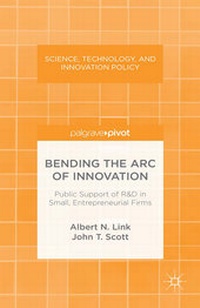
Bending the Arc of Innovation: Public Support of R&D in Small, Entrepreneurial Firms
Description
Bending the Arc of Innovation offers a theoretical model of the effects of the SBIR program. Link and Scott demonstrate that with SBIR support of R&D often comes contractual commercial agreements with other firms to sell the rights to the technology generated by the public support. These agreements between another firm and a small firm with a SBIR-award enable an effective transfer of knowledge created with the small firm's publicly-supported research. Both parties to the agreement have better access to the knowledge resources of the other. Link and Scott show how these agreements allow the dedication of resources and organizational efforts necessary for the commercially successful access to and use of external knowledge.
More details
Other editions
Additional editions
Persons
Albert N. Link is Professor of economics at the University of North Carolina at Greensboro (UNCG). He received the B.S. degree in mathematics from the University of Richmond and the Ph.D. degree in economics from Tulane University. His research is in the areas of the economics of R&D, technological change, and innovation policy. Recently, he completed a five-year term as the U.S. Representative to the United Nations Economic Commission for Europe (UNECE), Team of Specialists on Innovation and Competitiveness Policies Initiative. He is currently Editor-in-Chief of the Journal of Technology Transfer (Springer). He is also editor of this Palgrave series.
John T. Scott received the Ph.D. in Economics from Harvard University and the A.B. in Economics and English from the University of North Carolina at Chapel Hill. He holds the position of Professor of Economics at Dartmouth College. His research is in the areas of industrial organization and the economics of technological change. He served as the President of the Industrial Organization Society and as an Associate Editor, and he has been a member of several editorial boards.