

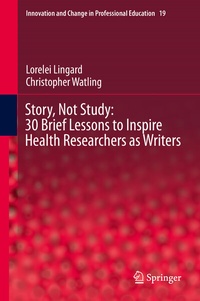
Story, Not Study: 30 Brief Lessons to Inspire Health Researchers as Writers
Description
More details
Other editions
Additional editions
Persons
>250 peer-reviewed scholarly works. In 2014, she was awarded the prestigious appointment of Fellow of the Canadian Academy of Health Sciences, in recognition of the impact of her work on Canadian healthcare. In 2017, she received the Meridith Marks Mentorship prize in recognition of exemplary mentorship in the Canadian medical education community. In 2018, Lorelei was awarded the highest international honor in her scientific field, the Karolinska Institutet Prize for Research in Medical Education.
Chris Watling is a neurologist and an accomplished medical education researcher and leader. He is the Director of the Centre for Education Research and Innovation at Western University's Schulich School of Medicine and Dentistry in London, Canada. Prior to taking on this role, he was Western's Associate Dean for Postgraduate Medical Education for nearly a decade, overseeing residency and fellowship traini^100 scholarly works, including empiric research, primers on methodology, perspective pieces, and commentaries.
Content
1. Introduction.- SECTION I: THE STORY.- 3. Mapping the Gap- 4. Citation Technique.- 5. Methods: Where Story Meets Study.- 6. Effective Use of Quotes in Qualitative Research.- 7. Writing a Discussion that Realizes its Potential.- 8. The Art of Limitations.- 9. Bonfire Red Titles.- 10. Making Every Word Count: Keys to a Strong Research Abstract.- SECTION II: THE CRAFT.- 11. Mastering the Sentence.- 12. Enlisting the Power of the Verb.- 13. The Power of Parallel Structure.- 14. Get Control of Your Commas.- 15. Avoiding Prepositional Pile-Up.- 16. Avoiding Clutter: Using Adjectives and Adverbs Wisely.- 17. From Semi-Conscious to Strategic Paragraphing.- 18. Coherence: Keeping the Reader on Track.- 19. The Three "S"s of Editing: Story, Structure, and Style.- 20. Pace, Pause & Silence: Creating Emphasis & Suspense in Your Writing.- 21. The Academic Hedge, Part I: Modal Tuning in Your Research Writing.- 22. The Academic Hedge II: Getting Politeness Right in Your Research Writing.- 23. From Silent to Audible Voice: Adjusting Register, Stance & Engagement in Your Writing.- SECTION III: THE COMMUNITY.- 24. Collaborative Writing: Strategies and Activities.- 25. Collaborative Writing: Roles, Authorship & Ethics.- 26. Giving Feedback on Others' Writing.- 27. Coaching Writing I: Being Thoughtful About the Process.- 28. Coaching Writing II: Relationship and Identity.- 29. Cultivating a Writing Community.- 30. Navigating the Peer Review Process Successfully.- Epilogue.