

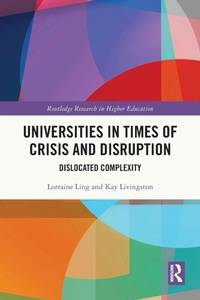
Universities in Times of Crisis and Disruption
Dislocated Complexity
1st Edition
Published on 30. January 2025
Book
Paperback/Softback
176 pages
978-1-032-11957-1 (ISBN)
Description
This book examines the role and future of universities in times of chronic disruption and crisis - presented via an original conceptual framework which the authors term 'Dislocated Complexity' - and discusses how to move forward in the face of severely disrupted social, political, economic and environment contexts.
Demonstrating how global crises, especially the COVID-19 pandemic, have dramatically dislocated and disrupted all contexts of society, the authors use this framework of Dislocated Complexity to propose a set of characteristics and values that underpin roles for universities, considering the future of universities with regards to teaching and learning, research, management and leadership, workforce change, policymaking and engagement. Novel, innovative concepts and theoretical perspectives are brought to the analysis of futures, roles and activities of universities by the authors, such as 'Unscripted Agency', 'Clashing -ologies', 'Emanant Trust' and 'Dislocated Complexity Leadership Theory'.
Ultimately calling for a rethink of university futures, this timely book will be of great interest to academics, researchers and post-graduate students in the fields of higher education research and teaching and learning. It will also be of interest to university managers, educational policy makers, and those who are 'hidden' or informal educators in the community.
Demonstrating how global crises, especially the COVID-19 pandemic, have dramatically dislocated and disrupted all contexts of society, the authors use this framework of Dislocated Complexity to propose a set of characteristics and values that underpin roles for universities, considering the future of universities with regards to teaching and learning, research, management and leadership, workforce change, policymaking and engagement. Novel, innovative concepts and theoretical perspectives are brought to the analysis of futures, roles and activities of universities by the authors, such as 'Unscripted Agency', 'Clashing -ologies', 'Emanant Trust' and 'Dislocated Complexity Leadership Theory'.
Ultimately calling for a rethink of university futures, this timely book will be of great interest to academics, researchers and post-graduate students in the fields of higher education research and teaching and learning. It will also be of interest to university managers, educational policy makers, and those who are 'hidden' or informal educators in the community.
Reviews / Votes
"The University in Dislocated Complexity is a tremendous book, working as it does on several levels and yet with a conversational and highly accessible and inviting style. It is chockfull of ideas and builds on innovative concepts (such as 'dislocated complexity' itself, 'unscripted agency', 'emanant trust'), it is full of telling examples, it will have wide resonance across the world, and it is motivated by a sense that universities can even develop their agency amid the maelstroms that they face. The complexity that universities face may be dislocated and, indeed, dislocating but it need not be dispiriting: there is much that can be done. It is a book for our times in higher education."- Ronald Barnett, Emeritus Professor of Higher Education, University College London, UK. "The University in Dislocated Complexity is a tremendous book, working as it does on several levels and yet with a conversational and highly accessible and inviting style. It is chockfull of ideas and builds on innovative concepts (such as 'dislocated complexity' itself, 'unscripted agency', 'emanant trust'), it is full of telling examples, it will have wide resonance across the world, and it is motivated by a sense that universities can even develop their agency amid the maelstroms that they face. The complexity that universities face may be dislocated and, indeed, dislocating but it need not be dispiriting: there is much that can be done. It is a book for our times in higher education."
- Ronald Barnett, Emeritus Professor of Higher Education, University College London, UK.
More details
Series
Language
English
Place of publication
London
United Kingdom
Publishing group
Taylor & Francis Ltd
Target group
College/higher education
Postgraduate
Illustrations
2 s/w Abbildungen, 2 s/w Photographien bzw. Rasterbilder
2 Halftones, black and white; 2 Illustrations, black and white
Dimensions
Height: 234 mm
Width: 156 mm
Thickness: 10 mm
Weight
292 gr
ISBN-13
978-1-032-11957-1 (9781032119571)
Copyright in bibliographic data and cover images is held by Nielsen Book Services Limited or by the publishers or by their respective licensors: all rights reserved.
Schweitzer Classification
Other editions
Additional editions
E-Book
10/2023
1st Edition
Routledge
€53.99
Available for download
E-Book
10/2023
1st Edition
Routledge
€53.99
Available for download
Book
10/2023
1st Edition
Routledge
€206.00
Shipment within 10-20 days
Persons
Lorraine Ling is Emeritus Professor at La Trobe University, Victoria, Australia and has worked as an education academic in universities for over 35 years during which time she has fulfilled a range of roles including lecturing, executive Dean of Education, Head of Campus and Associate Pro Vice-Chancellor. Her research interests include education policy, educational administration, sociology of education, values in education and research paradigms and methods. Lorraine has led international educational development projects and has authored and co-authored many journal articles and books. She had received numerous awards in recognition of her contribution to education and teacher education.
Kay Livingston is Professor of Educational Research, Policy and Practice at the School of Education, University of Glasgow, UK. She has worked as an education academic for over 30 years, holding a range of roles in universities including Co-ordinator of International Education, Director of an Education Research Centre, Reseach Impact Champion and undertaken a secondment to a government agency as Director of International Research and Innovation in an educational policy context. Her work has a strong international focus and she has knowledge and expertise in education systems across Europe. Her main research interests include teacher education, innovation in curriculum, assessment and pedagogy and digital literacies. Kay has lead many international research and development projects. She has authored and co-authored journal articles and books and was editor of the European Journal of Teacher Education for many years and was a co-editor of the Curriculum Journal.
Kay Livingston is Professor of Educational Research, Policy and Practice at the School of Education, University of Glasgow, UK. She has worked as an education academic for over 30 years, holding a range of roles in universities including Co-ordinator of International Education, Director of an Education Research Centre, Reseach Impact Champion and undertaken a secondment to a government agency as Director of International Research and Innovation in an educational policy context. Her work has a strong international focus and she has knowledge and expertise in education systems across Europe. Her main research interests include teacher education, innovation in curriculum, assessment and pedagogy and digital literacies. Kay has lead many international research and development projects. She has authored and co-authored journal articles and books and was editor of the European Journal of Teacher Education for many years and was a co-editor of the Curriculum Journal.
Content
1. Introduction: Inspiration for this Book 2. The Concept of Dislocated Complexity 3. The University in Dislocated Complexity 4. University Policymaking in Dislocated Complexity 5. University Leadership in Dislocated Complexity 6. Learning and Teaching in Universities in Dislocated Complexity 7. University Research in Dislocated Complexity 8. The University Workforce in Dislocated Complexity 9. University and the Community - A Mutual Affinity Paradigm 10. From the Neoliberal to the Agentic University 11. Reflections on Dislocated Complexity