

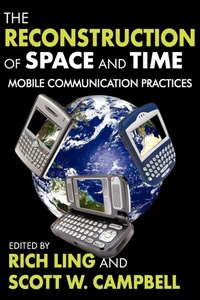
The Reconstruction of Space and Time
Mobile Communication Practices
1st Edition
Published on 30. January 2010
Book
Paperback/Softback
282 pages
978-1-4128-1108-8 (ISBN)
Description
One of the most significant and obvious examples of how mobile communication influences our understanding of time and space is how we coordinate with one another. Mobile communication enables us to call specific individuals, not general places. Regardless of location, we are able to make contact with almost anyone, almost anywhere. This advancement has changed, and continues to change, human interaction. Now, instead of agreeing on a particular time well beforehand, we can iteratively work out the most convenient time and place to meet at the last possible moment--on the way to the meeting or once we arrive at the destination.In their early days, mobile devices were primarily used for various types of emergency situations and for work. In some cases, the device was an essential element in various business operations or used so that overseas workers could communicate with their families. The distance between a remote posting and the people back home was suddenly and dramatically reduced. People began to share these devices not necessarily out of economic issues, but also questions of family and interpersonal dynamics.The process of sharing decisions as to who is a legitimate partner makes the nature of relationships more explicit. By examining the economy of sharing, we not only see how sharing mobile phones restructures social space, but are also given insight into an individual's web of interactions. This cutting-edge book deals with modern ways of thinking about communication and human interaction; it will illuminate the ways in which mobile communication alters our experience with space and time.
More details
Language
English
Place of publication
New York
United States
Publishing group
Taylor & Francis Inc
Target group
College/higher education
Professional and scholarly
Dimensions
Height: 229 mm
Width: 152 mm
Thickness: 15 mm
Weight
413 gr
ISBN-13
978-1-4128-1108-8 (9781412811088)
Copyright in bibliographic data and cover images is held by Nielsen Book Services Limited or by the publishers or by their respective licensors: all rights reserved.
Schweitzer Classification
Other editions
Additional editions
E-Book
07/2017
Routledge
€67.49
Available for download
E-Book
07/2017
Routledge
€67.49
Available for download
Book
01/2009
1st Edition
Routledge
€155.99
Article not available at the moment
Person
Rich Ling is a sociologist at Telenor's research institute near Oslo, Norway and has been Pohs Visiting Professor of Communication at the University of Michigan, Ann Arbor. He is the author of New Tech, New Ties: How Mobile Communication is Reshaping Social Cohesion and The Mobile Connection: The Cell Phone's Impact on Society. Scott W. Campbell is assistant professor and Pohs Fellow of Telecommunications in the Department of Communication Studies at the University of Michigan. His research has been published in the journals Communication Education, Communication Monographs, International Journal of Communication, Journal of Applied Communication Research, New Media & Society, and others.
Content
Introduction The Reconstruction of Space and Time through Mobile Communication Practices; 1: Tailing Untethered Mobile Users: Studying Urban Mobilities and Communication Practices; 2: Migrant Workers and Mobile Phones: Technological, Temporal, and Spatial Simultaneity; 3: Portable Objects in Three Global Cities: The Personalization of Urban Places; 4: New Reasons for Mobile Communication: Intensification of Time-Space Geography in the Mobile Era; 5: Nonverbal Cues in Mobile Phone Text Messages: The Effects of Chronemics and Proxemics; 6: Mobile Phones: Transforming the Everyday Social Communication Practice of Urban Youth; 7: Trust, Friendship, and Expertise: The Use of Email, Mobile Dialogues, and SMS to Develop and Sustain Social Relations in a Distributed Work Group; 8: Negotiations in Space: The Impact of Receiving Phone Calls on the Move; 9: Mobile Phone Work: Disengaging and Engaging Mobile Phone Activities with Concurrent Activities; 10: Beyond the Personal and Private: Modes of Mobile Phone Sharing in Urban India; Conclusion Mobile Communication in Space and Time Furthering the Theoretical Dialogue