

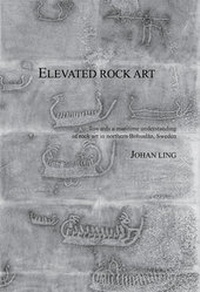
Elevated Rock Art
Published on 11. November 2014
Book
Hardback
272 pages
978-1-78297-762-9 (ISBN)
Description
How may Bohuslaen rock art and landscape be perceived and understood? Since the Bronze Age, the landscape has been transformed by shore displacement but, largely due to misunderstanding and certain ideas about the character of Bronze Age society, rock art research in Tanum has drawn much of its inspiration from the present agrarian landscape. This perception of the landscape has not been a major issue. This volume, republished from the GOTAC Serie B (Gothenburg Archaeological thesis 49) aims to shed light on the process of shore displacement and its social and cognitive implications for the interpretation of rock art in the prehistoric landscape. The findings clearly show that in the Bronze Age, the majority of rock art sites in Bohuslaen had a very close spatial connection to the sea.
Much rock art analysis focuses on the contemplative observer. The more direct activities related to rock art are seldom fully considered. Here, the basic conditions for the production of rock art, social theory and approaches to image, communication, symbolism and social action are discussed and related to palpable social forms of the "reading" of rock art. The general location and content of the Bronze Age remains indicate a tendency towards the maritime realm, which seems to have included both socio-ritual and socio-economic matters of production and consumption and that Bronze Age groups in Bohuslaen were highly active and mobile. The numerous configurations of ship images on the rocks could indicate a general transition or drift towards the maritime realm. Marking or manifesting such transitions in some way may have been important and it is tempting to perceive the rock art as traces of such transitions or positions in the landscape. All this points to a maritime understanding of Bronze Age rock art in northern Bohuslaen.
Much rock art analysis focuses on the contemplative observer. The more direct activities related to rock art are seldom fully considered. Here, the basic conditions for the production of rock art, social theory and approaches to image, communication, symbolism and social action are discussed and related to palpable social forms of the "reading" of rock art. The general location and content of the Bronze Age remains indicate a tendency towards the maritime realm, which seems to have included both socio-ritual and socio-economic matters of production and consumption and that Bronze Age groups in Bohuslaen were highly active and mobile. The numerous configurations of ship images on the rocks could indicate a general transition or drift towards the maritime realm. Marking or manifesting such transitions in some way may have been important and it is tempting to perceive the rock art as traces of such transitions or positions in the landscape. All this points to a maritime understanding of Bronze Age rock art in northern Bohuslaen.
Reviews / Votes
This is a well-produced and extensively illustratedvolume, although the quality of the maps varies. * Antiquity *
More details
Series
Language
English
Place of publication
Oxford
United Kingdom
Target group
Professional and scholarly
Illustrations
b/w and colour illustrations
Dimensions
Height: 297 mm
Width: 210 mm
ISBN-13
978-1-78297-762-9 (9781782977629)
Copyright in bibliographic data and cover images is held by Nielsen Book Services Limited or by the publishers or by their respective licensors: all rights reserved.
Schweitzer Classification
Other editions
Additional editions
Ling Johan Ling
Elevated Rock Art
Towards a Maritime Understanding of Bronze Age Rock Art in Northern Bohuslan, Sweden
E-Book
03/2015
Oxbow Books
€29.49
Available for download
Ling Johan Ling
Elevated Rock Art
Towards a maritime understanding of Bronze Age rock art in northern Bohuslän, Sweden
E-Book
11/2014
OXBOW BOOKS
€29.49
Available for download
Person
Johan Ling is a researcher and lecturer at the Department of Archaeology and Ancient History in Gothenburg. His research interests are primarily in rock art, its chronology and landscapes, particularly the relationship between rock art and shore displacement in Bronze Age Sweden; and in the use of lead isotope analyses on bronze items to investigate the possibility of copper extraction in Sweden at that time.