

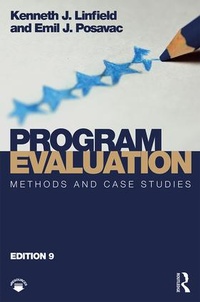
Program Evaluation
Methods and Case Studies
9th Edition
Published on 4. September 2018
Book
Hardback
352 pages
978-1-138-10396-2 (ISBN)
Description
This text provides a solid foundation in program evaluation, covering the main components of evaluating agencies and their programs, how best to address those components, and the procedures to follow when conducting evaluations. Different models and approaches are paired with practical techniques, such as how to plan an interview to collect qualitative data and how to use statistical analyses to report results. In every chapter, case studies provide real world examples of evaluations broken down into the main elements of program evaluation: the needs that led to the program, the implementation of program plans, the people connected to the program, unexpected side effects, the role of evaluators in improving programs, the results, and the factors behind the results. In addition, the story of one of the evaluators involved in each case study is presented to show the human side of evaluation. This new edition also offers enhanced and expanded case studies, making them a central organizing theme, and adds more international examples.
New online resources for this edition include a table of evaluation models, examples of program evaluation reports, sample handouts for presentations to stakeholders, links to YouTube videos and additional annotated resources. All resources are available for download under the tab eResources at www.routledge.com/9781138103962.
New online resources for this edition include a table of evaluation models, examples of program evaluation reports, sample handouts for presentations to stakeholders, links to YouTube videos and additional annotated resources. All resources are available for download under the tab eResources at www.routledge.com/9781138103962.
More details
Edition
9th edition
Language
English
Place of publication
London
United Kingdom
Publishing group
Taylor & Francis Ltd
Target group
College/higher education
Illustrations
26 s/w Abbildungen, 26 s/w Zeichnungen, 7 s/w Tabellen
7 Tables, black and white; 26 Line drawings, black and white; 26 Illustrations, black and white
Dimensions
Height: 229 mm
Width: 152 mm
Weight
640 gr
ISBN-13
978-1-138-10396-2 (9781138103962)
Copyright in bibliographic data and cover images is held by Nielsen Book Services Limited or by the publishers or by their respective licensors: all rights reserved.
Schweitzer Classification
Other editions
New editions
Book
01/2025
10th Edition
Routledge
€232.40
Shipment within 10-20 days
Previous edition

Book
07/2015
8th Edition
Pearson
€200.56
Article not available for order
Persons
Kenneth J. Linfield is Professor and Director of Graduate Training in the School of Professional Psychology at Spalding University in Louisville, KY, USA where he teaches the Program Evaluation course in the doctoral Clinical Psychology program.
Emil J. Posavac is Professor Emeritus of Psychology at Loyola University of Chicago, USA where he served as director of the Applied Social Psychology Graduate Program and chairman of the Psychology Department.
Emil J. Posavac is Professor Emeritus of Psychology at Loyola University of Chicago, USA where he served as director of the Applied Social Psychology Graduate Program and chairman of the Psychology Department.
Content
1. Program Evaluation: An Overview
2. Planning an Evaluation
3. Developing and Using a Theory of the Program
4. Developing Measures of Implementation and Outcomes
5. Ethics in Program Evaluation
6. The Assessment of Need
7. Monitoring the Implementation and the Operation of Programs
8. Qualitative Evaluation Methods
9. Outcome Evaluations with One Group
10. Quasi-Experimental Approaches to Outcome Evaluation
11. Using Experiments to Evaluate Programs
12. Analyses of Costs and Outcomes
13. Evaluation Reports: Interpreting and Communicating Findings
14. How to Encourage Utilization
2. Planning an Evaluation
3. Developing and Using a Theory of the Program
4. Developing Measures of Implementation and Outcomes
5. Ethics in Program Evaluation
6. The Assessment of Need
7. Monitoring the Implementation and the Operation of Programs
8. Qualitative Evaluation Methods
9. Outcome Evaluations with One Group
10. Quasi-Experimental Approaches to Outcome Evaluation
11. Using Experiments to Evaluate Programs
12. Analyses of Costs and Outcomes
13. Evaluation Reports: Interpreting and Communicating Findings
14. How to Encourage Utilization