

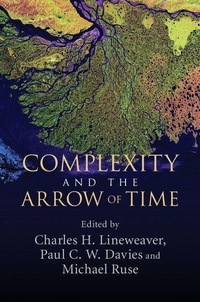
Complexity and the Arrow of Time
Published on 8. August 2013
Book
Hardback
368 pages
978-1-107-02725-1 (ISBN)
Description
There is a widespread assumption that the universe in general, and life in particular, is 'getting more complex with time'. This book brings together a wide range of experts in science, philosophy and theology and unveils their joint effort in exploring this idea. They confront essential problems behind the theory of complexity and the role of life within it: what is complexity? When does it increase, and why? Is the universe evolving towards states of ever greater complexity and diversity? If so, what is the source of this universal enrichment? This book addresses those difficult questions, and offers a unique cross-disciplinary perspective on some of the most profound issues at the heart of science and philosophy. Readers will gain insights in complexity that reach deep into key areas of physics, biology, complexity science, philosophy and religion.
Reviews / Votes
'The emergence of complex systems after the Big Bang, from a Universe that started out in a very simple state, is one of the great puzzles of science. This book provides the best single-volume insight into the nature of this puzzle, and hints at its possible resolution. It may be the answer to life, the Universe, and everything.' John Gribbin, University of Sussex 'In physics, chemistry and biology, the topic of complexity is, in a word, complicated. This collection is invaluable as an introduction to the many intractable open questions this subject raises, such as how best to define complexity, and how, why and if it increases.' Jeremy Butterfield, University of Cambridge '... fascinating lines of thought ...' Daniel McShea, Science 'This work is essential reading for researchers in almost every philosophy- or theory-based field. It exposes the universe as a 'quantum computer' from which meaning can be found only through intradisciplinary and interdisciplinary thinking ... Highly recommended.' J. A. van Reenen, ChoiceMore details
Language
English
Place of publication
Cambridge
United Kingdom
Illustrations
2 Halftones, unspecified; 12 Line drawings, unspecified
Dimensions
Height: 235 mm
Width: 157 mm
Thickness: 24 mm
Weight
686 gr
ISBN-13
978-1-107-02725-1 (9781107027251)
Copyright in bibliographic data and cover images is held by Nielsen Book Services Limited or by the publishers or by their respective licensors: all rights reserved.
Schweitzer Classification
Other editions
Additional editions
Charles H. Lineweaver
Complexity and the Arrow of Time
E-Book
08/2013
Cambridge University Press
€24.49
Available for download
Charles H. Lineweaver | Paul C. W. Davies | Michael Ruse
Complexity and the Arrow of Time
E-Book
07/2013
1st Edition
Cambridge University Press
€27.99
Available for download
Persons
Content
1. What is complexity? Is it increasing? Charles H. Lineweaver, Paul C. W. Davies and Michael Ruse; 2. Directionality principles from cancer to cosmology Paul C. W. Davies; 3. A simple treatment of complexity: cosmological entropic boundary conditions on increasing complexity Charles H. Lineweaver; 4. Using complexity science to search for unity in the natural sciences Eric J. Chaisson; 5. On the spontaneous generation of complexity in the universe Seth Lloyd; 6. Emergent spatiotemporal complexity in field theory Marcelo Gleiser; 7. Life: the final frontier for complexity? Simon Conway Morris; 8. Evolution beyond Newton, Darwin, and entailing law: the origin of complexity in the evolving biosphere Stuart A. Kauffman; 9. Emergent order in processes: the interplay of complexity, robustness, correlation, and hierarchy in the biosphere D. Eric Smith; 10. The inferential evolution of biological complexity: forgetting nature by learning to nurture David C. Krakauer; 11. Information width: a way for the second law to increase complexity David Wolpert; 12. Wrestling with biological complexity: from Darwin to Dawkins Michael Ruse; 13. The role of generative entrenchment and robustness in the evolution of complexity William C. Wimsatt; 14. On the plurality of complexity-producing mechanisms Philip Clayton; Index.