

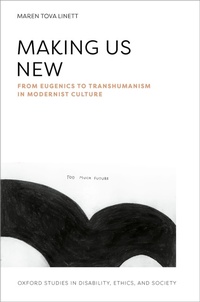
Making Us New
From Eugenics to Transhumanism in Modernist Culture
Will be published approx. on 30. September 2026
Book
Paperback/Softback
328 pages
978-0-19-784369-7 (ISBN)
Description
Making Us New argues not only that modernist writers were influenced by
eugenic and early transhumanist thinking, but that Anglo-American modernist
culture was saturated with ideas and shaped by debates about making humans new.
Maren Linett explores cultural expressions of, and interventions into, eugenic and
transhumanist thought by excavating and analyzing four key sets of debates between
and among eugenicists and transhumanists. The first set of debates relates to the body:
what sorts of bodies, and especially what sorts of sensory organs, should improved people
have? The second set surrounds reproduction: how might we produce new human beings
via reproduction? The third set concerns racial difference: in what ways will race be
transformed for future people? And the final set involves animality: how might
animality be either left behind by or useful for these improved people?
Linett carefully distinguishes between the two modes of human improvement and
their ethical and political implications, while viewing both eugenics and transhumanism
as simultaneously utopian and oppressive--oppressive not only because of their real-world
applications but because of their false assumptions about human worth. The study
foregrounds the fundamental aims of eugenic and transhumanist thought--to shape
and control human evolutionary futures--contending that eugenics and transhumanism
are part of the larger modernist quest to make it new.
eugenic and early transhumanist thinking, but that Anglo-American modernist
culture was saturated with ideas and shaped by debates about making humans new.
Maren Linett explores cultural expressions of, and interventions into, eugenic and
transhumanist thought by excavating and analyzing four key sets of debates between
and among eugenicists and transhumanists. The first set of debates relates to the body:
what sorts of bodies, and especially what sorts of sensory organs, should improved people
have? The second set surrounds reproduction: how might we produce new human beings
via reproduction? The third set concerns racial difference: in what ways will race be
transformed for future people? And the final set involves animality: how might
animality be either left behind by or useful for these improved people?
Linett carefully distinguishes between the two modes of human improvement and
their ethical and political implications, while viewing both eugenics and transhumanism
as simultaneously utopian and oppressive--oppressive not only because of their real-world
applications but because of their false assumptions about human worth. The study
foregrounds the fundamental aims of eugenic and transhumanist thought--to shape
and control human evolutionary futures--contending that eugenics and transhumanism
are part of the larger modernist quest to make it new.
More details
Series
Language
English
Place of publication
New York
United States
Product notice
Paperback (trade)
Unsewn / adhesive bound
Dimensions
Height: 235 mm
Width: 156 mm
ISBN-13
978-0-19-784369-7 (9780197843697)
Copyright in bibliographic data and cover images is held by Nielsen Book Services Limited or by the publishers or by their respective licensors: all rights reserved.
Schweitzer Classification
Other editions
Additional editions
Book
approx. 09/2026
Oxford University Press Inc
€100.50
Not yet published
Person
Maren Linett is a professor of English at Purdue University, the founder of Purdue's Disability Studies program, and the associate editor of Modern Fiction Studies. She is the author of three previous books-Literary Bioethics, Bodies of Modernism, and Modernism, Feminism, and Jewishness. She edited the Cambridge Companion to Modernist Women Writers and is co-editing the forthcoming Oxford Handbook of Disability and Literatures in English, 1900-Present.
Content
- Incoming