

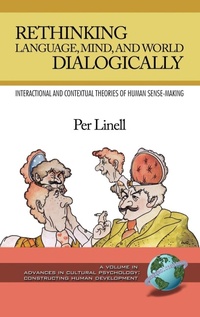
Rethinking Language, Mind, and World Dialogically
Will be published approx. on 24. April 2009
Book
Hardback
516 pages
978-1-59311-996-6 (ISBN)
Description
Rethinking Language, Mind, and World Dialogically written by Per Linell discusses Interactional and contextual theories of human sense - making.
Reviews / Votes
This is a remarkable and highly original work on dialogism, dialogical theories and dialogue. With his erudite and broadly based scholarship Per Linell makes a path-breaking contribution to the study of the human mind, presenting a novel alternative to traditional monologism and exploring the dynamics of sense-making in different forms of interaction and communicative projects. Although Per Linell discusses complex dialogical concepts, the text is written with exceptional clarity, taking the reader through critique as well as appreciation of great intellectual traditions of our time. (Professor Ivana Markova, University of Stirling, U.K.) ""Per Linell's Rethinking Language, Mind And World Dialogically represents a landmark in the development ofa transdisciplinary dialogically based paradigm for the human sciences. The author's lucid analysis and constructive rethinking ranges all the way from integrating explanations of significant empirical contributions across the entire range of human sciences dealing with language, thought and communication to foundational, epistemological and ontological issues."" (Professor Ragnar Rommetveit, University of Oslo, Norway)More details
Series
Language
English
Place of publication
Charlotte
United States
Publishing group
Emerald Publishing Inc
Target group
College/higher education
Professional and scholarly
Illustrations
Illustrations
Dimensions
Height: 240 mm
Width: 161 mm
Thickness: 32 mm
Weight
933 gr
ISBN-13
978-1-59311-996-6 (9781593119966)
Copyright in bibliographic data and cover images is held by Nielsen Book Services Limited or by the publishers or by their respective licensors: all rights reserved.
Schweitzer Classification
Other editions
Additional editions
E-Book
01/2009
1st Edition
Information Age Publishing
from
€62.33
Available for download
Person
Per Linell took his degree in linguistics and is currently professor of language and culture, with a specialisation on communication and spoken interaction, at the University of Linkoeping, Sweden. He has been instrumental in building up an internationally renowned interdisciplinary graduate school in communication studies in Linkoeping. He has worked for many years on developing a dialogical alternative to mainstream theories in linguistics, psychology and social sciences. His production comprises more than 100 articles on dialogue, talk-in-interaction and institutional discourse. His more recent books include Approaching Dialogue (1998), The Written Language Bias in Linguistics (2005) and Dialogue in Focus Groups (2007, with I. Markova, M. Grossen and A. Salazar Orvig).
Content
Series Editor's Introduction: Rethinking Dialogicality
Preface and Overview.
Part I. Into the World of Dialogical Concepts.
Chapter 1. Conceptual and Terminological Preliminaries: Dialogue, Dialogism, Dialogicality.
Chapter 2. Dialogism and Its Axiomatic Assumptions.
Chapter 3. Monologism.
Chapter 4. Situations and Situation-Transcending Practices.
Part II. Social Minds: Selves, Others and the Inter-world.
Chapter 5. Dialogue and the Other.
Chapter 6. The Dialogical Self.
Chapter 7. A Relational Interworld Beyond Individual Minds.
Part III. Sense-making: Interactions, Communicative Projects, Utterances and Texts.
Chapter 8. Monological and Dialogical Practices.
Chapter 9. Social Interaction and Power.
Chapter 10. Meaning and Understanding.
Chapter 11. Signs and Representations as Dialogical Entities.
Chapter 12. Dynamics and Potentialities of Sense-Making: Developmental Aspects.
Part IV. Languaging: Embodiment and Social Embedding.
Chapter 13. Rethinking Language in Dialogical Terms.
Chapter 14. Dialogue and Grammar: Methods for Constructing Utterances.
Chapter 15. Dialogue and Lexicology: Meaning Potentials of Lexical Resources.
Chapter 16. Dialogue and Artefacts.
Chapter 17. Dialogue and the Brain.
Part V. Dialogical Theories: Convergences and Divergences.
Chapter 18. Dialogism and the Scientific Enterprise.
Chapter 19. Monologism and Dialogism: Summary with Some Historical Flashbacks.
Chapter 20. Some Misinterpretations of Dialogism.
Chapter 21. Epilogue.
References.
Preface and Overview.
Part I. Into the World of Dialogical Concepts.
Chapter 1. Conceptual and Terminological Preliminaries: Dialogue, Dialogism, Dialogicality.
Chapter 2. Dialogism and Its Axiomatic Assumptions.
Chapter 3. Monologism.
Chapter 4. Situations and Situation-Transcending Practices.
Part II. Social Minds: Selves, Others and the Inter-world.
Chapter 5. Dialogue and the Other.
Chapter 6. The Dialogical Self.
Chapter 7. A Relational Interworld Beyond Individual Minds.
Part III. Sense-making: Interactions, Communicative Projects, Utterances and Texts.
Chapter 8. Monological and Dialogical Practices.
Chapter 9. Social Interaction and Power.
Chapter 10. Meaning and Understanding.
Chapter 11. Signs and Representations as Dialogical Entities.
Chapter 12. Dynamics and Potentialities of Sense-Making: Developmental Aspects.
Part IV. Languaging: Embodiment and Social Embedding.
Chapter 13. Rethinking Language in Dialogical Terms.
Chapter 14. Dialogue and Grammar: Methods for Constructing Utterances.
Chapter 15. Dialogue and Lexicology: Meaning Potentials of Lexical Resources.
Chapter 16. Dialogue and Artefacts.
Chapter 17. Dialogue and the Brain.
Part V. Dialogical Theories: Convergences and Divergences.
Chapter 18. Dialogism and the Scientific Enterprise.
Chapter 19. Monologism and Dialogism: Summary with Some Historical Flashbacks.
Chapter 20. Some Misinterpretations of Dialogism.
Chapter 21. Epilogue.
References.