

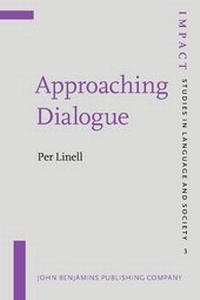
Approaching Dialogue
Talk, interaction and contexts in dialogical perspectives
Published on 15. December 1998
Book
Paperback/Softback
330 pages
978-90-272-1846-9 (ISBN)
Description
Approaching Dialogue has its primary focus on the theoretical understanding and empirical analysis of talk-in-interaction. It deals with conversation in general as well as talk within institutions against a backdrop of Conversation Analysis, context-based discourse analysis, social pragmatics, socio-cultural theory and interdisciplinary dialogue analysis.
People's communicative projects, and the structures and functions of talk-in-interaction, are analyzed from the most local sequences to the comprehensive communicative activity types and genres. A second aim of the book is to explore the possibilities and limitations of dialogism as a general epistemology for cognition and communication. On this point, it portrays the dialogical approach as a major alternative to the mainstream theories of cognition as individually-based information processing, communication as information transfer, and language as a code. Stressing aspects of interaction, joint construction and cultural embeddedness, and drawing upon extensive theoretical and empirical research carried out in different traditions, this book aims at an integrating synthesis. It is largely interdisciplinary in nature, and has been written in such a way that it can be used at advanced undergraduate courses in linguistics, sociopragmatics of language, communication studies, sociology, social psychology and cognitive science.
About the author: Per Linell holds a Ph.D. in linguistics and has been professor within the interdisciplinary graduate program of Communication Studies at the University of Linkoeping, Sweden, since 1981. He has published widely in the fields of discourse studies and social pragmatics of language.
People's communicative projects, and the structures and functions of talk-in-interaction, are analyzed from the most local sequences to the comprehensive communicative activity types and genres. A second aim of the book is to explore the possibilities and limitations of dialogism as a general epistemology for cognition and communication. On this point, it portrays the dialogical approach as a major alternative to the mainstream theories of cognition as individually-based information processing, communication as information transfer, and language as a code. Stressing aspects of interaction, joint construction and cultural embeddedness, and drawing upon extensive theoretical and empirical research carried out in different traditions, this book aims at an integrating synthesis. It is largely interdisciplinary in nature, and has been written in such a way that it can be used at advanced undergraduate courses in linguistics, sociopragmatics of language, communication studies, sociology, social psychology and cognitive science.
About the author: Per Linell holds a Ph.D. in linguistics and has been professor within the interdisciplinary graduate program of Communication Studies at the University of Linkoeping, Sweden, since 1981. He has published widely in the fields of discourse studies and social pragmatics of language.
More details
Series
Language
English
Place of publication
Amsterdam
Netherlands
Target group
College/higher education
Professional and scholarly
Dimensions
Height: 240 mm
Width: 160 mm
Weight
640 gr
ISBN-13
978-90-272-1846-9 (9789027218469)
Copyright in bibliographic data and cover images is held by Nielsen Book Services Limited or by the publishers or by their respective licensors: all rights reserved.
Schweitzer Classification
Person
Content
1. Preface; 2. Part I. Monologism and Dialogism Constracted; 3. Chapter 1. Perspectives on language and discourse; 4. Chapter 2. Monologism: Its basic assumptions; 5. Chapter 3. Dialogism: Some historical roots and present-day trends; 6. Chapter 4. Language strusture and linguistiv practices; 7. Part II. Interacting and making sense in contexts; 8. Chapter 5. The dynamics of dialogue; 9. Chapter 6. Speakers and listeners; 10. Chapter 7. Sense-making in discourse and the situated fixation of linguistic meanings; 11. Chapter 8. Contexts in discourse and discourse in context; 12. Chapter 9. Elementary contributors to discourse; 13. Chapter 10. Episodes and topics; 14. Chapter 11. Communitative projects; 15. Chapter 12. situation definitions, activity types and communicative genres; 16. Part III. Monologism and dialogism reconciled?; 17. Chapter 13. Diaologism: opportunities and limitations; 18. Chapter 14. Reconstructing monologism as a special case; 19. References; 20. Appendix: Transcription conventions; 21. Index