

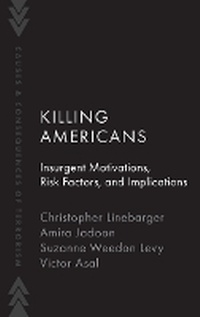
Killing Americans
Insurgent Motivations, Risk Factors, and Implications
Published on 2. February 2026
Book
Hardback
224 pages
978-0-19-769377-3 (ISBN)
Description
Why do some insurgent groups target American nationals? At first glance, it appears to be a risky strategy, inviting retaliation from the world's foremost military power. But a number of incentives make anti-American violence an attractive option for certain insurgent organizations.
Killing Americans explores the risk factors involved in insurgent groups' decisions to plan and conduct attacks on Americans. If, for example, American culture is prevalent in a given country, this tends to lessen the likelihood of attacks. On the other hand, extremist ideology and the deployment of American military forces in the area encourages them. And the consequences for an insurgent group that carries out violence against American citizens can be beneficial: they can raise their profile among sympathizers and gain credibility with would-be recruits. Drawing on quantitative analysis and case studies from around the world, this book shows that insurgents tend to become more lethal and more likely to survive after having made their first attacks on Americans. By considering American involvement abroad, organizational traits of insurgent groups, and potential consequences of attacks, Killing Americans provides a comprehensive account of variation in insurgent anti-American violence.
Killing Americans explores the risk factors involved in insurgent groups' decisions to plan and conduct attacks on Americans. If, for example, American culture is prevalent in a given country, this tends to lessen the likelihood of attacks. On the other hand, extremist ideology and the deployment of American military forces in the area encourages them. And the consequences for an insurgent group that carries out violence against American citizens can be beneficial: they can raise their profile among sympathizers and gain credibility with would-be recruits. Drawing on quantitative analysis and case studies from around the world, this book shows that insurgents tend to become more lethal and more likely to survive after having made their first attacks on Americans. By considering American involvement abroad, organizational traits of insurgent groups, and potential consequences of attacks, Killing Americans provides a comprehensive account of variation in insurgent anti-American violence.
More details
Series
Language
English
Place of publication
New York
United States
Target group
College/higher education
Product notice
sewn/stitched
Cloth over boards
Dimensions
Height: 234 mm
Width: 156 mm
Thickness: 16 mm
Weight
494 gr
ISBN-13
978-0-19-769377-3 (9780197693773)
Copyright in bibliographic data and cover images is held by Nielsen Book Services Limited or by the publishers or by their respective licensors: all rights reserved.
Schweitzer Classification
Other editions
Additional editions
Christopher Linebarger | Amira Jadoon | Suzanne Weedon Levy
Killing Americans
Insurgent Motivations, Risk Factors, and Implications
Book
approx. 04/2026
Oxford University Press Inc
€46.00
Not yet published
Persons
Christopher Linebarger is an Associate Professor at the University of Massachusetts Lowell. His research focuses on aspects of national and international security, specifically insurgency, terrorism, and civil conflict. He has published widely on the dynamics of insurgent organizations and counter-insurgency policy tools, including military intervention and border wall construction. He has published in numerous peer-reviewed journals, including International Studies Quarterly, Journal of Conflict Resolution, Studies in Conflict and Terrorism, and Journal of Peace Research, among others.
Amira Jadoon is an Associate Professor of Political Science at Clemson University, prior to which, she worked at the U.S. Military Academy at West Point, jointly appointed in the Department of Social Sciences and the Combating Terrorism Center (2017-2022). Her research explores the multifaceted consequences of international security tools and counterterrorism strategies, examining their
interlinkages with political violence, extremism, and the strategic dissemination of disinformation. Jadoon is also a nonresident fellow at the Stimson Center and an Associate Editor at the European Journal of International Security.
Suzanne Weedon Levy serves as the Director of Grants for a non-profit in New York's Capital Region. Prior to transitioning to the non-profit sector, she spent almost a decade as the Research Director of the Project on Violent Conflict (PVC) at the University at Albany, where she focused on the behavior of terrorist and insurgent non-state actors. Her previous work has centered on extremism in the United States and the relationships between proxy militias and state actors in the Middle East.
Victor Asal is Director of the Center for Policy Research and a Professor of Political Science at the University at Albany. His research focuses on nonstate actor violence and the causes of political discrimination, particularly related to ethnicity, sexuality and
gender. He also researches nuclear crisis behavior and pedagogy with a focus on interactive games. Asal has been involved in research projects funded by the Defense Advanced Research Projects Agency, Defense Threat Reduction Agency, The National Science Foundation, The Office of Naval Research, and the Department of Homeland Security.
Amira Jadoon is an Associate Professor of Political Science at Clemson University, prior to which, she worked at the U.S. Military Academy at West Point, jointly appointed in the Department of Social Sciences and the Combating Terrorism Center (2017-2022). Her research explores the multifaceted consequences of international security tools and counterterrorism strategies, examining their
interlinkages with political violence, extremism, and the strategic dissemination of disinformation. Jadoon is also a nonresident fellow at the Stimson Center and an Associate Editor at the European Journal of International Security.
Suzanne Weedon Levy serves as the Director of Grants for a non-profit in New York's Capital Region. Prior to transitioning to the non-profit sector, she spent almost a decade as the Research Director of the Project on Violent Conflict (PVC) at the University at Albany, where she focused on the behavior of terrorist and insurgent non-state actors. Her previous work has centered on extremism in the United States and the relationships between proxy militias and state actors in the Middle East.
Victor Asal is Director of the Center for Policy Research and a Professor of Political Science at the University at Albany. His research focuses on nonstate actor violence and the causes of political discrimination, particularly related to ethnicity, sexuality and
gender. He also researches nuclear crisis behavior and pedagogy with a focus on interactive games. Asal has been involved in research projects funded by the Defense Advanced Research Projects Agency, Defense Threat Reduction Agency, The National Science Foundation, The Office of Naval Research, and the Department of Homeland Security.
Author
Associate Professor, School of Criminology and Justice StudiesAssociate Professor, School of Criminology and Justice Studies, University of Massachusetts Lowell
Associate Professor, Department of Political ScienceAssociate Professor, Department of Political Science, Clemson University
Independent ScholarIndependent Scholar
Professor of Political ScienceProfessor of Political Science, Rockefeller College, University at Albany, State University of New York
Content
1: Introduction 2: Literature Review and Theoretical Framework 3: Insurgent Groups that Attack Americans in Their Home State: The Revolutionary Armed Forces of Colombia (FARC) and the Tehrik-E-Taliban Pakistan (TTP) 4: Insurgent Groups that Attack Americans Outside the Home State: Al-Shabaab and the Islamic Movement of Uzbekistan 5: Research Design 6: Risk Factors for Attacks on Americans 7: Insurgent Group Survival and Lethality 8: Conclusion Appendix