

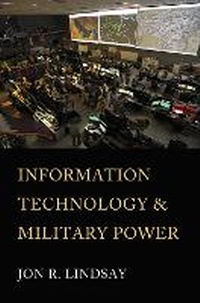
Information Technology and Military Power
Published on 15. July 2020
Book
Hardback
306 pages
978-1-5017-4956-8 (ISBN)
Description
Militaries with state-of-the-art information technology sometimes bog down in confusing conflicts. To understand why, it is important to understand the micro-foundations of military power in the information age, and this is exactly what Jon R. Lindsay's Information Technology and Military Power gives us. As Lindsay shows, digital systems now mediate almost every effort to gather, store, display, analyze, and communicate information in military organizations. He highlights how personnel now struggle with their own information systems as much as with the enemy.
Throughout this foray into networked technology in military operations, we see how information practice-the ways in which practitioners use technology in actual operations-shapes the effectiveness of military performance. The quality of information practice depends on the interaction between strategic problems and organizational solutions. Information Technology and Military Power explores information practice through a series of detailed historical cases and ethnographic studies of military organizations at war. Lindsay explains why the US military, despite all its technological advantages, has struggled for so long in unconventional conflicts against weaker adversaries. This same perspective suggests that the US retains important advantages against advanced competitors like China that are less prepared to cope with the complexity of information systems in wartime. Lindsay argues convincingly that a better understanding of how personnel actually use technology can inform the design of command and control, improve the net assessment of military power, and promote reforms to improve military performance. Warfighting problems and technical solutions keep on changing, but information practice is always stuck in between.
Throughout this foray into networked technology in military operations, we see how information practice-the ways in which practitioners use technology in actual operations-shapes the effectiveness of military performance. The quality of information practice depends on the interaction between strategic problems and organizational solutions. Information Technology and Military Power explores information practice through a series of detailed historical cases and ethnographic studies of military organizations at war. Lindsay explains why the US military, despite all its technological advantages, has struggled for so long in unconventional conflicts against weaker adversaries. This same perspective suggests that the US retains important advantages against advanced competitors like China that are less prepared to cope with the complexity of information systems in wartime. Lindsay argues convincingly that a better understanding of how personnel actually use technology can inform the design of command and control, improve the net assessment of military power, and promote reforms to improve military performance. Warfighting problems and technical solutions keep on changing, but information practice is always stuck in between.
Reviews / Votes
Practitioners on the application of military power would be wise to pick up a copy of this book. Its appeal, however, extends beyond. Those seeking to understand how information and technology have influenced recent military operations would gain from this work as well.(The Journal of Military History) This book will appeal to a wide audience. It is only a moderate exaggeration to say that if you are in the military and use a computer to do your work, you will find this book useful. Military personnel working in large command centers will find this book especially helpful.
(Strategic Studies Quarterly)
More details
Series
Language
English
Place of publication
Ithaca
United States
Product notice
Paper over boards
Illustrations
3 b&w halftones, 12 b&w line drawings, 2 charts - 3 Halftones, black and white - 12 Line drawings, black and white - 2 Charts
Dimensions
Height: 229 mm
Width: 152 mm
Thickness: 27 mm
Weight
1361 gr
ISBN-13
978-1-5017-4956-8 (9781501749568)
Copyright in bibliographic data and cover images is held by Nielsen Book Services Limited or by the publishers or by their respective licensors: all rights reserved.
Schweitzer Classification
Other editions
Additional editions
Jon R. Lindsay
Information Technology and Military Power
E-Book
07/2020
Cornell University Press
€33.49
Available for download
Person
Jon R. Lindsay is Assistant Professor of Digital Media and Global Affairs at the Munk School of Global Affairs and Public Policy and the Department of Political Science at the University of Toronto. He is the co-editor of Cross-Domain Deterrence and China and Cybersecurity. He has served in the US Navy with assignments in Europe, Latin America, and the Middle East. Follow him on X @jonrlindsay.
Content
Introduction: Shifting the Fog of War
1. The Technology Theory of Victory
2. A Framework for Understanding Information Practice
3. Strategic and Organizational Conditions for Success: The Battle of Britain
4. User Innovation and System Management: Aviation Mission Planning Software
5. Irregular Problems and Biased Solutions: Special Operations in Iraq
6. Increasing Complexity and Uneven Results: Drone Campaigns
7. Practical Implications of Information Practice
1. The Technology Theory of Victory
2. A Framework for Understanding Information Practice
3. Strategic and Organizational Conditions for Success: The Battle of Britain
4. User Innovation and System Management: Aviation Mission Planning Software
5. Irregular Problems and Biased Solutions: Special Operations in Iraq
6. Increasing Complexity and Uneven Results: Drone Campaigns
7. Practical Implications of Information Practice