

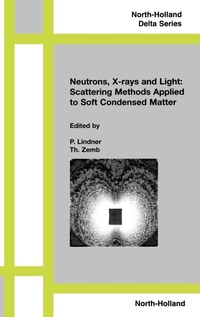
Neutrons, X-rays and Light: Scattering Methods Applied to Soft Condensed Matter
Published on 30. October 2002
Book
Hardback
552 pages
978-0-444-51122-5 (ISBN)
Description
Scattering experiments, using X-ray, light and neutron sources (in historical order) are key techniques for studying structure and dynamics in systems containing colliods, polymers, surfactants and biological macromolecules, summarized here as soft condensed matter. The education in this field in Europe is very heterogeneous and frequently inadequate, which severely limits an efficient use of these methods, especially at large-scale facilities. The series of "Bombannes" schools and the completely revised and updated second edition of the lecture notes are devoted to a practical approach to current methodology of static and dynamic techiques. Basic information on data interpretation, on the complementarity of the different types of radiation, as well as information on recent applications and developments is presented. The aim is to avoid over - as well as under-exploitation of data.
More details
Series
Language
English
Place of publication
United States
Publishing group
Elsevier Science & Technology
Target group
Professional and scholarly
Product notice
Laminated cover
Dimensions
Height: 241 mm
Width: 164 mm
Thickness: 36 mm
Weight
894 gr
ISBN-13
978-0-444-51122-5 (9780444511225)
Copyright in bibliographic data and cover images is held by Nielsen Book Services Limited or by the publishers or by their respective licensors: all rights reserved.
Schweitzer Classification
Other editions
New editions
Peter Lindner | Julian Oberdisse
Neutrons, X-rays, and Light
Scattering Methods Applied to Soft Condensed Matter
Book
12/2024
2nd Edition
Elsevier
€253.50
Shipment within 15-20 days
Additional editions

P. Lindner | Th. Zemb
Neutrons, X-rays and Light: Scattering Methods Applied to Soft Condensed Matter
Book
10/2002
Elsevier
€215.41
The article will not be published
Persons
Content
Part I. Using general principles
1. Introduction to scattering experiments (P.N. Pusey)
2. Scattering experiments: Experimental aspects, initial data reduction and absolute calibration (P. Lindner)
3. General theorems in small-angle scattering (O. Spalla)
4. The inverse scattering problem in small angle scattering (O. Glatter)
5. Fourier transformation and deconvolution (O. Glatter)
Part II. Methods
6. Instrumentation for small-angle x-ray and neutron scattering and instrumental smearing effects (J.S. Pedersen)
7. Contrast and contrast variaion in neutron, x-ray and light scatering (P. Schurtenberger)
8. Static light scattering of large systems (O. Glatter)
9. Dynamic light scattering (P.N. Pusey)
10.Inelastic neutron scattering: Dynamics of polymers (R. Zorn)
Part III. Revealing microstructures of soft condensed matter
11. Static properties of polymers (P. Schurtenberger)
12. Surfactant micelles and bilayers: Shapes and interactions (G. Porte)
13. Scattering by microemulsions (Th. Zemb)
14. Interacting colloidal suspensions (R. Klein)
15. Monte Carlo simulation techniques applied in the analysis of small-angle scattering data from colloids and polymer system (J.S. Pedersen)
16. Modelling of small-angle scattering data from colloids and polymer systems (J.S. Pedersen)
Part IV. Special Applications
17. Scattering experiments under external constraints: SANS and Shear flow (P. Lindner)
18. Using synchrotron radiation to study structure development in polymer processing (A.J.Ryan)
19. Biological applications of small-angle neutron scattering (R.P. May)
20. Light scattering in turbid suspensions, a tutorial (J. Ricka)
21. Use of scattering methods in chemical industr - SAXS an SANS from fibers and films (J. Rieger)
Subject Index
1. Introduction to scattering experiments (P.N. Pusey)
2. Scattering experiments: Experimental aspects, initial data reduction and absolute calibration (P. Lindner)
3. General theorems in small-angle scattering (O. Spalla)
4. The inverse scattering problem in small angle scattering (O. Glatter)
5. Fourier transformation and deconvolution (O. Glatter)
Part II. Methods
6. Instrumentation for small-angle x-ray and neutron scattering and instrumental smearing effects (J.S. Pedersen)
7. Contrast and contrast variaion in neutron, x-ray and light scatering (P. Schurtenberger)
8. Static light scattering of large systems (O. Glatter)
9. Dynamic light scattering (P.N. Pusey)
10.Inelastic neutron scattering: Dynamics of polymers (R. Zorn)
Part III. Revealing microstructures of soft condensed matter
11. Static properties of polymers (P. Schurtenberger)
12. Surfactant micelles and bilayers: Shapes and interactions (G. Porte)
13. Scattering by microemulsions (Th. Zemb)
14. Interacting colloidal suspensions (R. Klein)
15. Monte Carlo simulation techniques applied in the analysis of small-angle scattering data from colloids and polymer system (J.S. Pedersen)
16. Modelling of small-angle scattering data from colloids and polymer systems (J.S. Pedersen)
Part IV. Special Applications
17. Scattering experiments under external constraints: SANS and Shear flow (P. Lindner)
18. Using synchrotron radiation to study structure development in polymer processing (A.J.Ryan)
19. Biological applications of small-angle neutron scattering (R.P. May)
20. Light scattering in turbid suspensions, a tutorial (J. Ricka)
21. Use of scattering methods in chemical industr - SAXS an SANS from fibers and films (J. Rieger)
Subject Index