

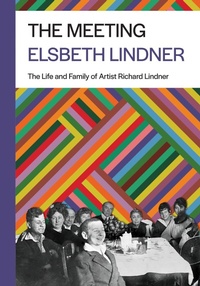
The Meeting
The Life and Family of Artist Richard Lindner
Will be published approx. on 19. January 2027
Book
Paperback/Softback
300 pages
978-1-954600-46-1 (ISBN)
Description
Documented through letters, reports and exhibition reviews, this beautifully-written, illustrated account of a family dispersed by war and shattered by the Holocaust foregrounds two brothers' lives rebuilt in the aftermath of horrific events, one who became a groundbreaking painter.
The diverging paths of two surviving brothers from a German Jewish family, Richard and Arthur Lindner, are traced by Arthur's daughter, who recounts her father's exile to an Australian internment camp and his family's eventual settlement in England alongside the story of Richard's life as an artist in Paris, later imprisoned in Nazi-occupied France. Securing release through art-world connections, Richard would emigrate to New York and go on to world-renown with his artwork collected by major museums around the United States and throughout Europe, including MoMA, the Smithsonian, the Guggenheim, Tate, Pompidou, and the National Gallery of American Art, and retrospectives at the Chicago Museum of Art and Hirshhorn in Washington DC.
Richard Lindner's influence on the development of the Pop Art movement in the 1960s cemented him as an artistic and cultural icon. Shaped by Cubism and Surrealism from his time in Paris, with a strong influence of German Expressionism, his use of bold color and provocative contemporary figures created a distinct visual language that captured the American zeitgeist. Although he would come to reject the association of his work with Pop Art artists like Andy Warhol and Roy Lichtenstein, his work, which often depicted ferocious and overtly-sexualized figures of 1930s German nightlife, was instead identified with the urban street scene of 1960s New York. For his niece, his icon status was cemented in 1967 when he was pictured on The Beatles' infamous album cover for Sgt. Pepper's Lonely Hearts Club Band.
Each brother's personal striving, relationships forged and fractured, assimilation (or its absence), and even a little humor animate the book. Elsbeth Lindner's investigation of her uncle's career and psyche, and the impact of the older generation's trauma leads to a clearer understanding of her own identity and affinity for her uncle.
The diverging paths of two surviving brothers from a German Jewish family, Richard and Arthur Lindner, are traced by Arthur's daughter, who recounts her father's exile to an Australian internment camp and his family's eventual settlement in England alongside the story of Richard's life as an artist in Paris, later imprisoned in Nazi-occupied France. Securing release through art-world connections, Richard would emigrate to New York and go on to world-renown with his artwork collected by major museums around the United States and throughout Europe, including MoMA, the Smithsonian, the Guggenheim, Tate, Pompidou, and the National Gallery of American Art, and retrospectives at the Chicago Museum of Art and Hirshhorn in Washington DC.
Richard Lindner's influence on the development of the Pop Art movement in the 1960s cemented him as an artistic and cultural icon. Shaped by Cubism and Surrealism from his time in Paris, with a strong influence of German Expressionism, his use of bold color and provocative contemporary figures created a distinct visual language that captured the American zeitgeist. Although he would come to reject the association of his work with Pop Art artists like Andy Warhol and Roy Lichtenstein, his work, which often depicted ferocious and overtly-sexualized figures of 1930s German nightlife, was instead identified with the urban street scene of 1960s New York. For his niece, his icon status was cemented in 1967 when he was pictured on The Beatles' infamous album cover for Sgt. Pepper's Lonely Hearts Club Band.
Each brother's personal striving, relationships forged and fractured, assimilation (or its absence), and even a little humor animate the book. Elsbeth Lindner's investigation of her uncle's career and psyche, and the impact of the older generation's trauma leads to a clearer understanding of her own identity and affinity for her uncle.
More details
Language
English
Place of publication
Los Angeles
United States
Product notice
Paperback (trade)
Illustrations
black and white images plus 16 pages of color plates
Dimensions
Height: 216 mm
Width: 152 mm
Thickness: 19 mm
ISBN-13
978-1-954600-46-1 (9781954600461)
Copyright in bibliographic data and cover images is held by Nielsen Book Services Limited or by the publishers or by their respective licensors: all rights reserved.
Schweitzer Classification
Persons
Elsbeth Lindner has had a distinguished career in British publishing, notably with Methuen, Weidenfeld & Nicolson and The Women's Press. She was a member of the Orange Prize management committee, editor of newbooks magazine and a 2021 Kirkus Prize for Fiction judge. Elsbeth Lindner presented on BBC Radio 4 National Arts Show and was selected as a featured speaker at Jewish Book Week, organized by the Jewish Book Council in London. She now lives in the United States.
Judith Zilczer, Curator Emerita of the Hirshhorn Museum and Sculpture Garden, has organized more than two dozen exhibitions and published widely on modern and contemporary art. Her essays have appeared in Art Bulletin, American Art, Art Journal, Archives of American Art Journal, artibus et historiae, and The Oxford Art Journal. She is the recipient of the Award for Best Exhibition of Time-Based Art, International Association of Art Critics (2005) and the George Wittenborn Memorial Book Award of the Art Libraries Society of North America (2006). She is the author of The Noble Buyer: John Quinn Patron of the Avant-Garde (Smithsonian Institution Press, 1978), Richard Lindner: Paintings and Watercolors, 1948-1977 (Prestel, 1996), Visual Music: Synaesthesia in Art and Music Since 1900 (Thames and Hudson, 2005), and A Way of Living: The Art of Willem de Kooning (Phaidon, 2014, 2nd ed. 2017, 3rd ed. 2023). She serves on the editorial board of The Woman's Art Journal.
Judith Zilczer, Curator Emerita of the Hirshhorn Museum and Sculpture Garden, has organized more than two dozen exhibitions and published widely on modern and contemporary art. Her essays have appeared in Art Bulletin, American Art, Art Journal, Archives of American Art Journal, artibus et historiae, and The Oxford Art Journal. She is the recipient of the Award for Best Exhibition of Time-Based Art, International Association of Art Critics (2005) and the George Wittenborn Memorial Book Award of the Art Libraries Society of North America (2006). She is the author of The Noble Buyer: John Quinn Patron of the Avant-Garde (Smithsonian Institution Press, 1978), Richard Lindner: Paintings and Watercolors, 1948-1977 (Prestel, 1996), Visual Music: Synaesthesia in Art and Music Since 1900 (Thames and Hudson, 2005), and A Way of Living: The Art of Willem de Kooning (Phaidon, 2014, 2nd ed. 2017, 3rd ed. 2023). She serves on the editorial board of The Woman's Art Journal.
Content
1 · The Meeting
2 · Germany 1901–33
3 · France 1933–41
4 · Uprooted
5 · Elsbeth
6 · Arrival – 1940
7 · Evelyn and the Letters
8 · The 1950s
9 · The 1960s
10 · The 1970s
11 · Afterwards
Notes
Bibliography
Acknowledgements
Plates