

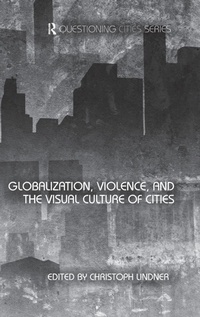
Globalization, Violence and the Visual Culture of Cities
1st Edition
Published on 29. July 2009
Book
Hardback
208 pages
978-0-415-48214-1 (ISBN)
Description
What connects garbage dumps in New York, bomb sites in Baghdad, and skyscrapers in Sao Paulo? How is contemporary visual culture - extending from art and architecture to film and digital media - responding to new forms of violence associated with global and globalizing cities? Addressing such questions, this book is the first interdisciplinary volume to examine the complex relationship between globalization, violence, and the visual culture of cities.
Violence - in both material and cultural forms - has been a prominent and endemic feature of urban life in the global metropolitan era. Focusing on visual culture and offering a strong humanities perspective that is currently lacking in existing scholarship, this book seeks to understand how the violent effects of globalization have been represented, theorized, and experienced across a wide range of cultural contexts and urban locations in Asia, Europe, North and South America, and the Middle East. Organized around three interrelated themes - fear, memory, and spectacle - essay topics range from military targeting in Baghdad, carceral urbanism in Sao Paulo, and the Paris banlieue riots, to the security aesthetics of G8 summits, the architecture of urban paranoia, and the cultural afterlife of the Twin Towers.
Globalization, Violence, and the Visual Culture of Cities offers fresh insight into the problems and potential of cities around the world, including Beijing, Berlin, London, New York, Paris, and Sao Paulo. With specially-commissioned essays from the fields of cultural theory, architecture, film, photography, and urban geography, this innovative volume will be a valuable resource for students, scholars, and researchers across the humanities and social sciences.
Violence - in both material and cultural forms - has been a prominent and endemic feature of urban life in the global metropolitan era. Focusing on visual culture and offering a strong humanities perspective that is currently lacking in existing scholarship, this book seeks to understand how the violent effects of globalization have been represented, theorized, and experienced across a wide range of cultural contexts and urban locations in Asia, Europe, North and South America, and the Middle East. Organized around three interrelated themes - fear, memory, and spectacle - essay topics range from military targeting in Baghdad, carceral urbanism in Sao Paulo, and the Paris banlieue riots, to the security aesthetics of G8 summits, the architecture of urban paranoia, and the cultural afterlife of the Twin Towers.
Globalization, Violence, and the Visual Culture of Cities offers fresh insight into the problems and potential of cities around the world, including Beijing, Berlin, London, New York, Paris, and Sao Paulo. With specially-commissioned essays from the fields of cultural theory, architecture, film, photography, and urban geography, this innovative volume will be a valuable resource for students, scholars, and researchers across the humanities and social sciences.
Reviews / Votes
"A timely and insightful exploration into one of the most important intersections today between cities, architecture and global culture. Stimulating and provocative." Prof Iain Borden, University of Central London, United KingdomUrban culture has always been marked by fear and enthrallment, mutability and meaning, rich and poor, but the specificity of these relations is ever changing. These wonderfully diverse and interdisciplinary essays, focusing especially on the visual culture of contemporary global cities, usefully present and take stock of these old themes in the garb of our time. Dr Thomas Bender, New York University, USA
More details
Series
Language
English
Place of publication
London
United Kingdom
Publishing group
Taylor & Francis Ltd
Target group
College/higher education
Product notice
Paper over boards
Illustrations
60 s/w Abbildungen, 60 s/w Photographien bzw. Rasterbilder
60 Halftones, black and white; 60 Illustrations, black and white
Dimensions
Height: 240 mm
Width: 161 mm
Thickness: 16 mm
Weight
482 gr
ISBN-13
978-0-415-48214-1 (9780415482141)
Copyright in bibliographic data and cover images is held by Nielsen Book Services Limited or by the publishers or by their respective licensors: all rights reserved.
Schweitzer Classification
Other editions
Additional editions
Christoph Lindner
Globalization, Violence and the Visual Culture of Cities
Book
03/2016
1st Edition
Routledge
€71.10
Shipment within 10-20 days
Christoph Lindner
Globalization, Violence and the Visual Culture of Cities
E-Book
09/2009
1st Edition
Routledge
€64.49
Available for download
Christoph Lindner
Globalization, Violence and the Visual Culture of Cities
E-Book
09/2009
Routledge
€64.49
Available for download
Person
Christoph Lindner is Professor and Chair of English Literature at the University of Amsterdam and Research Affiliate at the University of London Institute in Paris. His recent book publications include Revisioning 007 (2009), Urban Space and Cityscapes (2006), and Fictions of Commodity Culture (2003).
Content
Foreword (Nezar AlSayyad) 1. Globalization and Violence (Christoph Lindner) PART 1 - Fear 2. Architecture and Economies of Violence: Sao Paulo as Case Study (Richard J. Williams) 3. Drugs and Assassins in the City of Flows (Geoffrey Kantaris) 4. Temporary Discomfort: Jules Spinatsch's Documentation of Global Summits (Hugh Campbell) 5. American Military Imaginaries and Iraqi Cities: The Visual Economies of Globalizing War (Derek Gregory) PART 2 - Memory 6. Globalization and the Remembrance of Violence: Visual Culture, Space, and Time in Berlin (Simon Ward) 7. Trash Aesthetics: New York, Globalization, and Garbage (Lindner) 8. Global Beijing: 'The World' is a Violent Place (Stephanie Hemelryk Donald) PART 3 - Spectacle 9. The Poetics of Scale in Urban Photography (Shirley Jordan) 10. Globalization and Cultural Capital: Symbolic Violence in Recent Filmic Images of Paris (Ruth Cruickshank) 11. Conspiracy, Surveillance, and the Spatial Turn in the Bourne Trilogy (Sue Harris)