

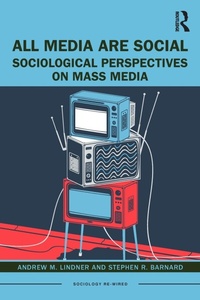
All Media Are Social
Sociological Perspectives on Mass Media
1st Edition
Published on 8. April 2020
Book
Paperback/Softback
194 pages
978-0-415-74954-1 (ISBN)
Description
From TV to smartphone apps to movies to newspapers, mass media are nearly omnipresent in contemporary life and act as a powerful social institution. In this introduction to media sociology, Lindner and Barnard encourage readers to think critically about the power of big media companies, state-media relations, new developments in journalism, representations of race, class, gender, and sexuality in media, and what social media may or may not be doing to our brains, among other topics. Each chapter explores pressing questions about media by carefully excavating the results of classic and contemporary social scientific studies. The authors bring these findings to life with anecdotes and examples ripped from headlines and social media newsfeeds. By synthesizing research on new media and traditional media, entertainment media and news, quantitative and qualitative studies, All Media Are Social offers a succinct and accessibly-written analysis of both enduring patterns and some of the newest developments in mass media. With strong emphases on theory and methods, Lindner and Barnard provide students and general readers alike with the tools to better understand the ever-changing media landscape.
Reviews / Votes
"We are long overdue for a sociological take on how mass media gets produced and consumed in the current digital age. All Media Are Social engages readers with compelling statistics and fascinating stories to highlight how power, culture, and technology shape media. I especially recommend the book's overview of how traditional media represents race, class, gender and sexuality alongside citizen-generated forms of media resistance and activism."-Nancy Wang Yuen, Associate Professor of Sociology, Biola University
"It's been years since anyone has written a theoretically sophisticated text in the sociology of media. Bravo to Lindner and Barnard for filling the void. I particularly appreciated their discussions of news."
-Gaye Tuchman, Professor Emerita of Sociology, University of Connecticut
More details
Series
Language
English
Place of publication
London
United Kingdom
Publishing group
Taylor & Francis Ltd
Target group
College/higher education
Product notice
Paperback (trade)
Unsewn / adhesive bound
Illustrations
25 s/w Abbildungen, 8 s/w Photographien bzw. Rasterbilder, 17 s/w Zeichnungen, 1 s/w Tabelle
1 Tables, black and white; 17 Line drawings, black and white; 8 Halftones, black and white; 25 Illustrations, black and white
Dimensions
Height: 229 mm
Width: 152 mm
Thickness: 11 mm
Weight
309 gr
ISBN-13
978-0-415-74954-1 (9780415749541)
Copyright in bibliographic data and cover images is held by Nielsen Book Services Limited or by the publishers or by their respective licensors: all rights reserved.
Schweitzer Classification
Other editions
New editions
Book
05/2026
2nd Edition
Routledge
€50.00
Shipment within 10-20 days
Additional editions
Book
04/2020
1st Edition
Routledge
€193.50
Article exhausted; check for reprint
Persons
Andrew M. Lindner is Associate Professor of Sociology at Skidmore College in Saratoga Springs, NY. He studies the intersection of culture, mass media, and politics. His research has appeared in publications including New Media & Society, Social Problems, and Information, Communication, & Society.
Stephen R. Barnard is Associate Professor at St. Lawrence University in Canton, NY. His research and teaching focus on the role media and communication technologies play in relations of power, practice, and democracy. He is author of Citizens at the Gates: Twitter, Networked Publics, and the Transformation of American Journalism.
Stephen R. Barnard is Associate Professor at St. Lawrence University in Canton, NY. His research and teaching focus on the role media and communication technologies play in relations of power, practice, and democracy. He is author of Citizens at the Gates: Twitter, Networked Publics, and the Transformation of American Journalism.
Content
Illustrations, Acknowledgements, 1 All Media Are Social, 2 Theorizing the Media, 3 Who Pays for It?, 4 In the Hands of a Few, 5 Big Brother Knows You're Watching, 6 The Makers and the Breakers, 7 Fear and Loathing on Cable News, 8 Doing Gender and Sexuality in Media, 9 Unequal Images in an Unequal Age, 10 Are We Robots?, 11 Or Are We Rebels?, Recommended Resources for All Media Are Social, Index