

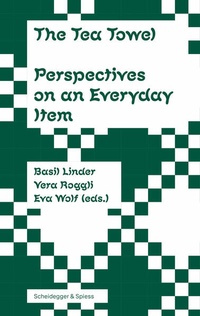
The Tea Towel
Description
The dishwasher has robbed the good old kitchen towel of some of its practical significance. Nevertheless, it remains present in many households, hand-woven or industrially produced, lint-free or absorbent, dirty or clean, inherited or replaceable. In some kitchens, special attention is also required, as there is one for the hands and one for the dishes.
For a long time, specially made kitchen towels were a luxury and reserved for the upper classes. Industrial mass production has changed this, and today two developments can be observed: while kitchen towels are displayed as design objects in museum stores and craft stores, they are also standardized cheap goods.
In The Tea Towel: Perspectives on an Everyday Item, 13 authors, artists, and designers enter into a dialogue with the object and examine it from a literary, journalistic, artistic, technical, and sociopolitical perspective. The contributions of very different tones complement each other and create new references. In text and images, the book encourages a rediscovery of the everyday kitchen towel as a sensual object with which many socially relevant topics are associated.
Reviews / Votes
"A great gift for kitchen intellectuals and anyone who secretly still thinks dishwashers are too modern." Süddeutsche Zeitung
"This quirky and endearing collection of essays spotlights that most hard-working of textiles - the tea towel, revealing its surprising potency as medium at once poetic, personal - and political." Aimee Farrell
The year's best interiors book. Financial Times House & Home
More details
Persons
Vera Roggli is a textile designer living and working between Italy, Switzerland, and Belgium.
Eva Wolf is a graphic designer and illustrator; Basil Linder is a graphic and typeface designer. They jointly run the Bern-based design firm Studio Eva Basil.