

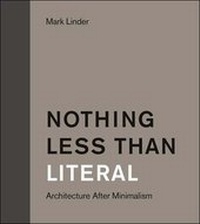
Nothing Less Than Literal
Architecture After Minimalism
Published on 4. February 2005
Book
Hardback
294 pages
978-0-262-12266-5 (ISBN)
Description
In Nothing Less than Literal, Mark Linder shows how minimalist art of the 1960s was
infiltrated by architecture, resulting in a reconfiguration of the disciplines of both art and
architecture. Linder traces the exchange of concepts and techniques between architecture and art
through a reading of the work of critics Clement Greenberg, Colin Rowe, Michael Fried, and the
artist-writer Robert Smithson, and then locates a recuperation of "the architecture of minimalism"
in the contemporary work of John Hejduk and Frank Gehry."Literal" was not only a term used by Fried
to attack minimalism; it was a key term for Greenberg as well, and in both cases their use of that
term coincides with discussions of the architectural qualities of art. Linder gives us the first
thorough examination of the role that architectural concepts, techniques of representation, and
practices played in the emergence of minimalism. Beginning with a comparison of the "postcubist"
writings of Clement Greenberg and Colin Rowe, he reveals surprising affinities in their critical
formulations of pictorialism -- including the use by both of an analogy between cubist collage and
architectural space. This is followed by an account of the sharp differences between Michael Fried
and Robert Smithson; Linder contrasts the sublimation of space and refusal of architecture in
Fried's concept of the "radically abstract" with Smithson's explicit embrace of architectural
thinking and his complex concepts of space. Finally, Linder looks at particular instances in the
work of two architects who, through collaboration with artists, engaged the legacy of literalism --
John Hejduk's Wall House and Frank Gehry's decade-long fascination with the figure of the fish.
Linder shows how the "productive impropriety" of transdisciplinary borrowing in the discourses
surrounding minimalism serves as a counterexample to the prevalent perception of "disciplines" as
conservative and institutionalizing.
infiltrated by architecture, resulting in a reconfiguration of the disciplines of both art and
architecture. Linder traces the exchange of concepts and techniques between architecture and art
through a reading of the work of critics Clement Greenberg, Colin Rowe, Michael Fried, and the
artist-writer Robert Smithson, and then locates a recuperation of "the architecture of minimalism"
in the contemporary work of John Hejduk and Frank Gehry."Literal" was not only a term used by Fried
to attack minimalism; it was a key term for Greenberg as well, and in both cases their use of that
term coincides with discussions of the architectural qualities of art. Linder gives us the first
thorough examination of the role that architectural concepts, techniques of representation, and
practices played in the emergence of minimalism. Beginning with a comparison of the "postcubist"
writings of Clement Greenberg and Colin Rowe, he reveals surprising affinities in their critical
formulations of pictorialism -- including the use by both of an analogy between cubist collage and
architectural space. This is followed by an account of the sharp differences between Michael Fried
and Robert Smithson; Linder contrasts the sublimation of space and refusal of architecture in
Fried's concept of the "radically abstract" with Smithson's explicit embrace of architectural
thinking and his complex concepts of space. Finally, Linder looks at particular instances in the
work of two architects who, through collaboration with artists, engaged the legacy of literalism --
John Hejduk's Wall House and Frank Gehry's decade-long fascination with the figure of the fish.
Linder shows how the "productive impropriety" of transdisciplinary borrowing in the discourses
surrounding minimalism serves as a counterexample to the prevalent perception of "disciplines" as
conservative and institutionalizing.
More details
Language
English
Place of publication
Cambridge, Mass.
United States
Publishing group
MIT Press Ltd
Target group
Professional and scholarly
Interest Age: From 18 years
Illustrations
137 s/w Abbildungen
137 b&w illus.
Dimensions
Height: 229 mm
Width: 203 mm
Thickness: 0 mm
Weight
454 gr
ISBN-13
978-0-262-12266-5 (9780262122665)
Copyright in bibliographic data and cover images is held by Nielsen Book Services Limited or by the publishers or by their respective licensors: all rights reserved.
Schweitzer Classification