

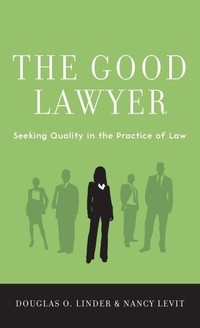
The Good Lawyer
Seeking Quality in the Practice of Law
Published on 26. June 2014
Book
Hardback
356 pages
978-0-19-936023-9 (ISBN)
Description
Every lawyer wants to be a good lawyer. They want to do right by their clients, contribute to the professional community, become good colleagues, interact effectively with people of all persuasions, and choose the right cases. All of these skills and behaviors are important, but they spring from hard-to-identify foundational qualities necessary for good lawyering. After focusing for three years on getting high grades and sharpening analytical skills, far too many lawyers leave law school without a real sense of what it takes to be a good lawyer.
In The Good Lawyer, a follow up to their book The Happy Lawyer, law professors Douglas O. Linder and Nancy Levit combine evidence from the latest social science research with numerous engaging accounts of able attorneys at work to explain just what makes a good lawyer. They organize the book around the qualities they see as crucial: courage, empathy, integrity, realism, a strong sense of justice, clarity of purpose, and an ability to transcend emotionalism. But as the authors point out, each one must be apportioned in the right measure, and achieving the right balance is difficult. Lawyers need to know when to empathize and also when to detach; courage without an appreciation of consequences becomes recklessness. And what do you do in tricky situations, where the urge to deceive is high? How can you maintain focus through a mind-taxing (or mind-numbing) project? Every lawyer faces these problems at some point -- they're inherent in the nature of the work-but if properly recognized and approached, they can be overcome.
It's not easy being good -- quality is less something one grasps and hangs onto than a goal that requires constant striving and attention -- but this engaging guide will serve as a handbook for any lawyer trying not only to figure out how to respond to difficult situations, but how to become a better -- meaning both more competent and more virtuous -- lawyer.
In The Good Lawyer, a follow up to their book The Happy Lawyer, law professors Douglas O. Linder and Nancy Levit combine evidence from the latest social science research with numerous engaging accounts of able attorneys at work to explain just what makes a good lawyer. They organize the book around the qualities they see as crucial: courage, empathy, integrity, realism, a strong sense of justice, clarity of purpose, and an ability to transcend emotionalism. But as the authors point out, each one must be apportioned in the right measure, and achieving the right balance is difficult. Lawyers need to know when to empathize and also when to detach; courage without an appreciation of consequences becomes recklessness. And what do you do in tricky situations, where the urge to deceive is high? How can you maintain focus through a mind-taxing (or mind-numbing) project? Every lawyer faces these problems at some point -- they're inherent in the nature of the work-but if properly recognized and approached, they can be overcome.
It's not easy being good -- quality is less something one grasps and hangs onto than a goal that requires constant striving and attention -- but this engaging guide will serve as a handbook for any lawyer trying not only to figure out how to respond to difficult situations, but how to become a better -- meaning both more competent and more virtuous -- lawyer.
Reviews / Votes
"A pleasingly eclectic approach... brisk and lively reading." --Wall Street Journal"A joy to read... the book is rich in advice and inspiration.... there is so much of value in the book to counsel law students and lawyers as they seek to develop, and maintain, self-respect. That means, then, that the book can serve as an empathetic guide throughout our legal careers, reminding us to ground our professionalism in our definition of success. Ultimately, the book reflects the beliefs of its authors that good lawyers are real people with actual
clients and careers that matter--and that we can each become a good lawyer." --Naomi Cahn, Concurring Opinions
"Full of engaging stories and well-chosen historical examples, The Good Lawyer paints a remarkable portrait of the values, visions, and virtues that lawyers should aspire to, in good times and bad. At a time of upheaval in the legal profession, this book is most welcome." --Jack Balkin, Knight Professor of Constitutional Law and the First Amendment, Yale Law School
"Good lawyers are not fictional and they are not cliches. They are real people, with actual clients, meaningful law practices, and satisfying careers. The ideal may be hard to realize, but it is far from impossible. Douglas Linder and Nancy Levit have now provided us with an outstanding guide to achieving a rewarding life as a good lawyer. Every attorney, or aspiring attorney, should read this book." --Steven Lubet, Williams Memorial Professor of Law
and Director, Bartlit Center for Trial Strategy, Northwestern University School of Law
"The very best lawyers, including those who fill the pages of our history books and those who quietly but effectively serve their clients every day, built their practices on much more than intellectual superiority and mastery of the law. Douglas O. Linder and Nancy Levit thoughtfully explore key characteristics that good lawyers share and, in the process, remind us why we became lawyers in the first place -- and why that matters now more than ever. The Good
Lawyer is a must-read for law students and prospective law students, new lawyers, and seasoned professionals." --Karen J. Mathis, Associate Executive Director of IAALS, the Institute for the Advancement
of the American Legal System, and Past President of the American Bar Association (2006-07)
More details
Language
English
Place of publication
New York
United States
Target group
Professional and scholarly
Dimensions
Height: 222 mm
Width: 145 mm
Thickness: 23 mm
Weight
579 gr
ISBN-13
978-0-19-936023-9 (9780199360239)
Copyright in bibliographic data and cover images is held by Nielsen Book Services Limited or by the publishers or by their respective licensors: all rights reserved.
Schweitzer Classification
Other editions
Additional editions
E-Book
05/2014
1st Edition
OUP eBook
€9.99
Available for download
E-Book
05/2014
1st Edition
OUP eBook
€9.99
Available for download
Persons
Douglas O. Linder is the Elmer N. Powell Peer Professor of Law at the University of Missouri, Kansas City and the co-author of The Happy Lawyer.
Nancy Levit, the Curators' and Edward D. Ellison Professor of Law at the University of Missouri, Kansas City, is the co-author of The Happy Lawyer and the author of The Gender Line: Men, Women, and the Law.
Nancy Levit, the Curators' and Edward D. Ellison Professor of Law at the University of Missouri, Kansas City, is the co-author of The Happy Lawyer and the author of The Gender Line: Men, Women, and the Law.
Content
PREFACE ; The Wolf at Lost Lake ; Obsessed with Quality ; INTRODUCTORY NOTE ; Chapter 1: THE GOOD LAWYER IS EMPATHETIC ; Feeling Clients' Pain on Thunderhead Ranch ; The Importance of Being Empathetic ; Using Empathy to Tell Better Stories ; The Origins and Science of Empathy ; Can Lawyers Learn to Be More Empathetic? ; The Challenge of Developing Empathy in Law Schools ; Is More Empathy Always Better? ; The Empathy Debate ; Do We Want Judges to Be Empathetic? ; Empathy and Moral Action ; Chapter 2: THE GOOD LAWYER IS COURAGEOUS ; A Profile in Courage ; Physical Courage ; Moral Courage ; Psychological Courage ; Can We Learn Courage? ; Courage in Law Schools ; Codes and Courage: Two Stories ; Courage and Justice ; Chapter 3: THE GOOD LAWYER PURSUES JUSTICE WITH INTEGRITY ; A Framed Corduroy Jacket ; Seeking Justice for People ; Chattanooga Revisited: One Lawyer's Sense of Justice ; Is the Pursuit of Justice Nothing More Than Helping Your Clients? ; 'Big Picture' Justice ; When It Is Your Job to Do Justice ; The Evolutionary Roots of Our Passion for Justice ; Emotions, Reason, and Our Sense of Justice ; Pursuing Justice, But with Integrity ; The Importance of Honesty ; Can Lawyers Be Honest All the Time? ; Honesty in the Practice ; 'Let Justice Be Done Though the Heavens May Fall' ; Pursuing Justice with Passion ; Chapter 4: THE GOOD LAWYER VALUES OTHERS IN THE LEGAL COMMUNITY ; A Humble (But Very Famous) Attorney ; Remembering What Matters ; The Power of Humility: One Lawyer's Approach to Negotiations ; Mellow Beats Bellow ; What to Do About Incivility ; The Idea of Political Fraternity ; Our Political Differences: Whose Side Are You On? ; Can Liberals and Conservatives Be Friends? ; Roots of Our Political Differences ; The Six Foundations for Moral Judgments ; 'Follow the Sacredness' and Seek Diversity ; Chapter 5: THE GOOD LAWYER USES BOTH INTUTION AND DELIBERATIVE THINKING ; The Medical Instrument That Wasn't ; Expert Intuition Is Simply Good Pattern Recognition ; The Costs and Benefits of Intuition ; Confirmation Bias ; Mental Blind Spots ; All We See Is All There Is ; Anchoring ; Too Narrow Framing ; Negative Implicit Attitudes ; It's Hard to Keep an Open Mind ; Chapter 6: THE GOOD LAWYER THINKS REALISTICALLY ; ABOUT THE FUTURE ; What Research Reveals About the Predictive Abilities of Lawyers ; We Want to Believe the World Is More Predictable Than It Is ; Here Come the Computers ; Being Smart About Probability ; Decision Trees, Game Theory and the Hope of a Better Settlement Process ; Imagining the Future (An Amazing Human Trick) ; The Future Is Hard to See ; Promise Keeping ; A Balance Between Knowing and Doubting ; Chapter 7: THE GOOD LAWYER SERVES THE TRUE INTERESTS OF CLIENTS ; A Story of a Wise Lawyer ; Being Clear About Aims ; Advocates and Counselors ; The Four Possible Aims of Lawyers ; What's Wrong with 'Winning Is Everything"? ; Lawyers as Hired Guns: What's Wrong With Maximizing Client Autonomy? ; Guru Lawyers: What's Wrong with Simply Doing Right as the Lawyer Sees It? ; Lawyers as Friends: Aiming for Client Goodness ; Establishing Trust ; Involving the Client in the Process ; Categorizing and Framing the Issues ; Identifying and Serving the Client's True Interests ; Thinking Like a Judge, Not a Lawyer ; Chapter 8: THE GOOD LAWYER HAS AMPLE WILLPOWER ; One Persistent Lawyer ; Willpower in a Stress-Filled Profession ; The Importance of Willpower ; Mindsets and Willpower ; Willpower Lessons ; Our Finite Supply of Willpower ; Can Willpower Be Strengthened? ; Emotional Traps that Drain Willpower and Harm Decision-Making ; Making the Future Bigger ; Chapter 9: THE GOOD LAWYER IS PERSUASIVE ; Being Honest and Courageous ; Being Empathetic ; Appealing to Moral Intuitions ; Using Words and Sounds That Stick ; Anchoring and Framing ; Respecting Opponents and Making Strategic Concessions ; Preparing Thoroughly ; Chapter 10: SEEKING QUALITY ; The Trajectory of Careers ; The Nature of Practice and What It Means for Quality ; Creating Environments Where Good Lawyers Can Flourish ; The Scourge of Billable Hours ; What a Good Lawyer Does ; Finding Work that Fits Your Strengths ; If You Are a Good Lawyer, Who Will Know? ; At Career's End: Remembrance of Things Past