

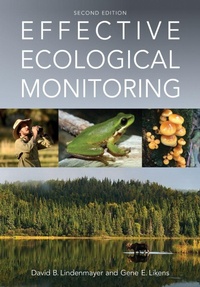
Effective Ecological Monitoring
2nd Edition
Published on 1. May 2018
Book
Paperback/Softback
224 pages
978-1-4863-0892-7 (ISBN)
Description
Long-term monitoring programs are fundamental to understanding the natural environment and managing major environmental problems. Yet they are often done very poorly and ineffectively. This second edition of the highly acclaimed Effective Ecological Monitoring describes what makes monitoring programs successful and how to ensure that long-term monitoring studies persist.
The book has been fully revised and updated but remains concise, illustrating key aspects of effective monitoring with case studies and examples. It includes new sections comparing surveillance-based and question-based monitoring, analysing environmental observation networks, and provides examples of adaptive monitoring.
Based on the authors' 80 years of collective experience in running long-term research and monitoring programs, Effective Ecological Monitoring is a valuable resource for the natural resource management, ecological and environmental science and policy communities.
More details
Edition
Second Edition
Language
English
Place of publication
Melbourne
Australia
Target group
Professional and scholarly
Dimensions
Height: 244 mm
Width: 170 mm
Thickness: 15 mm
Weight
586 gr
ISBN-13
978-1-4863-0892-7 (9781486308927)
Copyright in bibliographic data and cover images is held by Nielsen Book Services Limited or by the publishers or by their respective licensors: all rights reserved.
Schweitzer Classification
Other editions
Additional editions
David Lindenmayer | Gene Likens
Effective Ecological Monitoring
E-Book
05/2018
1st Edition
CSIRO Publishing
€58.99
Available for download
Gene Likens
Effective Ecological Monitoring
E-Book
05/2018
1st Edition
CSIRO PUBLISHING
€58.99
Available for download
Persons
David B. Lindenmayer is a world-leading expert in forest and woodland ecology and resource management, conservation science and biodiversity conservation. He currently runs five large-scale, long-term research programs in south-eastern Australia, primarily associated with developing ways to conserve biodiversity in farmland, wood production forests, plantations and reserves. He has maintained some of the largest, long-term research programs in Australia, with some running for more than 37 years. He is among the world's most highly cited ecological researchers and has received numerous awards for his work.