

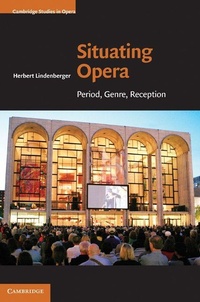
Situating Opera
Period, Genre, Reception
Published on 28. October 2010
Book
Hardback
324 pages
978-0-521-19989-6 (ISBN)
Description
Setting opera within a variety of contexts - social, aesthetic, historical - Lindenberger illuminates a form that has persisted in recognizable shape for over four centuries. The study examines the social entanglements of opera, for example the relation of Mozart's Abduction from the Seraglio and Verdi's Il trovatore to its initial and later audiences. It shows how modernist opera rethought the nature of theatricality and often challenged its viewers by means of both musical and theatrical shock effects. Using recent experiments in neuroscience, the book demonstrates how different operatic forms developed at different periods to create new ways of exciting a public. Lindenberger considers selected moments of operatic history from Monteverdi's Orfeo to the present to study how the form has communicated with its diverse audiences. Of interest to scholars and operagoers alike, this book advocates and exemplifies opera studies as an active, emerging area of interdisciplinary study.
Reviews / Votes
"...very accessible and offer excellent insights into why operas of the 20th century and beyond seem to have a more limited audience than the lyrical dramatic operas of the 19th century." --ChoiceMore details
Series
Language
English
Place of publication
Cambridge
United Kingdom
Target group
Professional and scholarly
Dimensions
Height: 235 mm
Width: 157 mm
Thickness: 24 mm
Weight
678 gr
ISBN-13
978-0-521-19989-6 (9780521199896)
Copyright in bibliographic data and cover images is held by Nielsen Book Services Limited or by the publishers or by their respective licensors: all rights reserved.
Schweitzer Classification
Other editions
Additional editions
E-Book
10/2010
1st Edition
Cambridge University Press
€66.49
Available for download
E-Book
09/2010
1st Edition
Cambridge University Press
€79.99
Available for download
Person
Herbert Lindenberger is Avalon Professor of Humanities Emeritus at Stanford University. He is the author of Opera in History: From Monteverdi to Cage (1998), The Literature in History: On Genre, Values, Institutions (1990), Opera: The Extravagant Art (1984), and Saul's Fall: A Critical Fiction (1979).
Content
Prologue. Why opera? Why (how, where) situate?; 1. Anatomy of a war horse: Il trovatore from A to Z; 2. On opera and society (assuming a relationship); 3. Opera and the novel: antithetical or complementary?; 4. Opera by other means; 5. Opera and/as lyric; 6. From separatism to unity: aesthetic theorizing from Reynolds to Wagner; 7. Toward a characterization of modernist opera; 8. Anti-theatricality in twentieth-century opera; 9. A brief consumer's history of opera; Epilogue. Why (what, how, if) opera studies?; Works cited.