

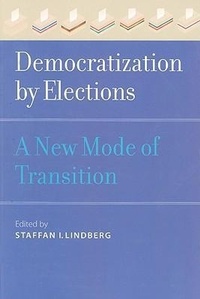
Democratization by Elections
A New Mode of Transition
Published on 26. November 2009
Book
Paperback/Softback
432 pages
978-0-8018-9319-3 (ISBN)
Description
Contested, multiparty elections are conventionally viewed as either an indicator of the start of democracy or a measure of its quality. In practice, the role that elections play in the transition from authoritarian rule is much more significant. Using as a starting point Guillermo O'Donnell and Phillipe C. Schmitter's 1986 classic, Transitions from Authoritarian Rule, and Robert Dahl's original formulation of democratization as the outcome of increasing the costs of repression while decreasing the costs of toleration, this volume subjects to critical empirical tests the thesis that repeated elections positively affect democratic rights and processes. The first section uses global and quantitative regional studies based on new and unique data sets to present and rigorously evaluate the debate on the democratizing power of elections. The second section looks closely at specific electoral mechanisms and types of elections in Africa, post-Communist Europe and Eurasia, Latin America, the Middle East, and North Africa to uncover those that support the long-term institutionalization of a democratic transition.
The concluding section develops and formalizes a theory of democratization by elections. Each chapter includes in-depth discussions of policy implications and a wealth of statistical information. Featuring contributions by leading scholars of democracy, original research, and worldwide and country-specific data on elections and democracy, this collaborative exploration of the effect of elections on democratic transitions represents the cutting edge of comparative democratization studies. Contributors: Jason Brownlee, Valerie J. Bunce, Larry Diamond, Axel Hadenius, Jonathan Hartlyn, Marc M. Howard, Staffan I. Lindberg, Jennifer L. McCoy, Bryon Moraski, Pippa Norris, Ellen Lust-Okar, Lise Rakner, Philip G. Roessler, Andreas Schedler, Jan Teorell, Nicolas van de Walle, Sharon L. Wolchik
The concluding section develops and formalizes a theory of democratization by elections. Each chapter includes in-depth discussions of policy implications and a wealth of statistical information. Featuring contributions by leading scholars of democracy, original research, and worldwide and country-specific data on elections and democracy, this collaborative exploration of the effect of elections on democratic transitions represents the cutting edge of comparative democratization studies. Contributors: Jason Brownlee, Valerie J. Bunce, Larry Diamond, Axel Hadenius, Jonathan Hartlyn, Marc M. Howard, Staffan I. Lindberg, Jennifer L. McCoy, Bryon Moraski, Pippa Norris, Ellen Lust-Okar, Lise Rakner, Philip G. Roessler, Andreas Schedler, Jan Teorell, Nicolas van de Walle, Sharon L. Wolchik
Reviews / Votes
Democratization by Elections represents an important contribution to our understanding of how competitive-authoritarian regimes evolve. It is destined to become required reading for those interested in understanding contemporary political events...Path-breaking and persuasive. -- Nic Cheeseman Journal of Modern African Studies 2010More details
Language
English
Place of publication
Baltimore, MD
United States
Target group
College/higher education
Product notice
Paperback (trade)
Illustrations
3 s/w Photographien bzw. Rasterbilder, 24 s/w Zeichnungen
24 Line drawings, black and white; 3 Halftones, black and white
Dimensions
Height: 226 mm
Width: 150 mm
Thickness: 25 mm
Weight
574 gr
ISBN-13
978-0-8018-9319-3 (9780801893193)
DOI
10.56021/9780801893186
Copyright in bibliographic data and cover images is held by Nielsen Book Services Limited or by the publishers or by their respective licensors: all rights reserved.
Schweitzer Classification
Other editions
Additional editions
Book
11/2009
Johns Hopkins University Press
€73.00
Article not available for order
Person
Staffan I. Lindberg is an assistant professor in the Department of Political Science and the Center for African Studies at the University of Florida. He has written numerous journal articles and book chapters and is the author of Democracy and Elections in Africa, also published by Johns Hopkins.
Content
List of Figures
List of Tables
Foreword
Preface
Introduction. Democratization by Elections: A New Mode of Transition?
Part I: The Democratizing Power of Elections: A Debate
Chapter 1. The Power of Elections in Africa Revisited
Chapter 2. The Relative Powerlessness of Elections in Latin America
Chapter 3. Elections as Levers of Democratization: A Global Inquiry
Chapter 4. Post-Cold War Political Regimes: When Do Elections Matter?
Chapter 5. Harbinger of Democracy: Competitive Elections before the End of Authoritarianism
Chapter 6. All Elections Are Not the Same: Why Power-Sharing Elections Strengthen Democratization
Part II: Determinants of the Power of Elections: Autocrats and Opposition Strategies
Chapter 7. Sources of Competition under Electoral Authoritarianism
Chapter 8. Opposition Parties and Incumbent Presidents: The New Dynamics of Electoral Competition in Africa
Chapter 9. Legislative Elections in Hegemonic Authoritarian Regimes: Competitive Clientelism and Resistance to Democratization
Chapter 10. Oppositions versus Dictators: Explaining Divergent Electoral Outcomes in Post-Communist Europe and Eurasia
Chapter 11. Judicial Complexity Empowering Opposition? Critical Elections in Armenia and Georgia
Part III: Reflections and Conclusions
Chapter 12. The Contingent Power of Authoritarian Elections
Chapter 13. A Theory of Elections as a Mode of Transition
Notes
References
Contributors
Index
List of Tables
Foreword
Preface
Introduction. Democratization by Elections: A New Mode of Transition?
Part I: The Democratizing Power of Elections: A Debate
Chapter 1. The Power of Elections in Africa Revisited
Chapter 2. The Relative Powerlessness of Elections in Latin America
Chapter 3. Elections as Levers of Democratization: A Global Inquiry
Chapter 4. Post-Cold War Political Regimes: When Do Elections Matter?
Chapter 5. Harbinger of Democracy: Competitive Elections before the End of Authoritarianism
Chapter 6. All Elections Are Not the Same: Why Power-Sharing Elections Strengthen Democratization
Part II: Determinants of the Power of Elections: Autocrats and Opposition Strategies
Chapter 7. Sources of Competition under Electoral Authoritarianism
Chapter 8. Opposition Parties and Incumbent Presidents: The New Dynamics of Electoral Competition in Africa
Chapter 9. Legislative Elections in Hegemonic Authoritarian Regimes: Competitive Clientelism and Resistance to Democratization
Chapter 10. Oppositions versus Dictators: Explaining Divergent Electoral Outcomes in Post-Communist Europe and Eurasia
Chapter 11. Judicial Complexity Empowering Opposition? Critical Elections in Armenia and Georgia
Part III: Reflections and Conclusions
Chapter 12. The Contingent Power of Authoritarian Elections
Chapter 13. A Theory of Elections as a Mode of Transition
Notes
References
Contributors
Index