

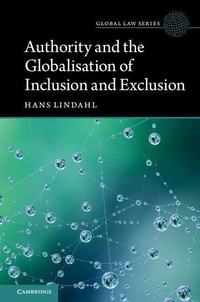
Authority and the Globalisation of Inclusion and Exclusion
Published on 6. September 2018
Book
Paperback/Softback
474 pages
978-1-316-63027-3 (ISBN)
Description
Protracted and bitter resistance by alter- and anti-globalisation movements shows that the globalisation of law transpires as the globalisation of inclusion and exclusion. Humanity is inside and outside global law in all its possible manifestations. But how is this possible? How must legal orders be structured, such that, even if we can now speak of law beyond state borders, no emergent global legal order is possible that does not include without excluding? Is an authoritative politics of boundaries possible that neither postulates the possibility of realising an all-inclusive global legal order nor accepts resignation or political paralysis in the face of the globalisation of inclusion and exclusion? These pressing questions guide this book, opening up a vast field of enquiry that demands integrating sociological, doctrinal and philosophical perspectives and insights.
More details
Series
Language
English
Place of publication
Cambridge
United Kingdom
Target group
Professional and scholarly
Product notice
Paperback (trade)
Illustrations
Worked examples or Exercises
Dimensions
Height: 229 mm
Width: 152 mm
Thickness: 26 mm
Weight
686 gr
ISBN-13
978-1-316-63027-3 (9781316630273)
Copyright in bibliographic data and cover images is held by Nielsen Book Services Limited or by the publishers or by their respective licensors: all rights reserved.
Schweitzer Classification
Other editions
Additional editions
Book
09/2018
Cambridge University Press
€79.00
Shipment within 15-20 days
E-Book
08/2018
Cambridge University Press
€33.99
Available for download
Person
Hans Lindahl is Professor of Legal Philosophy at the Department of European and International Public Law, Tilburg University, the Netherlands, and Professor of Global Law at the Department of Law, Queen Mary University of London.
Content
Acknowledgments; Introduction; 1. Law and the globalisation of inclusion and exclusion; 2. Collective action and emergent global legal orders; 3. Three variations on the theme of legal unification and pluralisation; 4. Anti-globalisations and the nomos of the earth; 5. Authority and reciprocal recognition; 6. Asymmetrical recognition; 7. Struggles for representation in a global context; Bibliography; Index.