

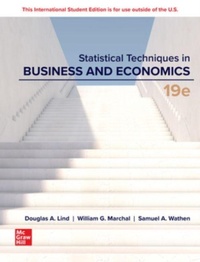
Statistical Techniques in Business and Economics ISE
19th Edition
Published on 27. February 2023
Book
Paperback/Softback
914 pages
978-1-266-28353-6 (ISBN)
Description
From its origins in 1976, Statistical Techniques in Business and Economics has become a best seller, providing students across the business specialisms with an introductory survey of descriptive and inferential statistics. With a step-by-step approach and clear writing style, any student can learn and succeed in Business Statistics.
The new edition includes a focus on the development of basic data analytical skills. Microsoft Excel, Minitab, and MegaStat are used throughout the text to illustrate statistical software analyses, and screen captures are used within the chapters, so the student becomes familiar with the nature of the software output. Additional resources are available online through Connect, with references or links in the text to Excel tutorials that provide users with clear demonstrations using statistical software to create graphical and descriptive statistics and analyses to test hypotheses.
What's changed:
The Nineteenth Edition made several changes to the flow and organization of the text by adding the sampling distribution of the proportion to Chapter 8, moving the one- and two-sample tests of hypothesis for proportions to Chapters 10, preceding the two-sample tests of hypothesis in Chapter 11 with the F-distribution, and the revision of several Chapter introductions.
Many of the calculation examples have been replaced with interpretative ones to help students understand and interpret the statistical results with more emphasis on the conceptual nature of the topics.
This edition also brings a renewed recognition of diversity, equity, and inclusion to the text, exercises, and examples through an increased diversity of persons and businesses from varied geographic, ethnic, and cultural groups.
The new edition includes a focus on the development of basic data analytical skills. Microsoft Excel, Minitab, and MegaStat are used throughout the text to illustrate statistical software analyses, and screen captures are used within the chapters, so the student becomes familiar with the nature of the software output. Additional resources are available online through Connect, with references or links in the text to Excel tutorials that provide users with clear demonstrations using statistical software to create graphical and descriptive statistics and analyses to test hypotheses.
What's changed:
The Nineteenth Edition made several changes to the flow and organization of the text by adding the sampling distribution of the proportion to Chapter 8, moving the one- and two-sample tests of hypothesis for proportions to Chapters 10, preceding the two-sample tests of hypothesis in Chapter 11 with the F-distribution, and the revision of several Chapter introductions.
Many of the calculation examples have been replaced with interpretative ones to help students understand and interpret the statistical results with more emphasis on the conceptual nature of the topics.
This edition also brings a renewed recognition of diversity, equity, and inclusion to the text, exercises, and examples through an increased diversity of persons and businesses from varied geographic, ethnic, and cultural groups.
More details
Edition
19th edition
Language
English
Place of publication
OH
United States
Target group
College/higher education
US School Grade: From College Freshman to College Graduate Student
Illustrations
463 Illustrations
Dimensions
Height: 263 mm
Width: 206 mm
Thickness: 32 mm
Weight
1495 gr
ISBN-13
978-1-266-28353-6 (9781266283536)
Copyright in bibliographic data and cover images is held by Nielsen Book Services Limited or by the publishers or by their respective licensors: all rights reserved.
Schweitzer Classification
Persons
Douglas A. Lind earned his B.S. in Business from Bowling Green State University, and his Ph.D. and M.B.A. from the University of Toledo. He is Emeritus Professor at Coastal Carolina University and the University of Toledo. Dr. Lind is a co-author of Statistical Techniques in Business and Economics with the late Robert D. Mason and William G. Marchal. He has more than 38 years of college teaching experience, including teaching statistics at the introductory, intermediate, and advanced undergraduate levels, as well as graduate courses in statistics and research methods. Dr. Lind is a past recipient of the Tony DeJute Outstanding Teacher Award.
William G. Marchal earned his B.S. in mathematics from the University of Dayton, his M.A. in mathematics from Catholic University of America, and his D.Sc. in operations research from George Washington University. He is Emeritus Professor of Information Systems and Operations Management at the University of Toledo College of Business Administration. Dr. Marchal has held visiting appointments at the University of Michigan and at George Mason University. He has worked at the Executive Office of the District of Columbia government, the George Washington University Institute for Management Science, and the U.S. Army Chemical Research and Development Center. He has also served as an associate editor of Naval Research Logistics.
Samuel A. Wathen earned his B.S. in forestry from the University of Illinois, an M.B.A. from Oklahoma State University, an M.S. in forest biometrics from Virginia Polytechnic Institute and State University, and his Ph.D. in business administration from the University of Minnesota. He is Distinguished Professor Emeritus of Management and Decision Sciences in the E. Craig Wall Sr. College of Business Administration at Coastal Carolina University. Dr. Wathen's research interests include applied statistics, teaching methods, and manufacturing and service process design. Most recently, he published the article "Using Real-Life Major League Baseball Data in an Introductory Statistics Course" in the Decision Sciences Journal of Innovative Education.
William G. Marchal earned his B.S. in mathematics from the University of Dayton, his M.A. in mathematics from Catholic University of America, and his D.Sc. in operations research from George Washington University. He is Emeritus Professor of Information Systems and Operations Management at the University of Toledo College of Business Administration. Dr. Marchal has held visiting appointments at the University of Michigan and at George Mason University. He has worked at the Executive Office of the District of Columbia government, the George Washington University Institute for Management Science, and the U.S. Army Chemical Research and Development Center. He has also served as an associate editor of Naval Research Logistics.
Samuel A. Wathen earned his B.S. in forestry from the University of Illinois, an M.B.A. from Oklahoma State University, an M.S. in forest biometrics from Virginia Polytechnic Institute and State University, and his Ph.D. in business administration from the University of Minnesota. He is Distinguished Professor Emeritus of Management and Decision Sciences in the E. Craig Wall Sr. College of Business Administration at Coastal Carolina University. Dr. Wathen's research interests include applied statistics, teaching methods, and manufacturing and service process design. Most recently, he published the article "Using Real-Life Major League Baseball Data in an Introductory Statistics Course" in the Decision Sciences Journal of Innovative Education.
Content
1 What Is Statistics?
2 Describing Data: Frequency Tables, Frequency Distributions, and Graphic Presentation
3 Describing Data: Numerical Measures
4 Describing Data: Displaying and Exploring Data
5 A Survey of Probability Concepts
6 Discrete Probability Distributions
7 Continuous Probability Distributions
8 Sampling, Sampling Methods, and the Central Limit Theorem
9 Estimation and Confidence Intervals
10 One-Sample Tests of Hypothesis
11 Two-Sample Tests of Hypothesis
12 Analysis of Variance
13 Correlation and Linear Regression
14 Multiple Regression Analysis
15 Nonparametric Methods Nominal Level Hypothesis Tests
16 Nonparametric Methods: Analysis of Ordinal Data
17 Index Numbers
18 Forecasting with Time Series Analysis
19 Statistical Process Control and Quality Management
20 An Introduction to Decision Theory (Online Only)
Appendixes
Appendixes, Data Sets, Tables, Software Commands, Answers
2 Describing Data: Frequency Tables, Frequency Distributions, and Graphic Presentation
3 Describing Data: Numerical Measures
4 Describing Data: Displaying and Exploring Data
5 A Survey of Probability Concepts
6 Discrete Probability Distributions
7 Continuous Probability Distributions
8 Sampling, Sampling Methods, and the Central Limit Theorem
9 Estimation and Confidence Intervals
10 One-Sample Tests of Hypothesis
11 Two-Sample Tests of Hypothesis
12 Analysis of Variance
13 Correlation and Linear Regression
14 Multiple Regression Analysis
15 Nonparametric Methods Nominal Level Hypothesis Tests
16 Nonparametric Methods: Analysis of Ordinal Data
17 Index Numbers
18 Forecasting with Time Series Analysis
19 Statistical Process Control and Quality Management
20 An Introduction to Decision Theory (Online Only)
Appendixes
Appendixes, Data Sets, Tables, Software Commands, Answers