

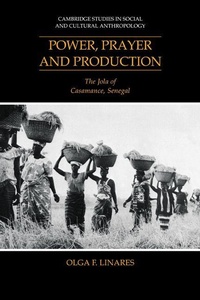
Power, Prayer and Production
The Jola of Casamance, Senegal
Published on 17. September 2007
Book
Paperback/Softback
284 pages
978-0-521-04035-8 (ISBN)
Description
The Jola (Diola) are intensive wet-rice cultivators in the Lower Casamance region of Senegal. In this study, the author examines the reasons behind startling contrasts in the organization of agricultural tasks among three Jola communities located within a 45-kilometre radius from Ziguinchor. In Sambujat, situated in the non-Islamisized region south of the river, wet rice is a monocrop cultivated by both men and women. In Jipalom, in the Kajamutay region north of the river, Islam and cash cropping have been adopted; and in Fatiya, in the so-called 'Mandingized' region of the Kalunay, social relations have become hierarchical and this has had profound effects on the cropping system and on the division of labour. The author examines the shift of power relations over time, and their effects on the way in which production has been organized by age and gender, kin and class. Larger issues dealt with are Islamization, women's labour and the introduction of cash cropping. A concluding section places the history of Jola labour relations within the context of the political economy of Senegal.
More details
Series
Language
English
Place of publication
Cambridge
United Kingdom
Target group
Professional and scholarly
Product notice
Paperback (trade)
Illustrations
Worked examples or Exercises
Dimensions
Height: 229 mm
Width: 152 mm
Thickness: 17 mm
Weight
465 gr
ISBN-13
978-0-521-04035-8 (9780521040358)
Copyright in bibliographic data and cover images is held by Nielsen Book Services Limited or by the publishers or by their respective licensors: all rights reserved.
Schweitzer Classification
Other editions
Additional editions
Book
12/1991
Cambridge University Press
€62.00
Article exhausted; check for reprint
Previous edition
Book
12/1991
Cambridge University Press
€62.00
Article exhausted; check for reprint
Person
Content
List of illustrations; List of tables; Acknowledgements; Note on orthography; Introduction: ideology and agrarian change; Part I. The Political Economy of Sambujat: 1. The power of the spirit-shrines; 2. Rice fields and labour relationships; Conclusions to part I; Part II. At the Crossroads: The Kujamaat Jola of Jipalom: 3. Islamization and the introduction of a cash crop; 4. The impact on social and productive relations; Conclusions to part II; Part III. Manding Models and Fatiya Mores: 5. Ideology and legitimation; 6. Social relations of production restructured; Conclusions to part III; Epilogue: the Jola in the present national scene; Notes; References; Index.